组成图示
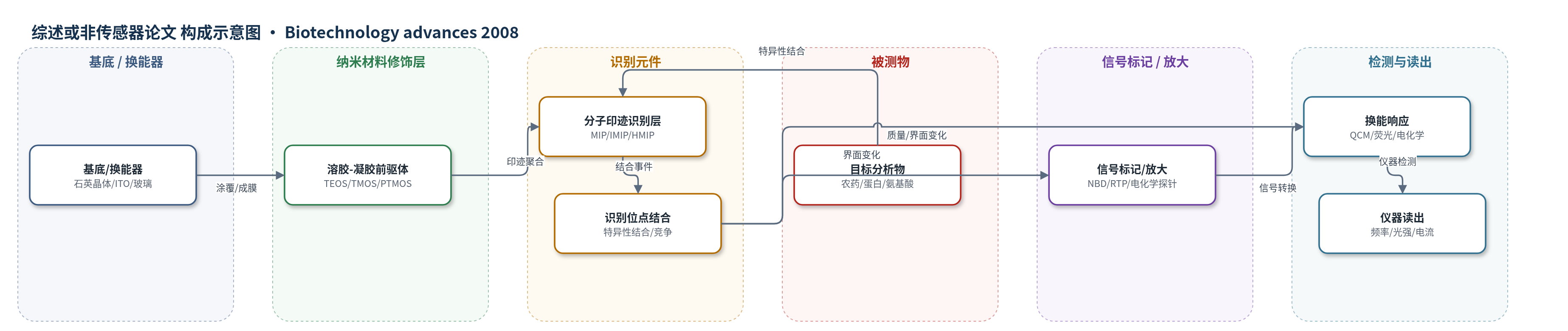
点击图片查看大图 · 依据论文自动绘制
传感器类型
综述或非传感器论文
检测对象
综述涉及多种被测物:DDT、对硫磷、氧乐果、五氯苯酚、2,4-D、L-组氨酸、苯丙氨酸、BSA、HSA、溶菌酶、RNase A、蓖麻毒素、IL-1、酵母细胞、芴、多巴胺、甲基黄嘌呤、萘夫西林、咖啡因/茶碱;样品基质包括水样、血清、食品、环境水样、细胞悬液。
检测原理
分子印迹溶胶-凝胶传感的核心是在模板分子存在下,由TEOS、TMOS、PTMOS、APTMS等前驱体水解缩合形成无机或杂化网络;去除模板后留下与目标分子在形状、大小和官能团位置互补的识别位点。当目标分析物进入溶胶-凝胶基质并与识别位点结合时,会引起局部质量、介电性质、荧光/磷光微环境或电化学界面状态变化。若采用QCM,结合质量使晶振频率下降;若采用荧光或室温磷光探针,结合改变探针微环境或引发光诱导电子转移(PET),导致光强变化;若采用电化学或比色体系,结合改变电子转移或酶催化产物生成,产生电流或颜色变化。表面印迹、杂化前驱体、荧光/电化学探针和酶催化等策略可提高灵敏度、选择性和响应速度。
检测灵敏度
综述未报告单一传感器;文中引用示例:LOD: 50 ppt;线性范围: 5×10⁻⁸ to 1×10⁻⁴ M;LOD: 2.5×10⁻⁸ M;LOD: 1.0×10⁻⁹ M;线性范围: 5.0×10⁻⁹ to 1.0×10⁻⁴ M;LOD: 1.0×10⁻⁹ mol L−1;线性范围: 2.0×10⁻⁵ to 1.0×10⁻⁸ mol L−1;LOD: 6 ng l−1;LOD: 5.8×10⁻⁶ M;线性范围: 最高 6×10⁻⁵ M;LOD: 低于 10 ppt;LOD: 微摩尔范围;线性范围: 2.0 mM to 0.8 mM;LOD: ∼2 pg/ml。
效应效果
综述总结的溶胶-凝胶分子印迹传感材料通常具有较高选择性、稳定性和可重复使用性。DDT印迹薄膜响应时间小于60 s且可重复使用;L-组氨酸QCM传感器在等电点附近响应最大,稳定性好、立体选择性高;五氯苯酚在线固相萃取-HPLC增强因子670,检测限6 ng/L,通量约5个/小时;萘夫西林RTP传感器30次以上进样后信号下降≤10%,通量22 h−1;IL-1 PIXIES检测限约2 pg/mL,响应<2 min,选择性>85%,16周漂移<6% RSD,25次循环可逆性>95%,加标回收率>85%。作者认为其可替代昂贵生物识别元件,用于环境、食品和临床传感。
传感器的构成
- 基底/换能器:石英晶体、ITO、玻璃或碳电极,提供质量、光学或电化学换能基础
- 溶胶-凝胶基质:TEOS、TMOS、PTMOS、MTMOS、APTMS、GPTMS等前驱体,经水解缩合形成多孔无机或杂化网络
- 分子印迹识别层:MIP、IMIP、HMIP,模板去除后形成与目标分子互补的识别位点
- 表面印迹层:表面溶胶-凝胶或表面分子印迹结构,使识别位点暴露于表面,提高传质和结合动力学
- 信号标记/放大:NBD荧光探针、室温磷光(RTP)探针、电化学活性探针、丁酰胆碱酯酶(BuChE)等,将结合事件转为光学、电化学或比色信号
- 读出接口:QCM、荧光/磷光光谱、电化学工作站、比色检测等,输出频率、光强、电流或颜色变化
中文摘要
分子印迹是一种通过模板分子组装具有特定结构和性质的分子组装体的新兴方法,已越来越多用于分离过程、微反应器、免疫分析、抗体模拟、催化、人工酶、生物传感器识别元件以及生物和化学传感器。溶胶-凝胶工艺在温和条件下进行且灵活多样,使其玻璃态基质适合分子印迹。基于溶胶-凝胶的分子印迹聚合物(MIPs)在多种应用中的进展可从不断增长的出版物看出。本综述主要关注溶胶-凝胶基质中的分子印迹以及分子印迹溶胶-凝胶衍生材料在传感器开发中的应用。将溶胶-凝胶工艺与分子印迹结合可获得传感应用所需的高灵敏度和选择性。文章讨论了溶胶-凝胶基质中分子印迹的优点、问题、挑战及影响因素,并重点关注有机改性硅烷前驱体(ORMOSILS)用于合成杂化分子印迹聚合物(HMIPs)以及表面溶胶-凝胶过程用于分子印迹等近期进展。分子印迹溶胶-凝胶纳米管用于生化分离和生物印迹是新的进展。模板干凝胶和分子印迹溶胶-凝胶薄膜为多种传感器应用提供了良好平台。
英文摘要
Molecular imprinting is a newly developed methodology which provides molecular assemblies of desired structures and properties and is being increasingly used for several applications such as in separation processes, microreactors, immunoassays and antibody mimics, catalysis, artificial enzymes, biosensor recognition elements and bio- and chemo-sensors. The ambient processing conditions and versatility of the sol-gel process makes sol-gel glassy matrix suitable for molecular imprinting. The progress of sol-gel based molecular imprinted polymers (MIPs) for various applications can be seen from the growing number of publications. The main focus of the review is molecular imprinting in sol-gel matrix and applications of molecular imprinted sol-gel derived materials for the development of sensors. Combining sol-gel process with molecular imprinting enables to procure the sensors with greater sensitivity and selectivity necessary for sensing applications. The merits, problems, challenges and factors affecting molecular imprinting in sol-gel matrix have been discussed. Considerable attention has been drawn on recent developments like use of organically modified silane precursors (ORMOSILS) for the synthesis of hybrid molecular imprinted polymers (HMIPs) and applying surface sol-gel process for molecular imprinting. The development of molecular imprinted sol-gel nanotubes for biochemical separation and bio-imprinting is a new advancement and is under progress. Templated xerogels and molecularly imprinted sol-gel films provide a good platform for various sensor applications.