组成图示
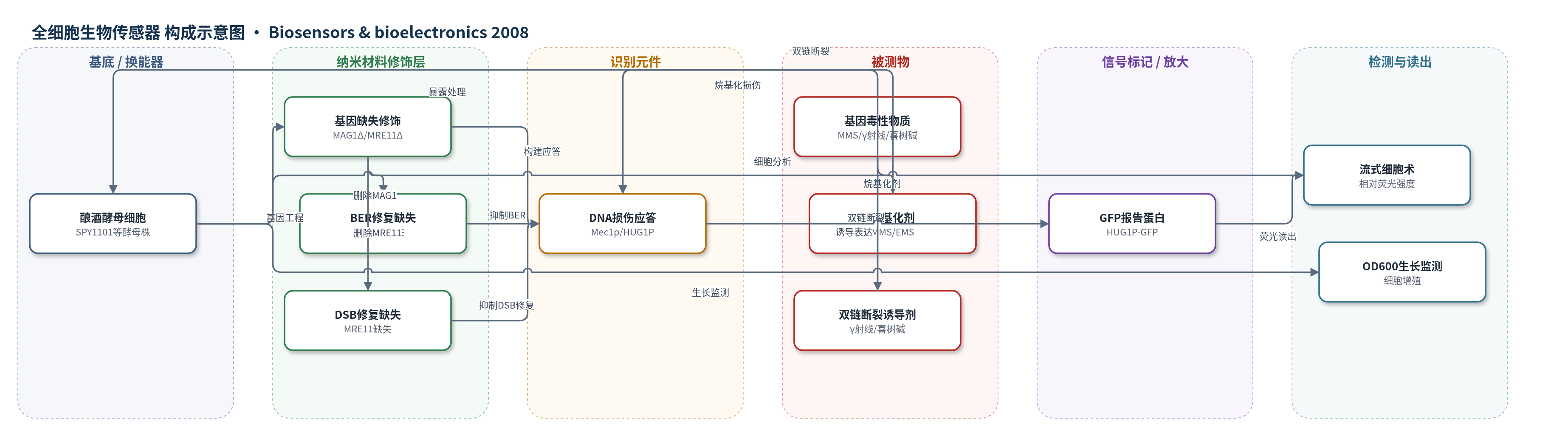
点击图片查看大图 · 依据论文自动绘制
传感器类型
全细胞生物传感器
检测对象
甲基甲烷磺酸(MMS)、乙基甲烷磺酸酯(EMS)、γ射线(γ-ray)、喜树碱(camptothecin)、4-硝基喹啉-1-氧化物(4-NQO)、1,2-二甲基肼(SDMH)、放线菌素(phleomycin)、羟基脲(HU)、甲醛(formaldehyde);样品基质为酿酒酵母细胞培养物(暴露后PBS洗脱细胞悬液)。
检测原理
基因毒性物质作用于酿酒酵母细胞后,造成DNA烷基化、单链或双链断裂等损伤。MAG1缺失使碱基切除修复(BER)受损,烷基化碱基积累并导致复制叉停滞,激活Mec1p激酶通路;MRE11缺失使RMX复合物介导的双链断裂感知与修复能力下降,双链断裂积累,同样激活Mec1p通路。HUG1启动子(HUG1P)被诱导,驱动绿色荧光蛋白(GFP)表达。GFP荧光强度随DNA损伤程度和基因毒性物质浓度增加而升高,经流式细胞术读出相对荧光。系统通过删除修复基因降低检测阈值,而非外源化学放大。
检测灵敏度
MMS:mag1Δ敏感性阈值0.0001% (v/v);0.0005% MMS时SPY1102相对荧光34,SPY1101为4;峰值154-fold @0.005% MMS(SPY1102),SPY1101峰值148-fold @0.01% MMS。γ射线:mre11Δ检测阈值50 Gy(8-fold诱导);SPY1101最低检测阈值200 Gy(相对荧光2.7),200 Gy时mre11Δ相对荧光14.7。喜树碱:mre11Δ可检测0.5 μg/mL,SPY1101检测限5 μg/mL。4-NQO:mag1Δ最低检测剂量0.01 μg/mL,SPY1101为0.05 μg/mL。
效应效果
系统具有类型选择性:MAG1缺失增强MMS、EMS和4-NQO响应,但不改变γ射线响应;MRE11缺失增强γ射线和喜树碱响应,对MMS峰值荧光约降低3倍,主要因基础GFP升高约2.6–2.7倍。双缺失株中mre11Δ表型占优势。结果至少3次独立实验平均,误差棒为标准差。未提高SDMH、放线菌素和HU检测,且各株均不响应甲醛。作者认为该真核酵母传感器比Ames等原核试验更贴近人类DNA损伤应答,定向删除修复基因可进一步提高敏感性和选择性。
传感器的构成
- 细胞基底/换能器:酿酒酵母(Saccharomyces cerevisiae)菌株SPY1101/SPY1102/SPY1103/SPY1105,作为活细胞换能器并承载报告基因。
- 基因工程修饰层:MAG1缺失(mag1Δ::kanr)和/或MRE11缺失(mre11Δ::kanr),削弱BER或RMX双链断裂修复以提高敏感性。
- 识别元件:细胞内DNA损伤应答通路(Mec1p激酶通路)与HUG1启动子(HUG1P),识别烷基化、双链断裂等DNA损伤。
- 信号标记物:绿色荧光蛋白(GFP),由HUG1P启动子驱动表达,荧光强度反映DNA损伤程度。
- 样品暴露层:基因毒性物质(MMS、EMS、γ射线、喜树碱等)处理酵母培养物,诱导DNA损伤。
- 信号读出:流式细胞术(flow cytometry)测量相对GFP荧光强度;OD600监测细胞增殖。
中文摘要
真核酵母DNA损伤细胞传感器相比传统原核致突变试验具有优势。HUG1P-GFP启动子报告构建体可有效筛选多种DNA损伤。为提高系统对不同DNA损伤的敏感性和选择性,作者删除了两个参与不同DNA损伤应答的基因。删除MAG1(编码DNA糖基化酶,属碱基切除修复BER通路)使生物传感器对烷基化剂甲基甲烷磺酸(MMS,敏感性阈值降至0.0001% v/v)和乙基甲烷磺酸酯(EMS)的敏感性提高。删除MRE11(高度保守RMX复合物组分,参与双链断裂感知与修复)增强了对γ射线(检测阈值50 Gy)和喜树碱的敏感性。在mag1Δ mre11Δ菌株中,mre11Δ表型占优势。通过删除,作者工程化提高了对烷基化剂、γ射线和喜树碱的选择性,因为对某一类损伤敏感性增加并不改变对其他基因毒性物质的定量响应。上述增强未影响系统检测1,2-二甲基肼(SDMH)、放线菌素和羟基脲(HU)的能力,也未改变其对潜在非基因毒性致癌物甲醛无响应的特性。
英文摘要
Eukaryotic yeast-based DNA damage cellular sensors offer many advantages to traditional prokaryotic-based mutagenicity assays. The HUG1P-GFP promoter-reporter construct has proven to be an effective method to selectively screen for multiple types of DNA damage. To enhance the sensitivity and selectivity of the system to different types of DNA damage, two genes involved in distinct DNA damage responses were deleted. Deletion of MAG1, a gene encoding a DNA glycosylase and member of the base excision repair (BER) pathway, increased the biosensor's sensitivity to the alkylating agents methyl methanesulfonate (MMS) (lowering the sensitivity threshold to 0.0001% (v/v)) and ethyl methanesulfonate (EMS). Deletion of MRE11, part of the highly conserved RMX complex that aids in sensing and repairing double strand breaks in budding yeasts, enhanced sensitivity to gamma radiation (gamma-ray) (detection threshold of 50Gy) and camptothecin. The mre11Delta phenotype dominated in mag1Deltamre11Delta strains. Through the deletions, we were able to engineer increased selectivity to alkylating agents, gamma-ray, and camptothecin, since increased sensitivity to one type of damage did not alter the quantitative response to other genotoxins. The enhancements to the HUG1P-GFP system did not affect its ability to detect several other DNA damaging agents, including 1,2-dimethyl hydrazine (SDMH), phleomycin, and hydroxyurea (HU), or affect its lack of response to the potentially non-genotoxic carcinogen formaldehyde.