组成图示
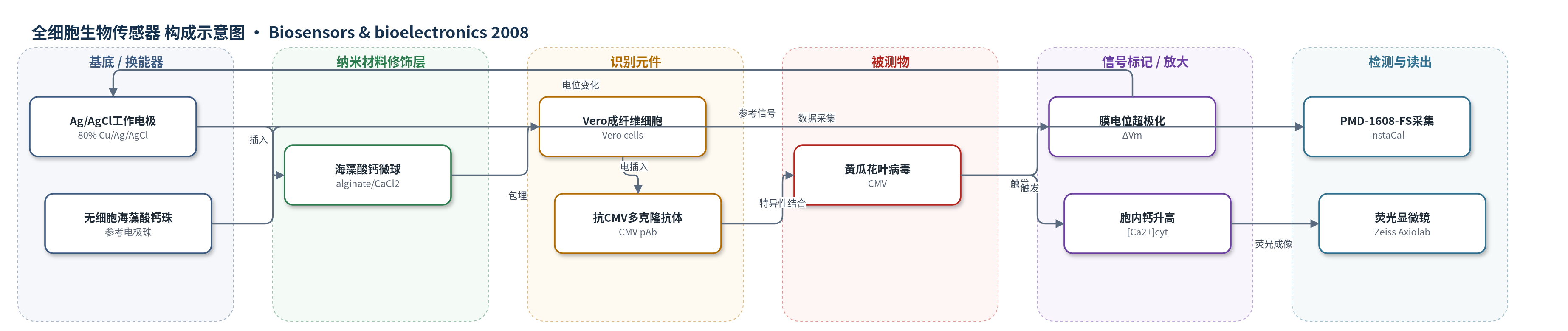
点击图片查看大图 · 依据论文自动绘制
传感器类型
全细胞生物传感器
检测对象
黄瓜花叶病毒(Cucumber mosaic virus, CMV);样品基质:PBS稀释的纯化病毒、植物叶片粗汁液(黄瓜/烟草)
检测原理
该传感器以Vero成纤维细胞为生物识别与换能单元。抗CMV多克隆抗体经电插入高密度嵌入细胞膜,形成特异性识别界面。当样品中的CMV颗粒与膜上抗体结合时,在抗体位点产生机电应力,改变细胞膜孔隙率、通透性和电导,使膜电位发生负向偏移(超极化),并伴随胞内Ca2+浓度升高。Ag/AgCl微电极插入包埋细胞的海藻酸钙微球中,按生物电识别检测(BERA)原理记录0–330 s内电位最大变化。非工程细胞因缺乏特异性抗体而不响应,异源CGMMV因不能与抗CMV抗体结合而无显著响应。该过程为定性识别,响应不随病毒浓度线性增加。
检测灵敏度
LOD: 1 ng ml−1
效应效果
该传感器对CMV具有明显选择性:非工程Vero细胞对CMV基本无响应,Vero-CMV细胞对异源CGMMV在1–15 ng ml−1范围内也无显著响应。空白对照电位为−0.29±0.03 mV;CMV响应重复性较好,1–15 ng ml−1时相对平均变化为2.8–9.4%,CGMMV为11–16%。植物粗汁液中,CMV感染样品响应为74±11 mV,无病毒对照为0±3 mV,差异显著。田间应用检测CMV感染烟草植物准确率接近100%。检测时间<10 min,单步、免洗,成本与酶免疫分析相当,但比原质体BERA检测限由25 ng ml−1降至1 ng ml−1。
传感器的构成
- 换能器电极:Ag/AgCl微电极(80% Cu基底,电化学镀Ag/AgCl,直径0.75 mm),插入细胞凝胶珠测量膜电位;参考电极为无细胞海藻酸钙珠
- 细胞包埋基质:2% (w/v) sodium alginate与0.8 M CaCl2交联形成calcium alginate beads(约2 mm),固定约75×10^3个Vero细胞,构成可消耗BERA-CMV传感器
- 传感细胞:Vero fibroblast cells(非洲绿猴肾成纤维细胞),作为生物识别与膜电位信号转导单元
- 识别元件:CMV polyclonal antibodies(抗黄瓜花叶病毒多克隆抗体),经1800 V/cm电插入高密度嵌入细胞膜,每细胞约8–10×10^3个抗体
- 信号指示/验证标记:3,3-dipropylthiadicarbocyanide iodide(膜电位荧光染料)与Fluo-3(胞内Ca2+探针),用于荧光显微镜验证膜超极化和钙信号
- 信号读出:PMD-1608-FS A/D转换器与InstaCal软件,记录0–330 s内传感器电位最大变化
中文摘要
本文描述了一种病毒抗原检测的新概念。该方法基于膜工程过程,即将病毒特异性抗体电插入成纤维细胞膜中。作为代表性实例,作者用抗黄瓜花叶病毒(CMV)抗体对Vero成纤维细胞进行工程化,并用于构建超灵敏微型细胞生物传感器系统。同源病毒结合会触发细胞膜电位发生特异性变化,这些变化通过适当微电极按照生物电识别检测(BERA)原理进行测量。当细胞接触异源黄瓜绿斑驳花叶病毒(CGMMV)时,未观察到膜电位变化。荧光显微镜观察显示,CMV颗粒结合到膜工程化细胞上伴随膜超极化和胞内Ca2+浓度升高。在另一项田间应用中,作者能够以接近100%的准确率检测CMV感染的烟草植物。
英文摘要
A novel concept for the assay of viral antigens is described. The methodological approach is based on a membrane-engineering process involving the electroinsertion of virus-specific antibodies in the membranes of fibroblast cells. As a representative example, Vero fibroblasts were engineered with antibodies against Cucumber mosaic virus (CMV) and used for the construction of an ultra-sensitive miniature cell biosensor system. The attachment of a homologous virus triggered specific changes to the cell membrane potential that were measured by appropriate microelectrodes, according to the principle of the bioelectric recognition assay (BERA). No change in the membrane potential was observed upon cell contact with the heterologous cucumber green mottle mosaic virus (CGMMV). Fluorescence microscopy observations showed that attachment of CMV particles to membrane-engineered cells was associated with membrane hyperpolarization and increased [Ca(2+)](cyt). In an additional field-based application, we were able to detect CMV-infected tobacco plants at an essentially 100% level of accuracy.