组成图示
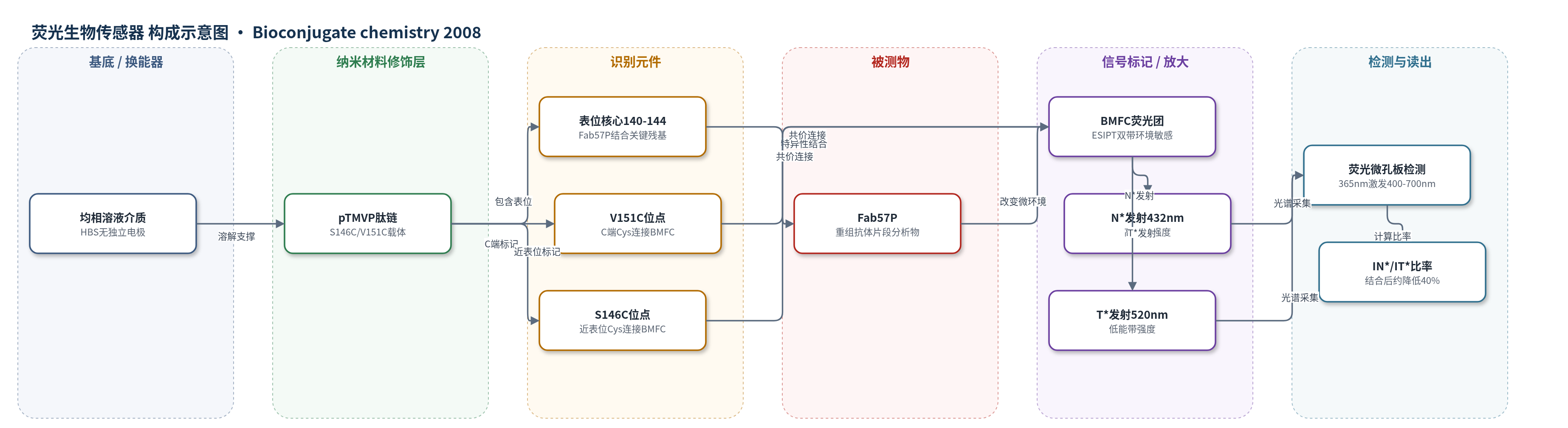
点击图片查看大图 · 依据论文自动绘制
传感器类型
荧光生物传感器
检测对象
重组抗体片段 Fab57P(Fab57P,蛋白分析物),样品基质:HEPES 缓冲生理盐水(HBS)溶液
检测原理
该传感器为均相分子荧光比率传感器,不含独立电极或纳米放大层。合成肽 pTMVP 作为识别元件,其 140-144 残基与重组抗体片段 Fab57P 高亲和力结合;BMFC 通过 Cys 侧链共价连接在 V151 或 S146 位点。BMFC/FC 发生激发态分子内质子转移(ESIPT),同时产生 N*(432 nm)和 T*(520 nm)双带发射,IN*/IT* 对局部极性和氢键能力敏感。Fab57P 结合后,结合界面附近水分子被排除,荧光团微环境氢键能力下降,导致 N*/T* 强度比改变;V151C-FC 的 IN*/IT* 约降低 40%,而 S146C-FC 几乎无变化。检测时以 365 nm 激发,采集 400-700 nm 稳态荧光谱并计算两峰强度比,实现无试剂直接蛋白检测。
检测灵敏度
未报告 LOD、线性范围、灵敏度斜率或相关系数。
效应效果
V151C-FC 对 Fab57P 选择性明显:等摩尔 Fab57P 使 IN*/IT* 从约 0.95 降至 0.58,平均变化 39%(10 μM 时 43%);无关山羊抗兔 F(ab')2 仅平均变化 5.8%(5 μM)或 0%(10 μM)。S146C-FC 几乎无响应(平均 2.8%),说明标记位点决定传感能力。SPR 得 pTMVP Kd 1.6 nM、V151C-FC 2.37 nM、S146C-FC 6.3 nM,标记未显著破坏亲和力;荧光量子产率 0.061 和 0.046。未报告实际样品回收率、RSD 或与 ELISA/HPLC/qPCR 对比。比率读出可减轻仪器漂移、光漂白和浓度差异影响,适合未来固定化蛋白定量与微阵列。
传感器的构成
- 识别元件:合成肽 pTMVP(TMVP 134-151)及其 Cys 突变体 S146C/V151C,特异性结合 Fab57P
- 信号标记物:6-溴甲基-2-(2-呋喃基)-3-羟基色酮(BMFC),经 Cys 硫醚键连接,提供环境敏感双带荧光
- 荧光团母体:2-(2-呋喃基)-3-羟基色酮(FC),发生 ESIPT,产生 N* 与 T* 双发射
- 标记位点:V151C(C端)或 S146C(近表位),决定结合后荧光微环境变化
- 检测介质:HEPES 缓冲生理盐水(HBS),维持肽-Fab57P 结合与荧光测量
- 读出方式:稳态荧光光谱/微孔板检测,激发 365 nm,监测 400-700 nm,计算 IN*/IT*
中文摘要
本文报道了用于蛋白分析物波长比率生物传感的肽基荧光构建体的设计、合成与功能评价。该概念以18个氨基酸肽 pTMVP 与重组抗体片段 Fab57P 之间的高亲和力模型相互作用展示。pTMVP 在两个不同位点用 6-溴甲基-2-(2-呋喃基)-3-羟基色酮(BMFC)功能化,该荧光团为环境敏感型并具有双带发射。标记后 pTMVP 与 Fab57P 相互作用的平衡解离常数基本保持。通过荧光团正常激发态(N*)与互变异构激发态(T*)发射带相对强度变化(IN*/IT*)评价标记肽构建体的生物传感能力。当肽在 C 端标记时,分析物结合使 IN*/IT* 变化 40%;而在对结合最重要的残基附近标记则得到完全缺乏比率生物传感能力的构建体。将识别与信号功能分子集成的无试剂检测元件,有望成为未来固定化蛋白定量检测设计的重要贡献。
英文摘要
We present the design, synthesis, and functional evaluation of peptide-based fluorescent constructs for wavelength-ratiometric biosensing of a protein analyte. The concept was shown using the high-affinity model interaction between the 18 amino acid peptide pTMVP and a recombinant antibody fragment, Fab57P. pTMVP was functionalized in two different positions with 6-bromomethyl-2-(2-furanyl)-3-hydroxychromone, an environmentally sensitive fluorophore with a two-band emission. The equilibrium dissociation constant of the interaction between pTMVP and Fab57P was largely preserved upon labeling. The biosensor ability of the labeled peptide constructs was evaluated in terms of the relative intensity change of the emission bands from the normal (N*) and tautomer (T*) excited-state species of the fluorophore ( I(N*)/I(T*)) upon binding of Fab57P. When the peptide was labeled in the C terminus, the I(N*)/I(T*) ratio changed by 40% upon analyte binding, while labeling close to the residues most important for binding resulted in a construct that completely lacked ratiometric biosensor ability. Integrated biosensor elements for reagentless detection, where peptides and ratiometric fluorophores are combined to ensure robustness in both recognition and signaling, are expected to become an important contribution to the design of future protein quantification assays in immobilized formats.