组成图示
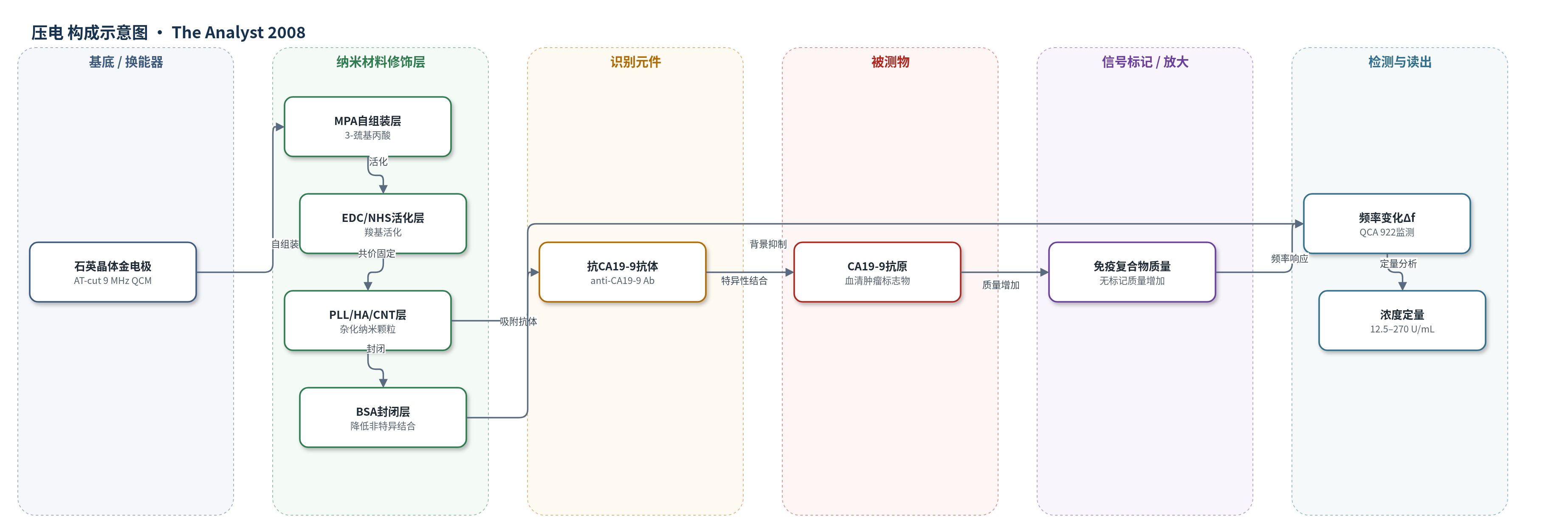
点击图片查看大图 · 依据论文自动绘制
传感器类型
压电(QCM)生物传感器
检测对象
糖类抗原19-9(CA19-9,carbohydrate antigen 19-9);样品基质:人血清(肿瘤患者阳性血清、正常人血清)
检测原理
该传感器以 QCM 压电晶体为换能器。金电极表面先由 MPA 自组装形成含羧基的单分子层,再用 EDC/NHS 活化羧基,使 PLL/HA/CNT 杂化纳米颗粒通过表面氨基共价固定。PLL/HA/CNT 中 HA 与 PLL 具有良好生物相容性,可作为亲和模板吸附抗 CA19-9 抗体,BSA 封闭非特异位点。当样品中的 CA19-9 与固定抗体特异性结合时,免疫复合物沉积在晶体表面,使有效质量增加。根据 Sauerbrey 关系,QCM 共振频率随表面质量增加而下降,频率变化 Δf 与结合抗原量及 CA19-9 浓度相关。该体系为无标记直接质量响应,未使用酶催化或核酸放大,信号随抗原浓度升高而增大。
检测灵敏度
LOD: about 8.3 U ml-1;线性范围: around 12.5–270.0 U ml-1
效应效果
在优化条件下,100.0 U mL−1 CA19-9 产生约 312 Hz 频率变化,而 700 mg mL−1 HSA 非特异吸附仅约 12 Hz,表明选择性良好。100.0 U mL−1 CA19-9 重复测定 5 次,RSD 为 6.8%。对 6 份肿瘤患者血清样品进行检测,并与化学发光免疫分析(CLIA)比较,原文表格给出的相对偏差为 212.6、9.4、6.3、28.3、11.2、24.2(负号可能丢失),作者认为两法结果合理一致。该压电免疫分析可作为临床实验室检测 CA19-9 的替代工具,其固定策略也适用于免疫传感器或芯片阵列设计。
传感器的构成
- 基底/换能器:AT-cut 9 MHz 石英晶体(QCM)及金电极,提供压电振荡与频率读出
- 自组装单分子层:3-巯基丙酸(MPA)在金表面自组装,提供表面羧基
- 活化连接层:EDC/NHS 活化 MPA 羧基,与 PLL/HA/CNT 表面氨基共价连接
- 纳米复合修饰层:PLL/HA/CNT 杂化纳米颗粒(PLL、HA、CNT),作为生物活性亲和模板负载抗体
- 识别元件:抗 CA19-9 抗体(anti-CA19-9 antibody),特异性识别 CA19-9 抗原
- 封闭层:牛血清白蛋白(BSA)封闭非特异性结合位点,降低背景
- 信号标记物:无标记,抗原结合质量直接引起 QCM 频率变化
中文摘要
本文报道了聚-L-赖氨酸/羟基磷灰石/碳纳米管(PLL/HA/CNT)杂化纳米颗粒的合成及其在压电免疫传感平台中的应用。作者以石英晶体微天平(QCM)为模型换能器,利用 PLL/HA/CNT 纳米复合物的吸附作用固定抗 CA19-9 抗体,构建了糖类抗原 19-9(CA19-9)免疫传感器。杂化纳米材料经透射电镜(TEM)、扫描电镜(SEM)和傅里叶变换红外光谱(FT-IR)表征,证实 HA 在羧基化 CNT 和 PLL 表面形成多层晶体,并保留 PLL 的酰胺特征峰。研究详细考察了抗体固定和免疫反应过程中的频率响应。该传感界面具有免活化固定和抗体高抗原结合活性等优点。所制备的免疫传感器可在约 12.5–270.0 U mL−1 范围内测定 CA19-9,为生物传感器界面设计提供了新的替代方案。
英文摘要
Hybrid composites are of special scientific interest for biochemical applications wherein the abilities to modulate the morphology and property of the hybrid material are important. In this paper, the formation of poly-L-lysine/hydroxyapatite/carbon nanotube (PLL/HA/CNT) hybrid nanoparticles is described and a general design strategy for an immunosensing platform has been proposed on the basis of PLL/HA/CNT nanocomposite adsorption of antibodies. Quartz crystal microbalance (QCM) used as a model transducer and the detection performances of the resulting immunosensor were investigated by use of the immuno-system of carbohydrate antigen 19-9 (CA19-9), an important indicator in the diagnosis of clinical cancers. The hybrid nanocomposite was characterized by the transmission electron microscope (TEM), scanning electron microscope (SEM) and Fourier transform-infrared (FT-IR) spectrum measurements. The frequency response characteristics for the processes of immobilization and immunoreaction of anchored anti-CA19-9 antibodies were studied in detail. It was found that the developed sensing interface has some advantages such as the activation-free immobilization and the high antigen-binding activities of antibodies. The as-prepared immunosensor can allow for the determination of CA19-9 in the concentration range of around 12.5-270.0 U ml(-1). Such an interface design with the hybrid nanocomposite should be tailored as a new alternative used for biosensor design.