组成图示
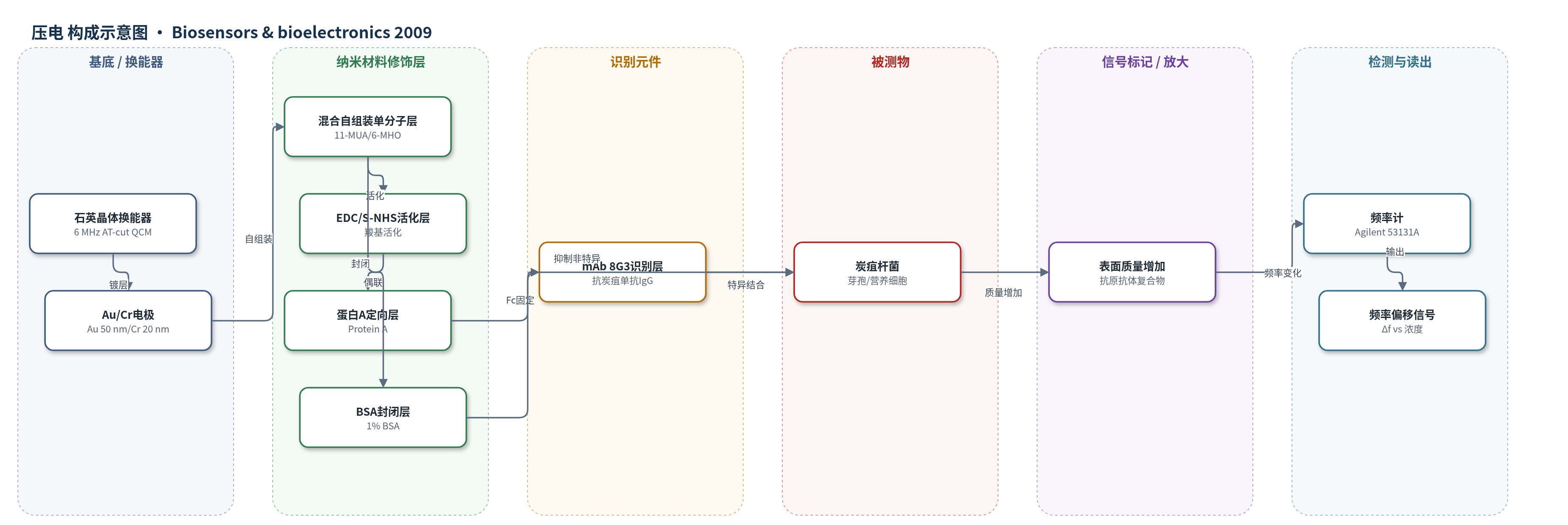
点击图片查看大图 · 依据论文自动绘制
传感器类型
压电(QCM)生物传感器
检测对象
炭疽杆菌芽孢(Bacillus anthracis spores)、炭疽杆菌营养细胞(Bacillus anthracis vegetative cells);样品基质:PBS缓冲液/细菌悬液
检测原理
该传感器以石英晶体微天平(QCM)为压电换能器,Au表面通过11-MUA/6-MHO混合自组装单分子层、EDC/S-NHS活化和蛋白A定向固定抗炭疽杆菌单克隆抗体mAb 8G3。当炭疽杆菌芽孢或营养细胞与表面抗体特异性结合后,识别事件使传感器表面质量增加。根据Sauerbrey关系,吸附质量与石英晶体谐振频率偏移Δf近似成正比,质量增加导致频率下降。通过频率计连续监测Δf,并与PBS基线比较,可得到与目标菌浓度相关的响应。浸洗干燥和静态加样可保留弱相互作用并增强信号,流动通过可实时监测并避免样品重量影响。无酶催化或核酸放大,主要依靠抗体-抗原直接结合产生的质量变化。
检测灵敏度
LOD: 10^3 CFU或spores/ml;LOD: 10^3 spores/ml(理论值);LOD: 低于7×10^2 CFU/ml;线性范围: 7×10^2–7×10^8 CFU/ml
效应效果
传感器对炭疽杆菌芽孢和营养细胞均产生明显响应,而对苏云金芽孢杆菌无显著响应:2×10^5 spores/mL炭疽芽孢引起-227±13 Hz,苏云金芽孢仅9±3 Hz;7×10^4 CFU/mL炭疽营养细胞在流动通过中10 min内达-70 Hz,苏云金营养细胞无明显响应,大肠杆菌1×10^5 CFU/mL波动约1.3 Hz。非相关小鼠IgG传感器对1×10^7 spores/mL无响应。4°C保存1个月后响应约为新传感器的70%(7×10^6 CFU/mL)。作者认为其性能优于或可媲美现有炭疽免疫传感器,可用于反恐生物检测。
传感器的构成
- 基底/换能器:6 MHz AT-cut石英晶体,Au/Cr电极(Au 50 nm,Cr 20 nm),提供压电换能与Au修饰表面
- 混合自组装单分子层:11-巯基十一烷酸(11-MUA)与6-巯基己醇(6-MHO)混合SAM,提供羧基并降低非特异吸附
- 化学活化层:EDC与S-NHS活化11-MUA羧基,形成活性酯用于共价偶联
- 定向固定蛋白:金黄色葡萄球菌蛋白A(Protein A),结合IgG Fc段实现抗体定向固定
- 识别元件:抗炭疽杆菌单克隆抗体8G3(mAb 8G3, IgG),特异性结合炭疽杆菌芽孢和营养细胞
- 封闭层:1%牛血清白蛋白(BSA),封闭非特异结合位点
中文摘要
自2001年美国炭疽孢子生物恐怖袭击以来,炭疽杆菌芽孢和营养细胞的早期检测备受关注。目前多基于多克隆抗体的石英晶体微天平(QCM)传感器用于检测炭疽杆菌模拟物。为实现对炭疽杆菌芽孢和营养细胞的同步快速检测,本文报道了一种利用抗炭疽杆菌单克隆抗体8G3(mAb 8G3,IgG)功能化的QCM传感器。通过比较四种抗体在Au表面的固定方式,优化后的mAb 8G3通过蛋白A固定在由11-巯基十一烷酸(11-MUA)和6-巯基己醇(6-MHO)组成的混合自组装单分子层(SAM)上,作为黏附层。在浸洗干燥、静态加样和流动通过三种条件下检测炭疽杆菌。结果表明,传感器对炭疽杆菌芽孢或营养细胞产生明显响应,而对苏云金芽孢杆菌无显著响应;能从同源菌中特异性识别炭疽杆菌芽孢和营养细胞,检测限(LOD)在30 min内达到10^3 CFU或芽孢/mL。循环伏安(CV)和扫描电镜(SEM)用于表征修饰及检测后传感器表面。该mAb功能化QCM生物传感器有望用于未来反恐生物检测。
英文摘要
Since the anthrax spore bioterrorism attacks in America in 2001, the early detection of Bacillus anthracis spores and vegetative cells has gained significant interest. At present, many polyclonal antibody-based quartz crystal microbalance (QCM) sensors have been developed to detect B. anthracis simulates. To achieve a simultaneous rapid detection of B. anthracis spores and vegetative cells, this paper presents a biosensor that utilizes an anti-B. anthracis monoclonal antibody designated to 8G3 (mAb 8G3, IgG) functionalized QCM sensor. Having compared four kinds of antibody immobilizations on Au surface, an optimized mAb 8G3 was immobilized onto the Au electrode with protein A on a mixed self-assembled monolayer (SAM) of 11-mercaptoundecanoic acid (11-MUA) and 6-mercaptohexan-1-ol (6-MHO) as adhesive layer. The detection of B. anthracis was investigated under three conditions: dip-and-dry, static addition and flow through procedure. The results indicated that the sensor yielded a distinct response to B. anthracis spores or vegetative cells but had no significant response to Bacillus thuringiensis species. The functionalized sensor recognized B. anthracis spores and vegetative cells specifically from its homophylic ones, and the limit of detection (LOD) reached 10(3)CFU or spores/ml of B. anthracis in less than 30 min. Cyclic voltammogram (CV) and scanning electronic microscopy (SEM) were performed to characterize the surface of the sensor in variable steps during the modification and after the detection. The mAb functionalized QCM biosensor will be helpful in the fabrication of a similar biosensor that may be available in anti-bioterrorism in the future.