组成图示
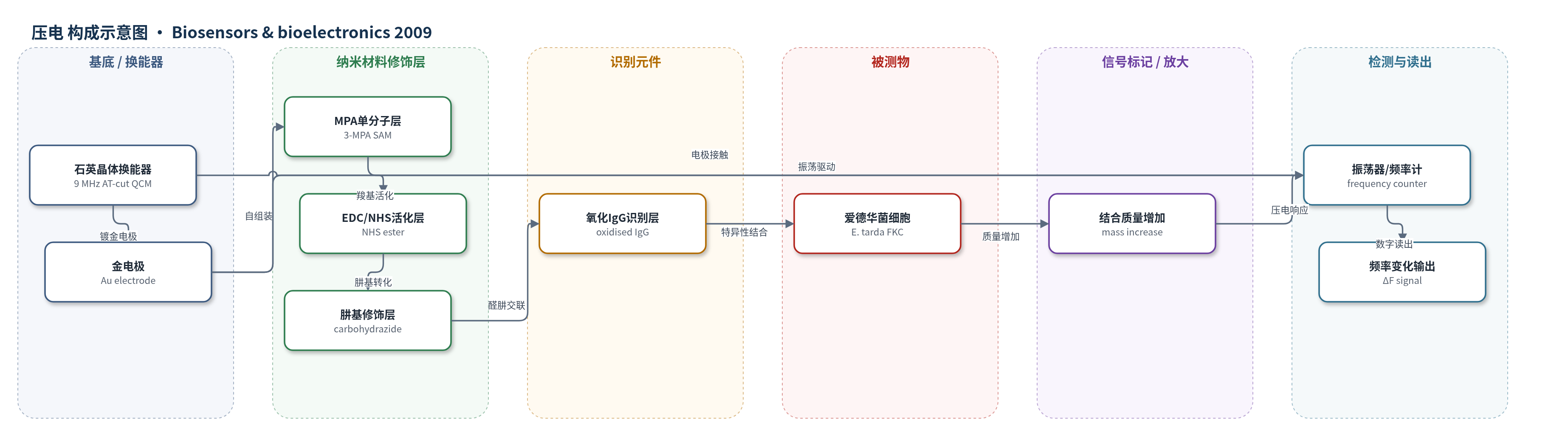
点击图片查看大图 · 依据论文自动绘制
传感器类型
压电(QCM)生物传感器
检测对象
爱德华菌(Edwardsiella tarda,E. tarda)福尔马林灭活细胞(FKC);样品基质:PBS反应液(模拟水样/鱼体样品)。
检测原理
该传感器基于压电QCM质量传感原理。金电极表面先形成3-巯基丙酸(MPA)自组装单分子层,经EDC/NHS活化后,用carbohydrazide将羧基转化为肼基。高碘酸钠氧化IgG的Fc区糖基,暴露醛基,与肼基发生醛肼缩合并经NaBH4还原稳定,使抗体定向固定且抗原结合位点暴露。当爱德华菌(E. tarda)福尔马林灭活细胞(FKC)流过芯片时,其表面抗原与氧化IgG特异性结合,使晶体表面质量增加。根据Sauerbrey关系,质量增加导致石英晶体共振频率下降,频率计实时读取频率变化ΔF。ΔF随细菌浓度增加而增大;多克隆抗体识别多个表位,因此响应高于单克隆抗体。
检测灵敏度
LOD: <50 μg(约5×10^7 cells);线性范围: 未明确报告(剂量响应范围0.5–10 mg/ml);R^2 = 0.90(IgG固定量与细菌响应频率变化关系)
效应效果
在1 mg/ml爱德华菌FKC下,氧化IgG/肼基芯片频率变化93.5±2.4 Hz,高于蛋白G(60.6±1.83 Hz)、N端(74.5±0.7 Hz)和C端(76.33±5.3 Hz)。IgG固定量与细菌响应正相关(R^2=0.90),多克隆响应比单克隆高1.7倍。10、5、1、0.5 mg/ml分别产生187±7.75、133±1、101.1±1.17、24.7±7.5 Hz;0.1 mg/ml不稳定。对大肠杆菌、创伤弧菌、嗜水气单胞菌(5 mg/ml)无显著非特异结合。芯片可再生10次,信号下降但仍可检测;较HPCE更简单、成本低。
传感器的构成
- 基底/换能器:9 MHz AT-cut压电石英晶片,两面镀5 mm直径金电极(Au),作为压电换能器和固定表面。
- 清洗层:piranha溶液(H2SO4:H2O2=7:3,60 ℃,5 min)清洗金表面,去除污染物。
- 自组装单分子层:10 mM 3-巯基丙酸(MPA)在金表面自组装,提供羧基锚定层。
- 活化层:46 mM EDC/NHS处理1 h,将MPA羧基活化为NHS酯,用于共价偶联。
- 肼基修饰层:5 mM carbohydrazide将羧基转化为肼基,提供与氧化IgG醛基交联的位点。
- 识别元件:高碘酸钠氧化IgG(兔抗爱德华菌多克隆IgG或单克隆IgG),Fc区暴露醛基,与肼基交联并用0.1 M NaBH4稳定,特异性识别E. tarda。
- 封闭剂:1 M ethanolamine-HCl及含1 mM EDTA、0.25% BSA、0.05% Tween-20的封闭缓冲液,封闭未反应位点。
- 再生剂:0.2 M Tris-glycine、0.6 M NaCl、1% DMSO、pH 2.3解离缓冲液,用于去除结合细菌并再生芯片。
- 信号标记物:无外源标记物(无标记质量传感),细菌结合后质量增加引起频率变化。
中文摘要
石英晶体微天平(QCM)技术具有实时输出、操作简便、成本低和高灵敏度等优点,其免疫传感器灵敏度可通过改善石英表面抗体固定化方法提高。固定化策略应同时控制抗体(免疫球蛋白IgG)在换能器上的数量与取向,以获得对抗原的高亲和性。本研究提出一种新方法:用高碘酸钠氧化IgG,使其Fc区糖基暴露醛基,再与NHS活化自组装单分子层(SAM)上由羧基转化而来的肼基交联,并与三种传统固定化方法比较。结果表明,该方法可固定化相当数量的抗体,且细菌注入后的频率变化高于其他方法,但IgG固定量低于传统方法。细菌细胞注入后的频率变化与IgG注入后的频率变化及细菌量呈正相关,说明频率变化主要反映细菌细胞与金表面交联IgG特异性结合引起的质量变化。对大肠杆菌、创伤弧菌和嗜水气单胞菌的特异性测试未见显著非特异结合。芯片可耐受重复再生,多克隆抗体比单克隆抗体更有效。结论表明,该新方法比所比较的传统方法更灵敏,并可重复使用10次。
英文摘要
QCM technology offers a real time output, simplicity of use and cost effectiveness in addition to high sensitivity. Sensitivity of QCM immunosensor can be enhanced by improving the immobilisation procedure on the quartz surface. The immobilisation strategy should be able to control both the amount and the orientation of the antibody (immunoglobulin; IgG) on the transducer for high affinity to antigens. This study introduced a new methodology recruiting oxidised IgG to expose aldehyde group in Fc region to cross-link to hydrazide conformed on self assembled monolayer (SAM) and compared with three conventional methods. Consequently, it was proved that considerable amount of antibody was immobilised and the sensitivity of new methodology was higher than other methods while ability of new methodology to immobilise IgG was lower than the conventional methods. The frequency shifts following bacterial cell injection were positively related to the frequency shifts after the injection of IgG and the amounts of bacterial cells, revealing that the frequency shifts after bacterial cell injection fully represented the weight change by specific attachments of bacterial cells to the IgG cross-linked on the gold surface. Specificity was tested on different bacteria including E. coli, V. vulnificus and A. hydrophila and showed no significant non-specific affinity on the tested bacteria. It was also demonstrated that the prepared sensor chip was stable enough to withstand repeated surface regeneration. Indeed, polyclonal antibody was more effective to detect antigen than monoclonal antibody which binds to only one epitope of antigen. Conclusively, the new methodology is appeared to be more sensitive than conventional methods tested and reusable for 10 times.