组成图示
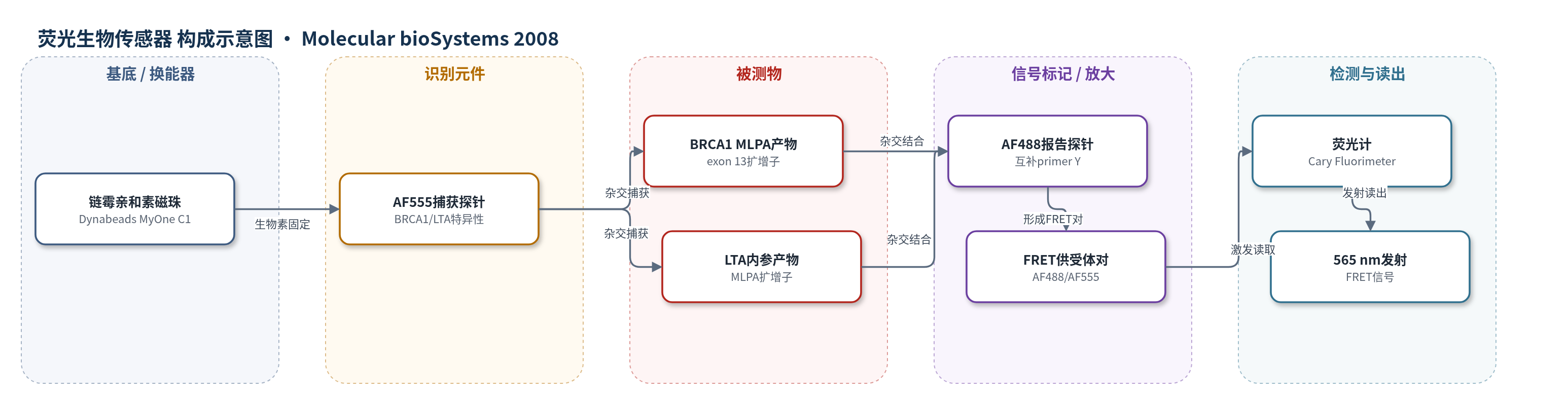
点击图片查看大图 · 依据论文自动绘制
传感器类型
荧光生物传感器
检测对象
BRCA1外显子13拷贝数/缺失(BRCA1 exon 13 copy number/deletion)、LTA内参基因拷贝数(LTA gene copy number);样品基质:基因组DNA(患者DNA与男性对照DNA)
检测原理
MLPA探针先与基因组DNA靶序列杂交并连接,随后用通用引物X/Y进行PCR扩增,产物同时包含靶序列特异区和5'端primer Y互补区。AF555标记的捕获探针经生物素-链霉亲和素固定于磁珠,杂交结合扩增子3'侧靶序列;AF488标记的通用探针再杂交结合扩增子5'端primer Y区。此时AF488供体与AF555受体因C6间隔基而空间靠近,492 nm激发AF488后发生无辐射能量转移,AF555在565 nm发射。FRET强度与连接并被指数扩增的MLPA产物量成正比,因而反映靶序列拷贝数;杂合缺失使产物量约减半,FRET信号相应降低。该设计仅检测连接扩增子,避免未连接探针造成假阳性。
检测灵敏度
未报告LOD、线性范围、灵敏度斜率或R^2。
效应效果
该FRET体系在15 min内即可观察到信号,并在60 ℃混合条件下于15–30 min达到平台,30 min后信号稳定。作者进行5次独立实验评估变异性和特异性,分别检测LTA与BRCA1外显子13探针。患者杂合BRCA1外显子13缺失样本的FRET信号显著低于男性基因组DNA对照,而LTA内参信号与对照相近,表明拷贝数由2降至1;外显子13信号约为LTA FRET信号的一半。MboI酶切去除primer X尾端未改善信号,说明尾端不造成空间位阻。该格式无需按片段大小分离,可避免MLPA长度依赖检测的局限,适用于微孔板、生物传感器和微阵列,为多重突变检测提供基础。
传感器的构成
- 基底:磁珠(Dynabeads MyOne C1),作为固相载体与磁分离平台。
- 修饰层:链霉亲和素(streptavidin)包被层,通过生物素-链霉亲和素作用固定探针。
- 识别元件:5'生物素化、3'Alexa Fluor 555(AF555)标记的BRCA1外显子13/LTA特异性寡核苷酸探针,杂交捕获MLPA扩增子3'靶序列。
- 信号标记物:5'Alexa Fluor 488(AF488)标记的通用检测探针,杂交结合MLPA扩增子5'端primer Y互补区。
- 信号换能元件:AF488供体与AF555受体形成的FRET对,C6间隔基缩短染料间距以增强能量转移。
- 光学读出:Cary荧光计,492 nm激发AF488并读取565 nm AF555发射。
中文摘要
本文报道了一种基于荧光共振能量转移(FRET)的多重连接依赖性探针扩增(MLPA)产物检测方法,用于扩展MLPA的诊断能力并展示其与微阵列结合检测多种突变的可能性。作者设计了一种夹心杂交体系:将3'端标记受体型染料Alexa Fluor 555(AF555)的固定化探针通过生物素-链霉亲和素作用固定于磁珠上,使其与特定MLPA PCR扩增子杂交;随后加入5'端标记供体型染料Alexa Fluor 488(AF488)的第二探针,使其与扩增子5'端通用序列杂交。当BRCA1外显子13特异性序列存在时,AF488与AF555靠近,在492 nm激发下产生FRET信号,并在565 nm处检测到AF555发射。利用携带BRCA1外显子13杂合缺失的患者DNA和男性基因组DNA对照验证,患者样本的FRET信号显著降低,而LTA内参信号与对照相近,表明该方法可区分基因组DNA序列拷贝数降低。该格式可应用于微孔板、生物传感器平台和微阵列,实现MLPA产物的多重直接检测。
英文摘要
A fluorescent resonance energy transfer (FRET)-based hybridization assay for detecting multiplex ligation-dependent probe amplification (MLPA) products has been developed, extending the diagnostic power of the technique and demonstrating the possibility of combining MLPA with microarrays for the detection of multiple mutations. FRET is one of the most commonly used detection techniques for hybridization assays. To investigate the applicability of FRET based detection of MLPA products, a sandwich assay was designed to detect gene copy number by exploiting an immobilized probe labeled with an acceptor dye, Alexa Fluor 555, which hybridises to specific PCR amplicons, followed by hybridization of a second probe labeled with the donor dye, Alexa Fluor 488. Following excitation of the Alexa Fluor 488, a FRET signal was produced only if a DNA sequence specific to the BRCA1 exon 13 was present in the test sample. We have verified this assay on a DNA sample of a patient carrying a heterozygous BRCA1 exon 13 deletion using male genomic DNA as control. Here we demonstrate that the DNA sample containing the heterozygous deletion generated a considerably reduced FRET signal as compared to the control male human DNA. Our results show that the FRET design presented in this study can differentiate between reduced copy numbers any genomic DNA sequence after MLPA analysis, and the reported format is applicable to multiplex detection of MLPA products, using microarrays, or optical biosensor arrays, and future work will focus on the demonstration of this.