组成图示
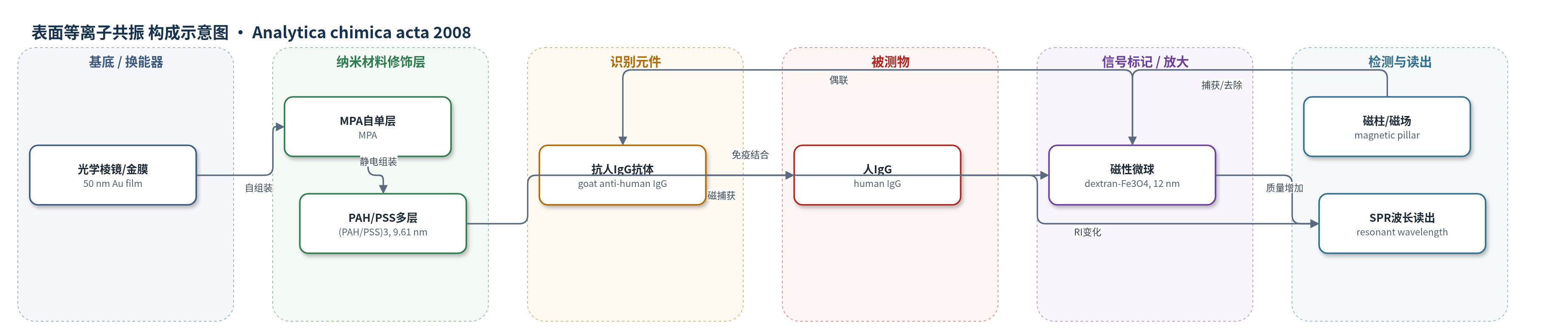
点击图片查看大图 · 依据论文自动绘制
传感器类型
表面等离子共振(SPR)生物传感器
检测对象
人免疫球蛋白G(human IgG, hIgG);样品基质:PBS缓冲液中的标准溶液(亦用兔IgG作干扰对照)
检测原理
该传感器采用波长调制SPR的Kretschmann配置。光在棱镜与约50 nm金膜界面激发表面等离子体,当金膜表面折射率变化时,共振波长发生红移。磁性微球表面偶联山羊抗人IgG抗体,在磁柱磁场作用下被捕获于(PAH/PSS)3聚电解质间隔层上;人IgG与抗体特异性结合后,界面质量与折射率增加,共振波长位移Δλeq随人IgG浓度升高而增大。聚电解质层使传感层远离金膜,将共振波长移至长波区,提高波长调制SPR灵敏度,并阻止磁珠直接沉积,便于水洗再生。
检测灵敏度
LOD: 0.078 μg mL−1;线性范围: 0.25–30.00 μg mL−1((PAH/PSS)3)
效应效果
传感器对兔IgG(5和10 μg/mL)无可见共振波长位移,显示对人IgG选择性良好。5.0 μg/mL人IgG重复11次,RSD为2.2%。(PAH/PSS)3修饰传感膜4 d后保持约94%初始活性,24 h损失约2%;未修饰金膜4 d后约85%。再生后(PAH/PSS)3的Δλ2为3.20±0.16 nm,明显低于无修饰层的28.56±1.13 nm,水洗可重复使用约8次,第8次后保持约82%活性。与无磁珠标准SPR(2.00–30.00 μg/mL)相比,(PAH/PSS)3将线性范围扩展至0.25–30.00 μg/mL,LOD降至0.078 μg/mL,灵敏度较(PAH/PSS)1提高约8倍。
传感器的构成
- 基底/换能器:光学棱镜底部约50 nm金膜(Au film),用于激发SPR并产生共振波长信号
- 锚定/功能化层:3-巯基丙酸(MPA)乙醇溶液处理金膜,提供负电表面以启动聚电解质组装
- 聚电解质间隔层:聚烯丙基胺盐酸盐(PAH)与聚苯乙烯磺酸(PSS)逐层静电组装形成(PAH/PSS)n,最佳为(PAH/PSS)3,平均厚度约9.61 nm,防止磁珠直接接触金膜
- 磁性标记微球:葡聚糖–Fe3O4磁性微球(dextran–Fe3O4 magnetic beads),直径约12 nm,表面经NaIO4氧化生成醛基,用于携带抗体并被磁柱捕获
- 识别元件:山羊抗人IgG抗体(goat anti-human IgG)通过Schiff碱反应偶联在磁性微球表面,特异性识别人IgG
- 封闭剂:牛血清白蛋白(BSA)封闭未反应基团
- 外部磁场/操作:磁柱(magnetic pillar)置于棱镜上方,提供约900 G磁场,用于捕获和去除磁珠–抗体偶联物
中文摘要
磁性微球与抗体偶联后可借助磁力被牢固捕获在金膜上,用于表面等离子共振(SPR)生物传感器的免疫分析。然而,由于磁珠难以从金膜上完全解离,该方法在鲁棒性和灵敏度方面存在明显局限。在金表面引入聚电解质膜可防止磁珠与金膜直接接触。聚电解质逐层组装可作为金表面与磁珠之间的间隔层。基于阳离子与阴离子之间的静电作用,不同层数的聚电解质可组装到金膜上。聚电解质膜在金膜上构建后,磁性微球可被有效沉积在膜上,有利于提高生物传感器灵敏度并改善传感膜再生。当在金膜上构建(PAH/PSS)3聚电解质层时,基于磁性微球的SPR生物传感器对人IgG在0.25–30.00 μg/mL浓度范围内表现出满意响应,所得检测限比(PAH/PSS)1层低8倍。
英文摘要
The conjugates of magnetic beads coupled with an antibody can be trapped on the Au film firmly due to the magnetic force for the immunoassay of a surface plasmon resonance (SPR) biosensor. However, this approach exhibits significant limitations in robustness and sensitivity due to incomplete dissociation of magnetic beads from the Au film. The incorporation of a polyelectrolyte film on the Au surface can prevent the magnetic beads from the direct contact with the Au film. The layer-by-layer assembly of polyelectrolyte was used as spacer between the gold surface and the magnetic bead. Different layers of polyelectrolyte can be assembled onto the Au film based on an electrostatic force between polycations and polyanions. After the polyelectrolyte film was fabricated on the Au film, the deposition of the magnetic beads was maintained effectively on the film, which favors the sensitivity of the biosensor and the regeneration of the sensing membrane. When the polyelectrolyte layers of (PAH/PSS)(3) were constructed on the Au film, the SPR biosensor with magnetic beads exhibited a satisfactory response to human IgG in the concentration range from 0.25 to 30.00 microg mL(-1), and the determination limit obtained is eight times lower than that obtained with (PAH/PSS)(1) layer.