组成图示
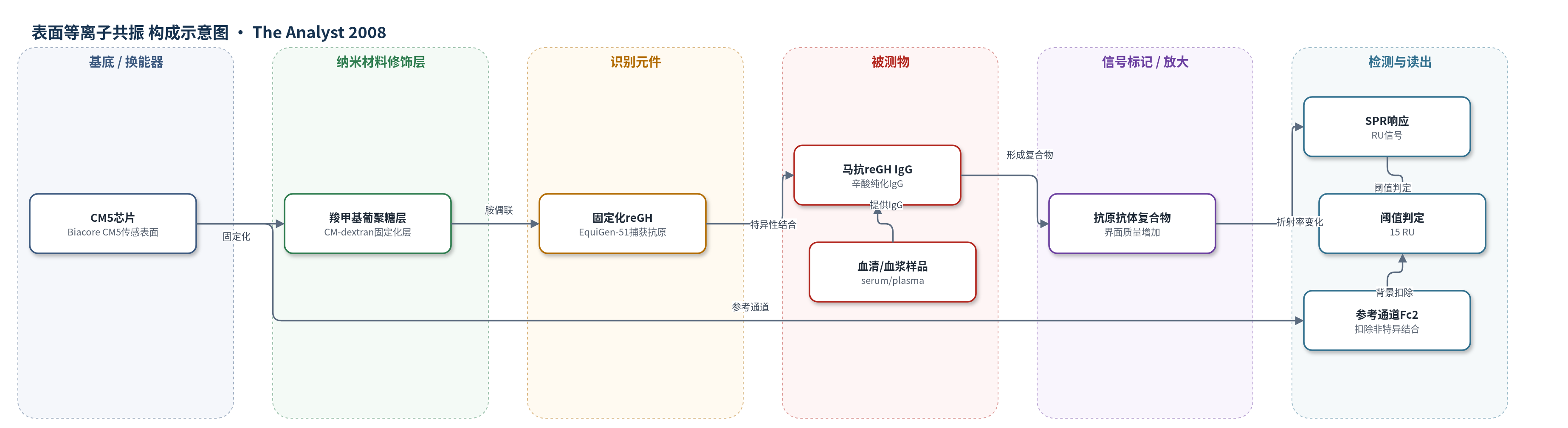
点击图片查看大图 · 依据论文自动绘制
传感器类型
表面等离子共振(SPR)生物传感器
检测对象
马抗重组马生长激素抗体(anti-reGH horse IgG / anti-met-eGH antibodies);样品基质:马血清/血浆(serum/plasma)
检测原理
SPR-BIA中,reGH(met-eGH)经胺偶联固定于CM5芯片羧甲基葡聚糖层。辛酸纯化的马血清/血浆IgG注入后,若存在抗reGH抗体,则与固定化reGH特异性结合,使传感界面质量与折射率增加,SPR共振角偏移,Biacore Q记录为响应单位RU;Fc2空白通道用于扣除非特异结合,信号超过15 RU判定阳性。ELISA中,reGH包被微孔板,样本IgG结合后,HRP标记山羊抗马IgG链结合,ABTS/H2O2显色,OD405随抗体量升高,阈值OD405=1.2。两种方法均通过抗原-抗体识别事件产生可量化信号,抗体浓度越高,RU或OD405越大。
检测灵敏度
判定阈值: SPR-BIA 15 RU;ELISA OD405 nm = 1.2
效应效果
SPR-BIA在reGH给药后第10至90天检出抗体,窗口约80天;ELISA在第8天至210天以上检出,窗口约200天。Western Blot在20和22天确认抗体特异性。辛酸沉淀平均去除约70%蛋白,主要去除白蛋白,提高灵敏度。ELISA三天重复检测标准差低;胰岛素包被孔无OD405变化,表明无交叉反应。233匹赛后马血浆中,母马、阉马、公马OD405分别为0.36±0.05、0.38±0.08、0.36±0.05,与空白(H497 0.51±0.03,H498 0.40±0.02)一致,未见阳性。作者认为该二级标志物窗口长于直接检测met-eGH,可补充IGF-1阈值(860 ng/mL)附近判断,并可能扩展至胰岛素或rhEPO滥用筛查。
传感器的构成
- 基底/换能器:CM5芯片(Biacore CM5),提供SPR传感表面
- 修饰层:羧甲基葡聚糖层(CM-dextran),用于胺偶联固定化reGH
- 捕获抗原:重组马生长激素reGH(met-eGH,EquiGen-51),固定于Fc1,捕获样本中抗reGH IgG
- 识别元件:马抗reGH IgG(anti-reGH horse IgG),来自辛酸纯化血清/血浆,与reGH特异性结合
- 运行缓冲液:HBS-EP,维持结合条件并输送样品
- 参考通道:Fc2空白通道,扣除非特异结合
- 再生液:5 mM NaOH + 200 mM NaCl,解离复合物再生芯片
- 读出:Biacore Q SPR信号(RU),阈值15 RU
中文摘要
自1998年澳大利亚商业化重组马生长激素(reGH,EquiGen-51/Bresagen)以来,该药物与天然马生长激素(eGH)仅在N端多一个甲硫氨酸(met-eGH),因此在全球赛马中被怀疑作为兴奋剂使用。reGH可影响生长、发育、生殖功能并提升运动表现,直接检测血浆中低浓度reGH仍困难。本文报道两种高通量筛查方法:表面等离子共振生物传感器免疫分析(SPR-BIA)和固相酶联免疫吸附试验(ELISA),用于检测马血清或血浆中因reGH暴露产生的抗reGH抗体。样品经辛酸沉淀纯化IgG后,分别注入固定化reGH的CM5芯片或reGH包被微孔板。对两匹连续两周接受reGH治疗的纯血马进行动力学研究,结果显示SPR-BIA可在给药后第10至90天检出抗体,ELISA可在第8天至210天以上检出,检测窗口分别约80天和200天。随后对233匹赛后马血浆进行随机群体研究,以评估背景水平。结果表明两种方法具有良好重复性和特异性,可作为马匹生长激素滥用长期筛查的二级生物标志物策略。
英文摘要
Since the Australian commercialisation of the recombinant equine growth hormone (reGH) in 1998 (EquiGen-5), Bresagen), this reGH, which differs only from eGH by an additional methionine at the N-terminal end (met-eGH), is worldwide suspected to be administered to racehorses as a doping agent. Indeed, the use of this biological drug is considered as a threat to horseracing since it acts both on growth, development or reproductive functions, and on the improvement of performances. In this work, we describe two reliable techniques based on surface plasmon resonance biosensor immunoassay (SPR-BIA) and solid-phase enzyme-linked immunosorbent assay (ELISA) as new, rapid and efficient long-term screening methods applicable to horseracing antidoping analysis. The ELISA and SPR-BIA tests were applied to octanoic acid purified IgGs from serum/plasma samples collected on two thoroughbreds treated with recombinant equine growth hormone for a period of two weeks. The first kinetic study of serum/plasma antibodies raised as a consequence of recombinant equine growth hormone administrations, which allows the detection from eight days up to 200 days after the beginning of the treatment, was performed. In order to trace the occurrence of anti-reGH antibodies in routine analysis and to monitor the animal level exposure to this forbidden molecule, a random population study was conducted on 233 post-race horses.