组成图示
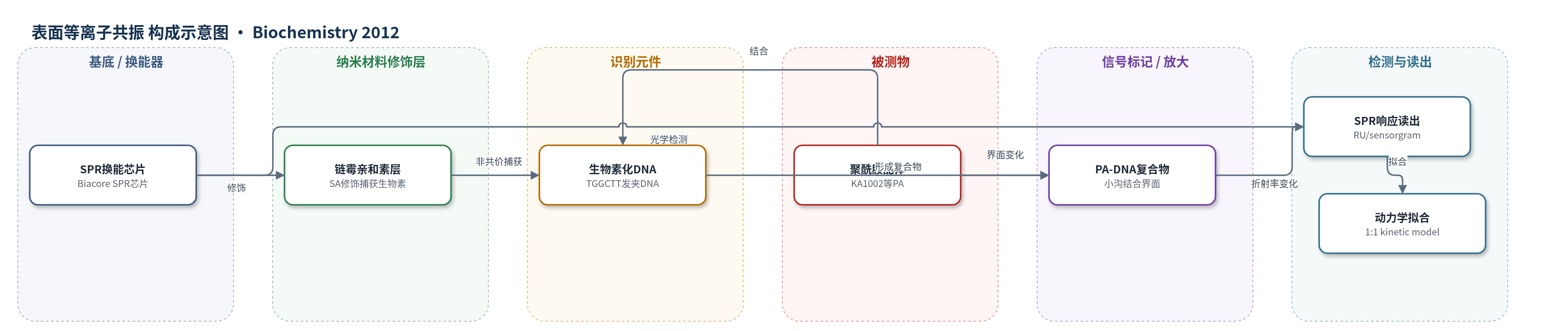
点击图片查看大图 · 依据论文自动绘制
传感器类型
表面等离子共振(SPR)生物传感器
检测对象
发夹聚酰胺(hairpin polyamides, KA1002、KA1007、KA1055、KA1039);样品基质:HBS缓冲液(10 mM HEPES、150 mM NaCl、3 mM EDTA、0.05% P20,pH 7.4)与HEPES缓冲液(10 mM HEPES、50 mM NaCl、1 mM EDTA,pH 7.4)
检测原理
链霉亲和素修饰的SPR芯片上通过生物素-链霉亲和素作用固定含TGGCTT位点的发夹DNA。注入不同浓度发夹聚酰胺(PA)后,PA以序列特异性方式进入DNA小沟,通过酰胺氢键、范德华作用和疏水堆积与碱基对识别。结合事件增加芯片表面质量与局部折射率,SPR共振信号以响应单位(RU)实时变化。稳态RU随游离PA浓度升高并趋于饱和,按单点结合模型RUobs=RUMax×KACfree/(1+KACfree)拟合得到平衡常数KA;连续结合-解离sensorgram用1:1动力学模型全局拟合得到ka和kd。低pH甘氨酸再生表面。该方法为无标记、实时、可重复的SPR传感检测,未使用酶或核酸信号放大。
检测灵敏度
原文未报告LOD、线性范围、灵敏度斜率或R^2。
效应效果
SPR显示KA1002对TGGCTT最强,KA=(37±7)×10^8 M−1;KA1007因N端β降低120倍至(0.29±0.01)×10^8 M−1,kd增大约15倍;KA1055仅降低3倍;KA1039弱25倍。ΔTm:KA1002对TGGCTT 6.8°C、TGCCTT 11.3°C,其他突变0.5–4.5°C;KA1055对TGGCTT 5.3°C、TGCCTT 6.2°C。实验至少重复三次且可重复,未报告RSD、回收率或ELISA/HPLC/qPCR对比。作者认为结果揭示β位置与DNA碱基位置对PA-DNA结合和选择性的序列依赖效应,可指导DNA靶向药物设计。
传感器的构成
- 换能器基底:streptavidin-derivatized SPR sensor chip(链霉亲和素修饰SPR芯片),提供表面捕获与SPR光学换能
- 捕获/识别层:biotinylated hairpin DNA 5′-biotin-CCTTGGCTTCTTTTGAAGCCAA-GG-3′,含TGGCTT位点,经生物素-链霉亲和素非共价固定
- 被测配体:hairpin polyamides KA1002、KA1007、KA1055、KA1039,序列特异性结合DNA小沟
- 流动相:HBS buffer(10 mM HEPES、150 mM NaCl、3 mM EDTA、0.05% P20,pH 7.4)及HEPES buffer(10 mM HEPES、50 mM NaCl、1 mM EDTA,pH 7.4)
- 抗非特异添加剂:0.05% (v/v) surfactant P20,降低非特异吸附
- 再生剂:10 mM glycine(pH 2.5),解离PA-DNA复合物并恢复基线
- 信号读出:Biacore T200/T100 optical biosensor,监测SPR响应单位RU并生成sensorgrams
中文摘要
为深入理解β-丙氨酸(β)取代及杂环数目对DNA结合亲和力与选择性的影响,作者研究了八环发夹聚酰胺(PA)及其两个β衍生物和一个六环类似物与同源DNA序列5′-TGGCTT-3′的相互作用,并利用同源DNA和五个突变DNA评估结合选择性与β效应。研究采用互补的能量与结构方法,包括紫外热熔融、生物传感器表面等离子共振(SPR)、等温滴定量热(ITC)、圆二色(CD)和DNA连接梯全局结构检测。六环PA因杂环减少而结合亲和力降低,但其聚集显著少于较大PA,从而可测定结合热力学。PA-DNA结合焓为较大负值,ΔCp也为较大负值,是Gibbs自由能的主要驱动项。完整SPR结果清楚表明,β取代可按位置依赖方式显著削弱发夹PA的结合亲和力;PA与突变DNA结合的变化进一步证实这种位置依赖效应。突变序列比较还显示T·A与A·T碱基对识别存在不同效应。DNA突变对单个PA结合以及β取代位置对结合的影响,共同揭示了PA-DNA序列依赖结合的规律。
英文摘要
To improve our understanding of the effects of β-alanine (β) substitution and the number of heterocycles on DNA binding affinity and selectivity, we investigated the interactions of an eight-ring hairpin polyamide (PA) and two β derivatives as well as a six-heterocycle analogue with their cognate DNA sequence, 5'-TGGCTT-3'. Binding selectivity and the effects of β have been investigated with the cognate and five mutant DNAs. A set of powerful and complementary methods have been employed for both energetic and structural evaluations: UV melting, biosensor surface plasmon resonance, isothermal titration calorimetry, circular dichroism, and a DNA ligation ladder global structure assay. The reduced number of heterocycles in the six-ring PA weakens the binding affinity; however, the smaller PA aggregates significantly less than the larger PAs and allows us to obtain the binding thermodynamics. The PA-DNA binding enthalpy is large and negative with a large negative ΔC(p) and is the primary driving component of the Gibbs free energy. The complete SPR binding results clearly show that β substitutions can substantially weaken the binding affinity of hairpin PAs in a position-dependent manner. More importantly, the changes in the binding of PA to the mutant DNAs further confirm the position-dependent effects on the PA-DNA interaction affinity. Comparison of mutant DNA sequences also shows a different effect in recognition of T·A versus A·T base pairs. The effects of DNA mutations on binding of a single PA as well as the effects of the position of β substitution on binding tell a clear and very important story about sequence-dependent binding of PAs to DNA.