组成图示
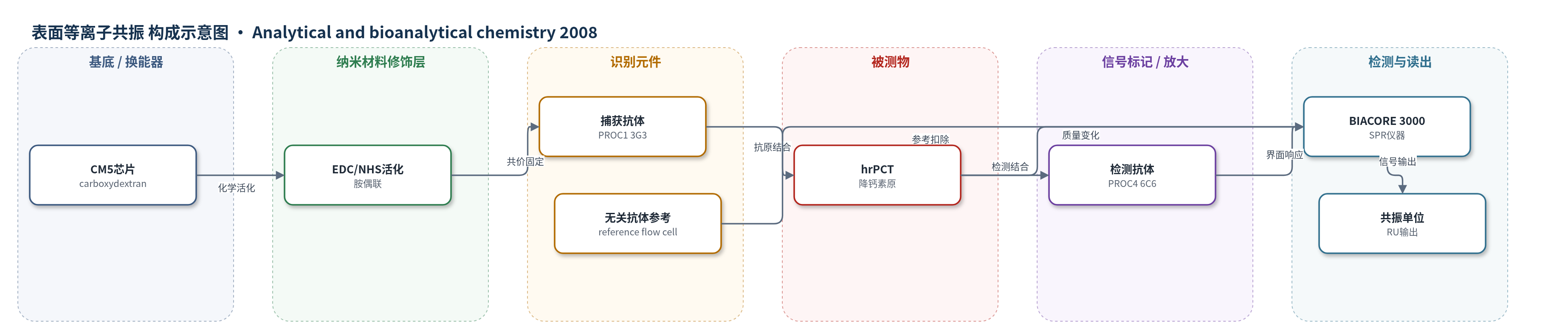
点击图片查看大图 · 依据论文自动绘制
传感器类型
表面等离子共振(SPR)生物传感器
检测对象
降钙素原(procalcitonin, PCT;标准为人重组 PCT, hrPCT);SPR 检测基质为 HBS 缓冲液,ELISA 验证基质为人血清。
检测原理
SPR 传感器采用无标记夹心模式。CM5 芯片经 EDC/NHS 活化后,将捕获单抗 PROC1 3G3 共价固定于表面;hrPCT 流经芯片时与捕获抗体结合,随后检测单抗 PROC4 6C6 等结合 PCT 的另一表位。抗原–抗体复合物的质量增加改变芯片表面局部折射率,BIACORE 3000 以共振单位(RU)实时读出。信号随 hrPCT 浓度增加而增大,在 0–20,000 µg/L 范围内呈线性,校准方程 y=5.4991+0.0109x,R2=0.9731。该过程不使用酶或荧光标记放大,灵敏度主要依赖抗体亲和力和表面结合量。
检测灵敏度
SPR: LOD: 92.5 µg L−1 (5.4 nM);线性范围: 0–20,000 µg L−1;斜率: 0.0109 RU/(µg L−1);R^2 = 0.9731。ELISA(未生物素化): LOD: 1.4–8.2 µg L−1;LLOQ: 2.3–12.8 µg L−1;工作范围: 2.7–177.8 µg L−1;R^2 = 0.988–0.999。ELISA(生物素化): LOD: 1.0–2.1 µg L−1;LLOQ: 4.1–6.0 µg L−1;工作范围: 9.0–374.6 µg L−1。
效应效果
SPR 表面经 80 次结合/再生循环保持稳定。夹心 ELISA 对降钙素和 katacalcin 无交叉反应,>3,000 µg/L 仍无信号。未生物素化 ELISA R2 为 0.988–0.999;最佳组合 PROC1 3G3–PROC4 6C6 的 LLOQ 为 2.3 µg/L,工作范围 2.7–80.3 µg/L,可覆盖脓毒症 2–10 µg/L 和细菌感染 ≥10 µg/L。生物素化体系 LLOQ 为 4.1–6.0 µg/L,曲线更一致。5 份健康志愿者血清本底由 BRAHMS LIA 测得约 0.1 µg/L,低于定量限;加标 20 µg/L 回收率 98.3%–115.7%,质控标准回收率约 90%。作者认为可用于即时诊断免疫传感器。
传感器的构成
- 基底/换能器:CM5 羧基葡聚糖传感器芯片,作为 SPR 换能表面并承载抗体
- 化学修饰层:EDC/NHS 胺偶联试剂,活化芯片羧基以共价固定捕获抗体
- 识别元件:捕获单抗 PROC1 3G3,特异性识别 PCT N 端区域
- 信号元件:检测单抗 PROC4 6C6/6B2/1G3/1D6,无标记结合 PCT 并改变界面质量
- 参考/缓冲体系:HBS 缓冲液含 0.05% P20,降低非特异结合;无关单抗参考流道用于扣除背景
- 再生/稳定层:10 mM glycine-HCl(pH 2.5)再生表面,HBS 恢复稳定
中文摘要
本文报道了五种新型大鼠抗降钙素原(PCT)单克隆抗体的开发与表征。PCT 是细菌感染和脓毒症的血清标志物。作者以 PCT 不同结构域肽段偶联 KLH/OVA 免疫大鼠和小鼠,筛选出 1 株捕获抗体 PROC1 3G3 和 4 株检测抗体 PROC4 6C6、PROC4 6B2、PROC4 1G3、PROC4 1D6。利用表面等离子共振(SPR)生物传感器测定抗原–抗体相互作用动力学:捕获抗体 PROC1 3G3 的平衡解离常数 KD 为 3.42×10⁻⁸ M;四株检测抗体均为高亲和力,KA 为 2.81–6.11×10⁸ M−1,KD 为 1.64–3.56×10⁻⁹ M,kd 为 1.70–2.40×10⁻³ s−1。以 PROC1 3G3 为捕获抗体、PROC4 抗体为检测抗体建立四种夹心 ELISA,对人重组 PCT 高度特异,不与降钙素和 katacalcin 交叉反应。PBS 体系中 LLOQ 为 2.3–12.8 µg/L;在含 4% 人血清白蛋白和 LowCross Buffer 的体系中 LLOQ 为 4.1–6.0 µg/L。用 PROC1 3G3 与生物素化 PROC4 6C6 检测 5 份健康志愿者血清,加标 20 µg/L 后回收率为 98.3%–115.7%。作者认为这些抗体可用于脓毒症和全身炎症的即时诊断免疫传感器。
英文摘要
The development of selective and sensitive biological recognition elements, e.g., antibodies, for the detection of relevant blood markers is a great challenge in the field of biosensors. In this context, five new rat monoclonal antibodies (mAbs) for procalcitonin (PCT), a marker for bacterial infection and sepsis, were developed and characterized. One mAb, PROC1 3G3, was used as capture antibody. Four mAbs, PROC4 6C6, PROC4 6B2, PROC4 1G3, and PROC4 1D6, were used as detection mAbs, either as Protein G-purified or as biotinylated mAbs. A surface plasmon resonance (SPR) biosensor was used to characterize the antigen-antibody biomolecular interactions. The capture mAb (PROC1 3G3) has an equilibrium dissociation constant (K (D)) of 3.42 x 10(-8) M. All four detection mAbs (PROC4 6C6, PROC4 6B2, PROC4 1G3, and PROC4 1D6) are of high affinity (K (A) = 2.81-6.11 x 10(8) M(-1); K (D) = 1.64-3.56 x 10(-9) M) and have moderate dissociation rate constants (k (d) = 1.70-2.40 x 10(-3) s(-1)). Four different sandwich enzyme-linked immunosorbent assays (ELISAs) with standards of human recombinant (hr) PCT, using PROC1 3G3 as capture mAb and PROC4 mAbs as detection mAbs, respectively, led to highly specific determinations of PCT without cross-reactivities to calcitonin and katacalcin. The lower limits of quantification (LLOQ) for hrPCT (in 40 mM phosphate-buffered saline (PBS), pH 7.6) with these assays ranged from 2.3 to 12.8 microg L(-1). In addition, sandwich ELISAs were set up with biotinylated PROC4 mAbs, and with hrPCT in 4% human serum albumin (diluted 1:10 in 40 mM PBS, including 1:5 (v/v) LowCross Buffer(R)). The LLOQs of these sandwich assays ranged from 4.1 to 6.0 microg L(-1) and were thus much closer together for the different assays. With the latter assay setup (PROC1 3G3 as capture mAb, PROC4 6C6-biotin as detection mAb) a first collection of five serum samples was determined (healthy volunteers, unspiked, and spiked). Recovery rates for the spiked samples ranged from 98.3 to 115.7%. The newly developed anti-PCT mAbs should find broad applications in immunosensors for point-of-care diagnostics of sepsis and systemic inflammation processes.