组成图示
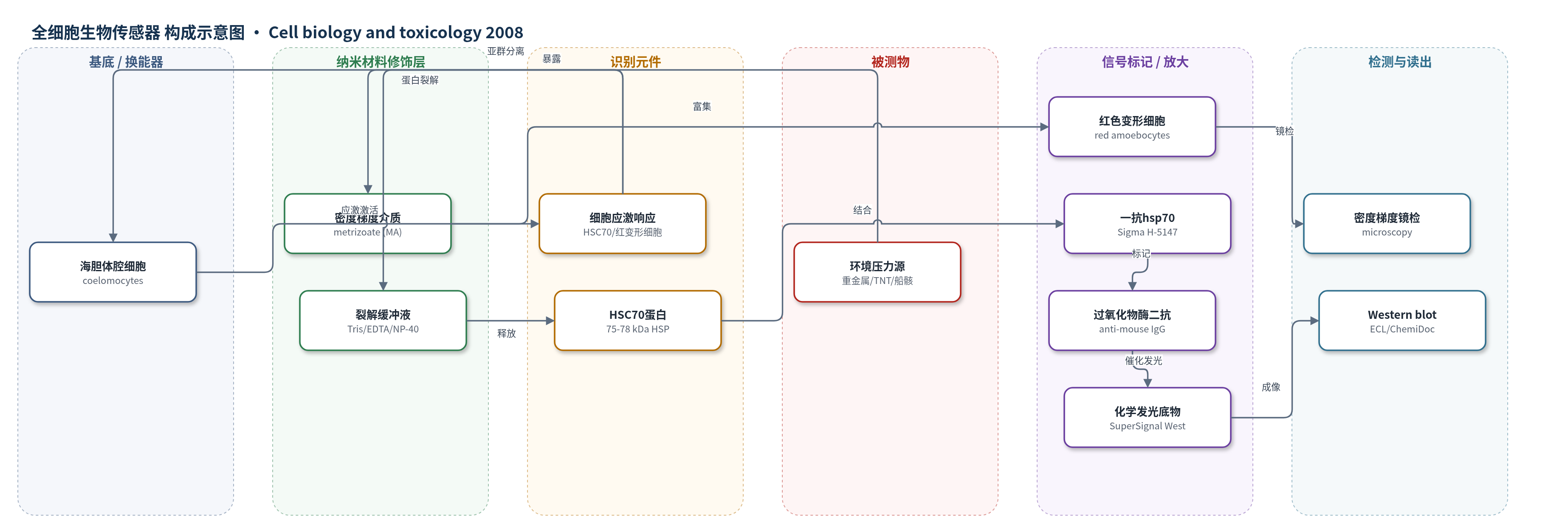
点击图片查看大图 · 依据论文自动绘制
传感器类型
全细胞生物传感器
检测对象
环境压力(environmental stress)、重金属(trace metals,Fe/Cu/Zn/Al/As)、TNT(2,4,6-trinitrotoluene);样品基质:海胆体腔细胞(coelomocytes)与生殖腺(gonads)
检测原理
海胆体腔细胞作为全细胞生物传感器,直接暴露于受污染海水/沉积物中的重金属、TNT等环境压力源。压力刺激激活细胞防御通路,引起红色变形细胞比例升高和HSC70蛋白表达上调。一方面,细胞悬液经Na-metrizoate密度梯度离心,按密度和形态富集红色变形细胞,镜检计数形成细胞形态学信号;另一方面,体腔细胞裂解后,HSC70经SDS-PAGE和Western blot被抗hsp70单克隆抗体识别,过氧化物酶偶联二抗结合后,化学发光底物催化发光,ECL胶片或ChemiDoc定量。信号强度随胁迫程度增加而升高,ICP-AES生殖腺金属测定用于验证污染源。
检测灵敏度
原文未报告LOD、线性范围、灵敏度斜率或相关系数。
效应效果
2003年Pianosa点10例中7例红色变形细胞增多,Caprara点6例均弱;HSC70多数Pianosa样本较Caprara升高约2倍,个别3–4倍。2004年40例Pianosa与11例Caprara Western blot证实Pianosa更高,ANOVA P≤0.022。生殖腺ICP-AES:Pianosa Fe 36±27 μg/g,Caprara 23±9 μg/g(P≤0.05);Zn Caprara 117±33 μg/g高于Pianosa 68±45 μg/g(P=0.1)。与1980s相比,Cu、Zn、As升高2.5–3、3.5–4和>20倍。未报告RSD、回收率或ELISA/qPCR对比,但作者认为可用于海洋生态毒理监测与修复决策。
传感器的构成
- 传感细胞层:Paracentrotus lividus体腔细胞(coelomocytes),作为环境压力识别与应激响应单元
- 亚群分离层:Na-metrizoate(MA)密度梯度介质,按密度/形态分离红色变形细胞(red amoebocytes)
- 裂解缓冲层:Tris/EDTA/NP-40/glycerol/DTT裂解液及蛋白酶抑制剂,裂解体腔细胞并保留HSC70
- 识别抗体层:抗牛脑70 kDa热休克蛋白单克隆抗体(hsp70 McAb,Sigma H-5147),识别HSC70/HSP70
- 信号标记层:过氧化物酶偶联抗小鼠IgG(peroxidase-conjugated anti-mouse IgG,Amersham),标记一抗复合物
- 发光读出层:SuperSignal West Pico化学发光底物(Pierce)与Hyperfilm ECL胶片(Amersham),产生并记录化学发光信号
中文摘要
本研究评估海胆作为哨兵生物用于海洋生物监测的适用性。作者于2003年和2004年两次海洋调查期间,采集意大利南部亚得里亚海特雷米蒂群岛海洋保护区内Pianosa和Caprara两点的Paracentrotus lividus海胆,利用体腔细胞(coelomocytes)作为环境压力细胞生物传感器。通过船上密度梯度分离,发现严格保护、禁止人类活动的Pianosa点红色变形细胞(red amoebocytes)比例明显升高,而限制较少的Caprara点未见该变化。Western blot检测显示,Pianosa点体腔细胞裂解液中热休克蛋白70(HSC70)水平较Caprara点升高约2倍,个别样本达3–4倍。该表观矛盾可用Pianosa海域存在二战常规弹药和商船残骸等持续金属污染源解释。ICP-AES检测海胆生殖腺显示Pianosa点Fe含量较高、Zn含量较低,支持污染胁迫。结果表明,海胆体腔细胞可作为评估环境压力的新型细胞生物传感器。
英文摘要
The aim of the present study was to investigate on the suitability of the sea urchin as a sentinel organism for the assessment of the macro-zoobenthos health state in bio-monitoring programmes. A field study was carried out during two oceanographic campaigns using immuno-competent cells, the coelomocytes, from sea urchins living in a marine protected area. In particular, coelomocytes subpopulations ratio and heat shock protein 70 (HSC70) levels were measured in specimens of Paracentrotus lividus (Lamark, 1816) collected in two sampling sites, namely Pianosa and Caprara Islands, both belonging to the Tremiti Island Marine Protected Area (MPA) in the Southern Adriatic Sea, Italy. By density gradients separation performed on board the Astrea boat, we found an evident increase in red amoebocytes, a subpopulation increasing upon stress, in those specimens collected around Pianosa (strictly protected area with no human activities allowed), unlike those collected around Caprara (low restrictions for human activities). Likewise, we found higher HSC70 protein levels in the low impacted site (Pianosa) by Western blots on total coelomocyte lysates. The apparent paradox could be explained by the presence in the Pianosa sampling area of contaminating remains from Second World War conventional ammunitions and a merchant boat wreck. Metal determination performed using sea urchin gonads by inductively coupled plasma atomic emission spectrometry (ICP-AES) revealed higher Fe and lower Zn levels around Pianosa with respect to Caprara, in accordance with the persistent contaminating metal sources, and thus calling for remediation measures. Taken all together, our results confirm the feasibility of using sea urchin coelomocytes as biosensors of environmental stress.