组成图示
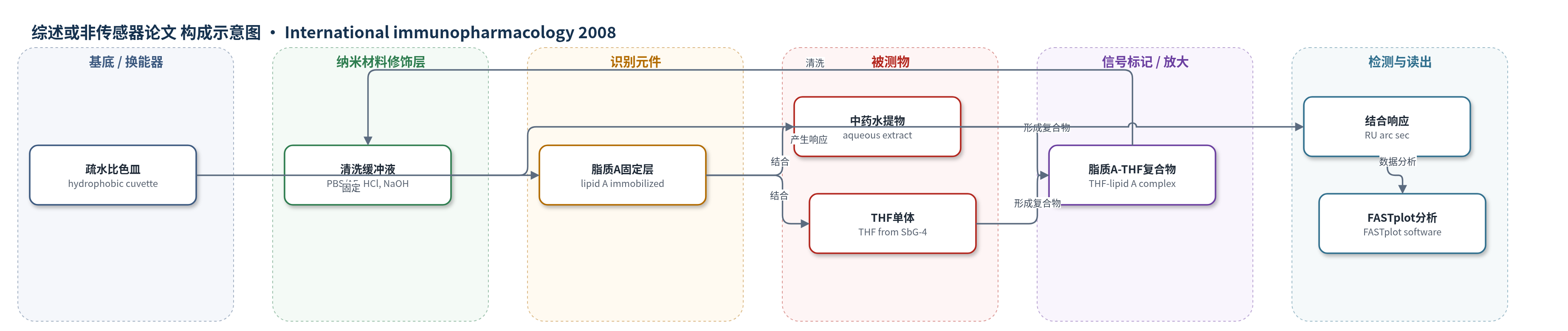
点击图片查看大图 · 依据论文自动绘制
传感器类型
综述或非传感器论文
检测对象
脂质A结合成分/单体(lipid A-binding components/monomer,含THF);样品基质:中药水提物(aqueous extract)、AB-8树脂/HPLC洗脱组分;另以鲎试剂检测内毒素(LPS/endotoxin),样品基质:小鼠血浆、体外LPS溶液。
检测原理
该亲和生物传感器以固定化脂质A作为识别靶标。将脂质A固定于疏水比色皿表面后,加入中药水提物或分离组分;其中能与脂质A结合的成分(如THF)与固定化脂质A结合,形成脂质A-结合物复合物。随后用PBS/AE、0.1 M HCl和10 mM NaOH交替清洗,去除非特异性吸附,保留特异性结合物。结合物在界面处的积累引起传感器响应变化,以响应单位RU(arc sec)表示,并用FASTplot软件读取和分析。响应大小随待测样品中脂质A结合成分的浓度或结合能力增加而升高,因此可用于筛选高脂质A结合活性的中药组分。该过程未使用酶催化、HCR、RCA或CRISPR-Cas等信号放大策略。
检测灵敏度
原文未报告LOD、线性范围、灵敏度斜率或相关系数。
效应效果
亲和筛选中,黄芩水提物脂质A结合活性较高;SbG-4响应113.4 arc sec,高于SbG-5的73.8 arc sec。体外LAL实验显示,THF 1.0、2.0、4.0 mg/L分别中和0.1 µg/L LPS的27.9%、39.8%、53.1%。THF剂量依赖抑制LPS诱导RAW264.7细胞TNF-α和IL-6释放,并下调TNF-α、TLR4 mRNA;MTT显示10–320 mg/L处理24 h无细胞毒性。体内THF 40 mg/kg显著保护热灭活大肠杆菌35218致死攻击(p<0.01),并降低内毒素血症小鼠血浆LPS(p<0.05)。作者认为THF是安全、有潜力的抗败血症候选药物。
传感器的构成
- 基底/换能器:疏水比色皿(hydrophobic cuvette,Thermo Labsystem),提供脂质A固定表面并承载亲和结合信号。
- 固定化识别靶标:脂质A(lipid A,Salmonella Re 595),按厂家说明固定于比色皿表面,用于捕获中药水提物中的脂质A结合成分。
- 待测样品:中药水提物(aqueous extract,15 g/L),含潜在脂质A结合成分,与固定化脂质A发生结合。
- 清洗/洗脱液:PBS/AE、0.1 M HCl、10 mM NaOH,交替清洗以去除非特异结合并保留特异性结合物。
- 信号读出:FASTplot 软件(Thermo Labsystem),分析结合响应(RU,arc sec),用于比较各中药或组分的脂质A结合活性。
中文摘要
脂多糖(LPS)是败血症发病的重要触发因子,其毒性成分为脂质A。中和LPS是重症败血症辅助治疗策略之一。为从传统中药中筛选能中和内毒素的成分,作者采用亲和生物传感器技术检测12味中药水提物与脂质A的结合能力,发现黄芩(Scutellaria baicalensis Georgi)具有较高脂质A结合活性,并作为后续研究对象。经大孔吸附树脂和高效液相色谱分离,在中和LPS及降低促炎细胞因子释放的活性导向下,获得2′,5,6′,7-四羟基黄烷醇(THF)。体外实验显示,THF可直接结合并中和LPS活性;以剂量依赖方式下调LPS诱导的RAW264.7细胞TNF-α mRNA表达,并减少TNF-α和IL-6释放,该抑制作用可能与下调LPS诱导的TLR4 mRNA上调有关。体内实验中,THF以剂量依赖方式显著保护小鼠免受热灭活大肠杆菌35218致死攻击,并降低内毒素血症小鼠血浆LPS水平。结果表明THF可能是治疗败血症的重要潜在药物,且其抑制细胞因子释放不太可能源于非特异性细胞毒性,可作为安全候选药物开发。
英文摘要
Lipopolysaccharide (LPS) is a known trigger in the pathogenesis of sepsis, lipid A being the toxic component. One of several adjuvant therapeutic approaches for severe sepsis is currently focusing on the neutralization of LPS. In order to obtain the components from traditional Chinese herbs that can neutralize the endotoxin, aqueous extractions of twelve herbs were tested using affinity biosensor technology. From twelve herbs, Scutellaria baicalensis Georgi (Huang Qin) found to possess high lipid A-binding abilities, and was selected in subsequent experiments. After subjected to macroporous adsorptive resins and HPLC, we obtained 2',5,6',7-tetrahydroxyflavanonol (THF) from S. baicalensis Georgi under the direction of neutralization of LPS and reducing proinflammatory cytokines. In vitro, THF directly bound to LPS and neutralized its activity. THF not only down-regulated TNF-alpha mRNA expression but also decreased TNF-alpha and IL-6 release from RAW264.7 cells induced by LPS in a dose-dependent manner. THF-mediated inhibition on proinflammatory cytokine release is probably associated with downregulation of LPS-induced TLR4 mRNA augmentation. In vivo, THF could significantly protect mice against a lethal challenge with heat-killed E. coli 35218 (E. coli 35218) in a dose-dependent manner, and decreased the plasma LPS level in endotoxemia mice. These findings provide compelling evidence that THF may be an important potential drug for sepsis treatment. Considering the inhibitory effects of THF on LPS-induced cytokine release are unlikely due to its nonspecific cellular toxicity, THF should be considered as a safe putative candidate for development as a drug for sepsis treatment.