组成图示
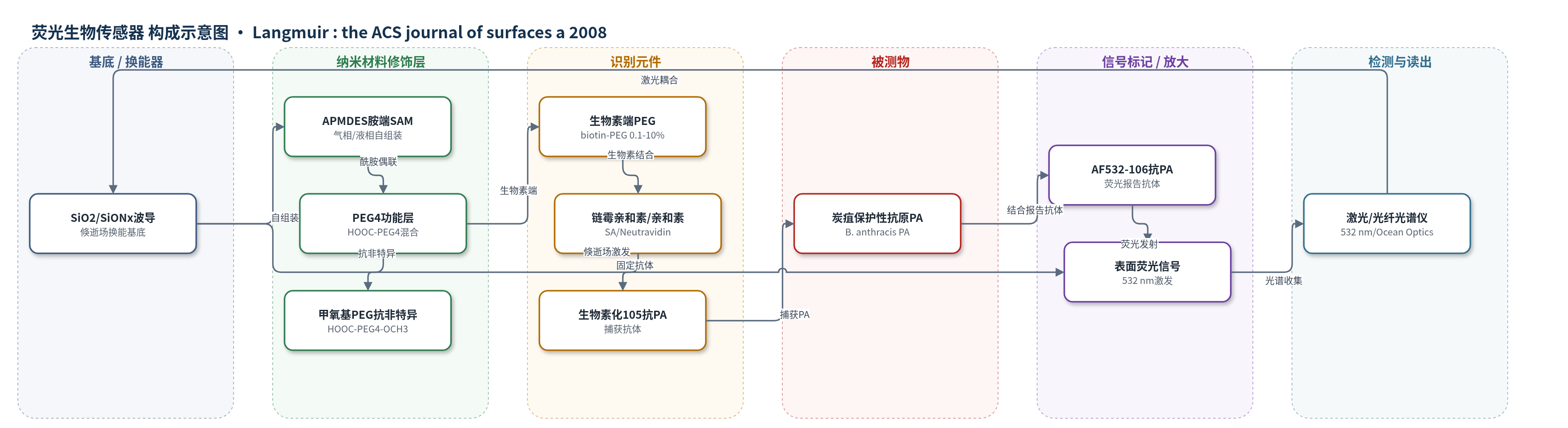
点击图片查看大图 · 依据论文自动绘制
传感器类型
荧光生物传感器
检测对象
炭疽保护性抗原(Bacillus anthracis protective antigen, PA);样品基质:PBS 缓冲液、胎牛血清(FBS)
检测原理
该检测基于波导荧光免疫夹心(伪三明治)原理。APMDES 自组装层与短 PEG 链共价连接,其中少量生物素端 PEG 通过生物素–链霉亲和素/亲和素相互作用固定生物素化 105-anti-PA 捕获抗体。样品中的炭疽保护性抗原 PA 被捕获抗体特异性结合后,再加入 Alexa-Fluor 532 标记的 106-anti-PA 报告抗体,形成抗原–抗体复合物。532 nm 激光经衍射光栅耦合进入 SiO2/SiONx 波导,在表面形成倏逝场,仅激发靠近表面的荧光标记物;报告抗体上的 Alexa-Fluor 532 发射荧光,由光纤光谱仪收集。PA 浓度越高,表面结合的荧光报告抗体越多,荧光强度越大。PEG 层抑制非特异吸附,提高信噪比。
检测灵敏度
LOD: 1–10 pM
效应效果
气相 APMDES/PEG 薄膜检测 1 nM PA 时 NSBc 约 1.3、SBc 约 203,优于液相 APMDES/PEG(NSBc 约 6.8、SBc 约 2.4);其非特异结合接近 BSA 封闭脂质双分子层(NSBc 0.27),但特异性信号远高于脂质双分子层(SBc 52),且无需长时间 BSA 封闭。在 1 nM PA 加标胎牛血清(FBS)中,NSBc 为 3.1,SBc 为 39,表明可在复杂介质中检测。薄膜在 80 °C 培养基中 60 min 后图案基本保持,沸腾培养基中降解;空气中 75 d 无明显降解,水或 PBS 中接触角随时间下降。作者认为该表面可再生、稳定,适用于自主生物传感器。
传感器的构成
- 基底/换能器:SiO2/SiONx 波导(nGiMAT),提供倏逝场以激发表面荧光
- 硅烷自组装层:APMDES(3-aminopropylmethyldiethoxysilane)气相/液相沉积形成胺端单分子层,提供氨基反应位点
- PEG 功能层:HOOC-PEG4-OCH3 与 HOOC-PEG4-NHFmoc 经 PyBOP/DIEA 偶联,形成短 PEG 抗非特异结合层
- 识别连接元件:0.1–10 mol% 生物素端 PEG(biotin-PEG),用于结合链霉亲和素/亲和素
- 捕获抗体:生物素化 105-anti-PA 抗体,经链霉亲和素/亲和素固定,特异性捕获 PA
- 信号标记物:Alexa-Fluor 532 标记的 106-anti-PA 报告抗体,与 PA 另一表位结合并发出荧光
- 封闭/洗涤:2% BSA/PBS、0.5% BSA/PBS 或 0.1% Tween-20/PBS,用于封闭和清洗非特异结合
中文摘要
本文报道了一种在氧化物表面制备功能化有机薄膜用于生物检测的通用方法。作者通过气相和液相沉积 3-氨基丙基甲基二乙氧基硅烷(APMDES),在二氧化硅表面自组装形成胺端硅烷单分子层。原子力显微镜(AFM)、椭偏仪和接触角测量表明,减压气相沉积可获得表面覆盖均匀、质量最高的单分子层。随后,胺端薄膜与不同功能度的羧酸端聚乙二醇(PEG)链混合修饰;其中 0.1–10 mol% 的 PEG 链端接生物素,使表面具有结合链霉亲和素的亲和力。将该功能化 PEG 表面用于波导平台上的伪三明治免疫检测,以检测炭疽杆菌保护性抗原(PA)时,可显著降低波导表面的非特异性结合,同时保持高特异性结合。作者利用 PA 检测验证了该薄膜在缓冲液和复杂介质中的传感性能。这些结果为构建稳健、可重复使用且自主运行的生物传感器提供了基础。
英文摘要
We report a general procedure to prepare functional organic thin films for biological assays on oxide surfaces. Silica surfaces were functionalized by self-assembly of an amine-terminated silane film using both vapor- and solution-phase deposition of 3'-aminopropylmethyldiethoxysilane (APMDES). We found that vapor-phase deposition of APMDES under reduced pressure produced the highest quality monolayer films with uniform surface coverage, as determined by atomic force microscopy (AFM), ellipsometry, and contact angle measurements. The amine-terminated films were chemically modified with a mixture of carboxylic acid-terminated poly(ethylene glycol) (PEG) chains of varying functionality. A fraction of the PEG chains (0.1-10 mol %) terminated in biotin, which produced a surface with an affinity toward streptavidin. When used in pseudo-sandwich assays on waveguide platforms for the detection of Bacillus anthracis protective antigen (PA), these functional PEG surfaces significantly reduced nonspecific binding to the waveguide surface while allowing for highly specific binding. Detection of PA was used to validate these films for sensing applications in both buffer and complex media. Ultimately, these results represent a step toward the realization of a robust, reusable, and autonomous biosensor.