组成图示
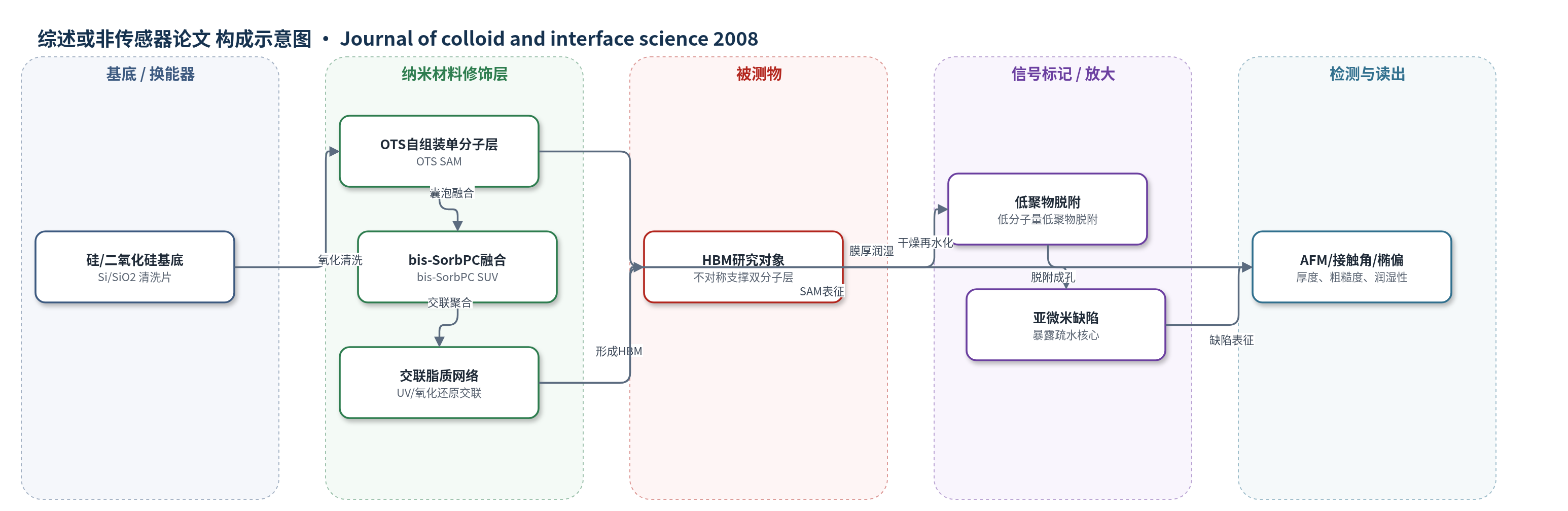
点击图片查看大图 · 依据论文自动绘制
传感器类型
综述或非传感器论文
检测对象
无(非传感检测论文;研究对象为 OTS SAM 上 poly(bis-SorbPC) 混合双分子层膜,样品基质为干燥/再水化膜表面)
检测原理
本文未建立传感检测,其核心是支撑双分子层膜的制备与稳定性机制。首先,在 Si/SiO2 上形成 OTS 自组装单分子层,提供疏水内叶;随后 bis-SorbPC 小单囊泡融合形成外叶磷脂单分子层。UV 或 K2S2O4/NaHSO3 氧化还原体系引发双烯基团自由基交联,生成 poly(bis-SorbPC) 共价网络,使膜在干燥后仍保留双分子层轮廓。然而,HBM 中交联仅发生在外叶,缺少对称 PSLB 中上下叶之间的叶间交联。当膜从水中取出、冲洗和干燥时,低分子量低聚物及未反应单体易从外叶脱附,形成亚微米孔洞并暴露疏水核心。接触角升高、椭偏厚度变化和 AFM 粗糙度增加反映缺陷密度。因此,外叶交联可部分稳定 HBM,但不足以实现反复干燥/再水化下的无缺陷膜。
检测灵敏度
—
效应效果
多数条件下,bis-SorbPC 交联使 HBM 干燥后保持脂质膜/SAM 结构,但始终存在亚微米缺陷。OTS SAM 接触角 109±2°、厚度 26±1 Å;红外交联 HBM 接触角 69–75°、厚度 26–36 Å、AFM rms 0.37–0.73 nm。水下膜连续光滑(rms 约 0.1 nm),干燥/再水化后粗糙度升至约 0.4 nm,说明缺陷在干燥时形成。DOPC 未交联膜厚度仅 3±3 Å、接触角 97°,显示流体脂质几乎脱附;未交联 bis-SorbPC 膜厚度 23±6 Å、rms 1.7 nm,呈聚集态。UV 聚合膜厚度 20±3 Å、接触角 93±4°、rms 2.7±0.2 nm,缺陷更多。45°C 聚合后厚度降至 1±2 Å,脂质基本损失。与对称 poly(bis-SorbPC) PSLB(接触角约 32°、几乎无缺陷)相比,HBM 稳定性较差,作者认为需叶间共价交联。
传感器的构成
- 基底:硅片(Si)及其原生二氧化硅(SiO2)层,提供平整支撑与亲水表面
- 内叶修饰层:正十八烷基三氯硅烷(OTS)自组装单分子层(SAM),形成疏水烷基界面并作为 HBM 内单分子层
- 外叶脂质层:双烯基磷脂酰胆碱(bis-SorbPC)小单囊泡(SUV)融合形成的磷脂单分子层,提供可交联双烯基团
- 交联网络:poly(bis-SorbPC) 共价交联网络,由 UV 或过硫酸钾/亚硫酸氢钠氧化还原自由基聚合形成,提高膜干燥稳定性
- 对照流体脂质层:1,2-二油酰基-sn-甘油-3-磷脂酰胆碱(DOPC)单分子层,用于比较未交联流体脂质的脱附行为
- 表征读出:椭偏仪、静态水接触角和原子力显微镜(AFM),用于测量厚度、润湿性和表面缺陷
中文摘要
平面支撑脂质双分子层(PSLB)常作为生物膜模型和生物传感器支架。由流体脂质构成的 PSLB 在化学、机械和热应力下易被破坏,是技术应用的局限。混合双分子层膜(HBM)和拴系双分子层脂质膜(tBLM)等不对称支撑双分子层被提出,其内单分子层共价连接基底,外单分子层通常为流体脂质。本文研究不对称支撑双分子层外单分子层中可交联脂质的交联聚合能否达到对称 PSLB 双叶均交联时的高稳定性。作者制备并表征了外叶为可交联脂质双烯基磷脂酰胆碱(bis-SorbPC)、内叶为自组装单分子层(SAM)的 HBM,改变囊泡融合时间、聚合方法、聚合时间和温度。多数条件下,bis-SorbPC 交联使 HBM 干燥后双分子层结构基本保持,但膜中始终存在亚微米缺陷,暴露 HBM 疏水核心。缺陷可能由膜从水中取出、冲洗和干燥时低分子量低聚物脱附引起。相比之下,类似条件下制备的 poly(bis-SorbPC) PSLB 几乎无缺陷。结果表明,仅在不对称支撑双分子层外叶形成交联网络不足以防止脂质脱附;叶间共价连接似乎是制备可耐受反复干燥和再水化的支撑聚脂质组装体所必需的,稳定性差异归因于对称 bis-SorbPC PSLB 中可形成的叶间交联。
英文摘要
Planar supported lipid bilayers (PSLBs) have been widely studied as biomembrane models and biosensor scaffolds. For technological applications, a major limitation of PSLBs composed of fluid lipids is that the bilayer structure is readily disrupted when exposed to chemical, mechanical, and thermal stresses. A number of asymmetric supported bilayer structures, such as the hybrid bilayer membrane (HBM) and the tethered bilayer lipid membrane (tBLM), have been created as an alternative to symmetric PSLBs. In both HBMs and tBLMs, the inner monolayer is covalently attached to the substrate while the outer monolayer is typically composed of a fluid lipid. Here we address if cross-linking polymerization of the lipids in the outer monolayer of an asymmetric supported bilayer can achieve the high degree of stability observed previously for symmetric PSLBs in which both monolayers are cross-linked [E.E. Ross, L.J. Rozanski, T. Spratt, S.C. Liu, D.F. O'Brien, S.S. Saavedra, Langmuir 19 (2003) 1752]. To explore this issue, HBMs composed of an outer monolayer of a cross-linkable lipid, bis-sorbylphosphatidylcholine (bis-SorbPC), and an inner SAM were prepared and characterized. Several experimental conditions were varied: vesicle fusion time, polymerization method, and polymerization time and temperature. Under most conditions, bis-SorbPC cross-linking stabilized the HBM such that its bilayer structure was largely preserved after drying; however these films invariably contained sub-micron scale defects that exposed the hydrophobic core of the HBM. The defects appear to be caused by desorption of low molecular weight oligomers when the film is removed from water, rinsed, and dried. In contrast, poly(bis-SorbPC) PSLBs prepared under similar conditions by Ross et al. were nearly defect free. This comparison shows that formation of a cross-linked network in the outer leaflet of an asymmetric supported bilayer is insufficient to prevent lipid desorption; inter-leaflet covalent linking appears to be necessary to create supported poly(lipid) assemblies that are impervious to repeated drying and rehydration. The difference in stability is attributed to inter-leaflet cross-linking between monolayers which can form in symmetric bis-SorbPC PSLBs.