组成图示
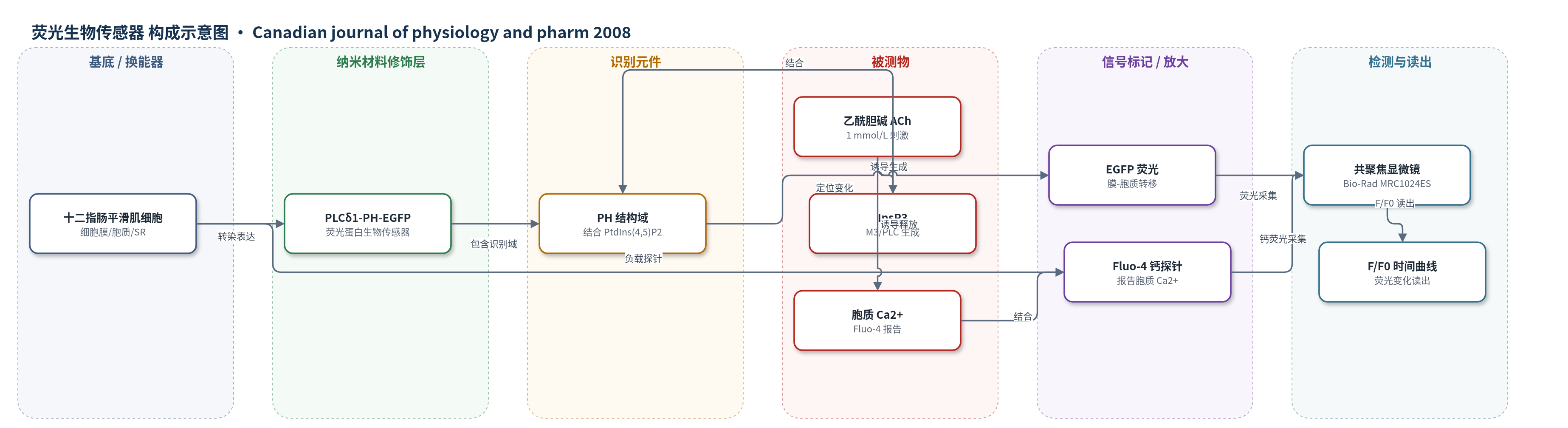
点击图片查看大图 · 依据论文自动绘制
传感器类型
荧光生物传感器
检测对象
肌醇 1,4,5-三磷酸(InsP3)/磷脂酰肌醇 4,5-二磷酸(PtdIns(4,5)P2)动态、细胞内钙离子(Ca2+);样品基质:大鼠十二指肠平滑肌细胞。
检测原理
乙酰胆碱(ACh)结合 M3 毒蕈碱受体后激活磷脂酶 C(PLC),水解膜磷脂酰肌醇 4,5-二磷酸(PtdIns(4,5)P2)生成 InsP3。PLCδ1-PH-EGFP 的 PH 结构域静息时结合膜 PtdIns(4,5)P2,ACh 刺激后 PtdIns(4,5)P2 减少且 InsP3 在胞质积累,使融合蛋白由膜向胞质转移,EGFP 膜/胞质荧光比值发生瞬态变化。同时,InsP3 结合肌浆网 InsP3R1 引起 Ca2+ 释放,Fluo-4 荧光增强报告胞质 Ca2+ 升高。M2 通路经 cADPR/RYR2 产生钙振荡。信号强度随 ACh 激活程度、InsP3 生成量和 SR Ca2+ 释放量变化。
检测灵敏度
原文未报告 LOD、线性范围、灵敏度斜率或 R^2。
效应效果
药理学与反义寡核苷酸结果显示选择性:8Br-cADPR 完全消除 ACh 诱导的钙振荡,但保留瞬态钙峰;heparin 进一步抑制该瞬态,提示其依赖 InsP3R1。asInsP3R1 降低首个钙峰幅度,但不改变振荡频率,并使振荡细胞比例从 60% 增至 88%。4DAMP 将首个瞬态从 5.0±0.4 降至 3.4±0.5 ratio units,不影响振荡频率;methoctramine 抑制振荡但不改变瞬态。InsP3 生物传感器经 3F-InsP3 验证,膜荧光下降 ΔF/F0=-0.23±0.02,胞质上升 0.21±0.03。作者主张该体系揭示 ACh 同时激活 M2/cADPR/RYR2 振荡与 M3/InsP3R1 瞬态,两条通路共同调节 PtdIns(4,5)P2 与 InsP3。
传感器的构成
- 细胞基底:大鼠十二指肠平滑肌细胞(duodenum myocytes),提供细胞膜、胞质与肌浆网(SR)环境。
- 荧光钙指示剂:Fluo-4 AM(2 mmol/L 负载),进入细胞后报告胞质 Ca2+ 浓度变化。
- InsP3 生物传感器:PLCδ1-PH-EGFP 融合蛋白(PLCd1-PH-EGFP),PH 结构域结合 PtdIns(4,5)P2/InsP3,EGFP 报告膜-胞质分布。
- 识别元件:PLCδ1 PH 结构域(PLCδ1-PH),识别磷脂酰肌醇 4,5-二磷酸(PtdIns(4,5)P2)及 InsP3 相关信号。
- 信号标记物:增强型绿色荧光蛋白(EGFP),以荧光强度与亚细胞定位变化作为读出信号。
- 读出装置:Bio-Rad MRC1024ES 共聚焦显微镜(Carl Zeiss),采集 F/F0 时间序列。
中文摘要
在平滑肌细胞中,激动剂激活的肌浆网(SR)钙释放通过不同但相互重叠的转导通路发生。为全面研究 SR 钙通道如何被激活,需要分离同时激活的不同钙信号。此前作者在大鼠十二指肠肌细胞中表征,乙酰胆碱(ACh)通过结合 M2 毒蕈碱受体并激活兰尼碱受体亚型 2 诱导钙振荡。本文显示,ACh 同时引起依赖肌醇 1,4,5-三磷酸(InsP3)受体亚型 1 激活的钙信号。药理学方法、针对 InsP3R1 的反义寡核苷酸以及表达由绿色荧光蛋白与磷脂酶 C 的 pleckstrin 同源结构域偶联的特异性生物传感器,提示 InsP3R1 依赖性钙信号是瞬态的,并由 M3 毒蕈碱受体介导的 InsP3 瞬态合成引起。此外,作者认为 M2 和 M3 信号通路均调节磷脂酰肌醇 4,5-二磷酸和 InsP3 浓度,从而描述 ACh 在十二指肠肌细胞中激活的密切相互作用通路。
英文摘要
In smooth muscle myocytes, agonist-activated release of calcium ions (Ca2+) stored in the sarcoplasmic reticulum (SR) occurs via different but overlapping transduction pathways. Hence, to fully study how SR Ca2+ channels are activated, the simultaneous activation of different Ca2+ signals should be separated. In rat duodenum myocytes, we have previously characterized that acetylcholine (ACh) induces Ca2+ oscillations by binding to its M2 muscarinic receptor and activating the ryanodine receptor subtype 2. Here, we show that ACh simultaneously evokes a Ca2+ signal dependent on activation of inositol 1,4,5-trisphosphate (InsP3) receptor subtype 1. A pharmacologic approach, the use of antisense oligonucleotides directed against InsP3R1, and the expression of a specific biosensor derived from green-fluorescent protein coupled to the pleckstrin homology domain of phospholipase C, suggested that the InsP3R1-dependent Ca2+ signal is transient and due to a transient synthesis of InsP3 via M3 muscarinic receptor. Moreover, we suggest that both M2 and M3 signalling pathways are modulating phosphatidylinositol 4,5-bisphosphate and InsP3 concentration, thus describing closely interacting pathways activated by ACh in duodenum myocytes.