组成图示
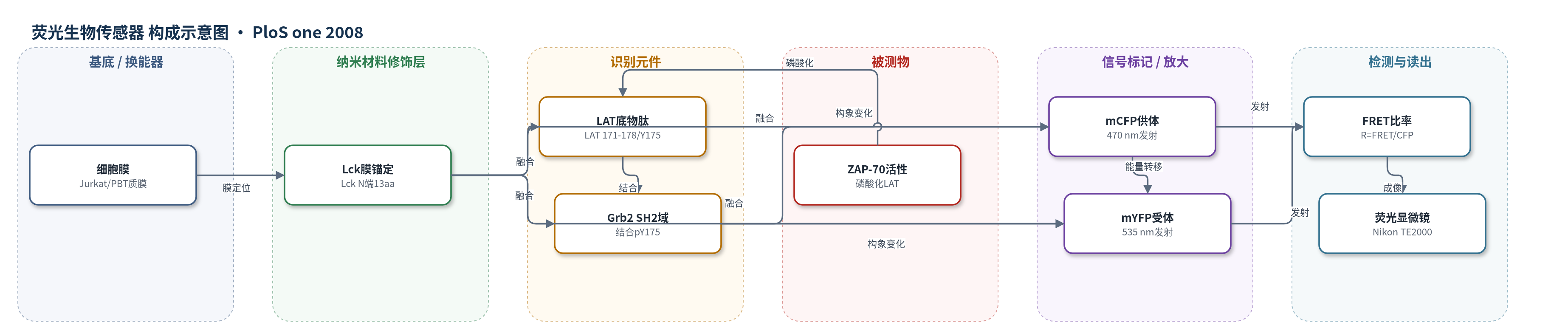
点击图片查看大图 · 依据论文自动绘制
传感器类型
荧光生物传感器
检测对象
ZAP-70 激酶活性(ZAP-70 kinase activity,以 LAT Y175 磷酸化为读出);样品基质:Jurkat T 细胞、人外周血 T 细胞(PBT)、T 细胞与 Raji B 细胞共培养体系
检测原理
ROZA是一种基因编码的比率型FRET探针,由mCFP、Lck膜锚定、Grb2 SH2结构域、LAT 171-178底物肽和mYFP组成。未受刺激时,CFP与YFP的相对距离或取向允许FRET,535/470 nm比率较高。TCR或磷酸酶抑制剂PV激活ZAP-70后,ZAP-70磷酸化探针内LAT Y175;Grb2 SH2随即与磷酸化肽段发生分子内结合,使探针构象受限,CFP-YFP距离/取向改变,FRET降低。因此FRET比率R=FRET/CFP下降,作者以1/R表示ZAP-70活性升高。该机制将激酶磷酸化事件直接转换为荧光比率变化,并通过膜定位提高局部信噪比,可在活细胞中实时成像免疫突触与反突触的ZAP-70活性。
检测灵敏度
原文未报告 LOD、线性范围、灵敏度斜率或相关系数。
效应效果
ROZA在Jurkat T细胞和人外周血T细胞(PBT)中均能响应刺激:PV或anti-CD3诱导FRET下降,Western blot显示刺激2 min后ZAP-70 p319和LAT p175磷酸化可检测。特异性方面,PP2和piceatannol抑制ROZA磷酸化,Y175F突变显著降低磷酸化,ZAP-70缺陷Jurkat P116细胞无FRET变化,说明信号依赖ZAP-70。anti-CD3在Jurkat中部分激活ZAP-70,PV可进一步完成激活;人PBT中anti-CD3引起快速大幅FRET下降。T细胞与超抗原负载Raji B细胞共培养时,ROZA在免疫突触聚集,FRET在接触后约1 min内达到最大,并在对侧反突触出现双极分布,1/R约1.25–1.7。作者认为该探针可实时、亚细胞分辨率研究TCR信号时空调控。
传感器的构成
- 荧光供体:mCFP(monomeric cyan fluorescent protein),位于ROZA N端,435 nm激发后发射约470 nm,作为FRET供体。
- 膜定位锚定:小鼠Lck N端13个残基,将ROZA靶向T细胞质膜/脂筏,提高局部ZAP-70接触概率。
- 识别底物元件:小鼠LAT残基171-178(含Y175),作为ZAP-70磷酸化底物,响应激酶活性。
- 磷酸酪氨酸结合元件:小鼠Grb2 SH2结构域(residues 56-152),结合磷酸化LAT Y175,诱导探针构象变化。
- 荧光受体:mYFP(monomeric yellow fluorescent protein),位于ROZA C端,发射约535 nm,作为FRET受体。
- 表达平台:pCDNA3.1质粒转染Jurkat T细胞或人外周血T细胞(PBT),提供活细胞表达与成像基质。
- 信号读出:荧光显微镜FRET比率(435 nm激发,470/535 nm发射),以R=FRET/CFP或1/R表示ZAP-70活性。
中文摘要
为阐明T细胞受体(TCR)识别抗原过程中信号转导的时空调控,本文报道了一种新型ZAP-70依赖性FRET生物传感器ROZA。ZAP-70是TCR介导信号中的关键蛋白酪氨酸激酶,受体结合后被招募并磷酸化接头蛋白LAT,进而募集PLCγ1、Grb2/SOS、GADS和SLP-76等信号复合物。ROZA由小鼠Grb2 SH2结构域、LAT磷酸化底物肽段以及CFP-YFP荧光供受体对组成,并通过Lck N端序列靶向质膜。当ZAP-70磷酸化探针中的LAT序列时,Grb2 SH2与磷酸化肽段发生分子内结合,改变CFP与YFP的相对距离或取向,使FRET比率下降。该探针可在活T细胞中实时、亚细胞分辨率地监测ZAP-70活性动力学及其定位。研究不仅观察到免疫突触处的ZAP-70依赖性FRET变化,还意外发现细胞对侧“反突触”也出现活性信号,提示T细胞激活可能存在双极信号体形成。
英文摘要
Many hypotheses attempting to explain the speed and sensitivity with which a T-cell discriminates the antigens it encounters include a notion of relative spatial and temporal control of particular biochemical steps involved in the process. An essential step in T-cell receptor (TCR) mediated signalling is the activation of the protein tyrosine kinase ZAP-70. ZAP-70 is recruited to the TCR upon receptor engagement and, once activated, is responsible for the phosphorylation of the protein adaptor, Linker for Activation of T-cells, or LAT. LAT phosphorylation results in the recruitment of a signalosome including PLCgamma1, Grb2/SOS, GADS and SLP-76. In order to examine the real time spatial and temporal evolution of ZAP-70 activity following TCR engagement in the immune synapse, we have developed ROZA, a novel FRET-based biosensor whose function is dependent upon ZAP-70 activity. This new probe not only provides a measurement of the kinetics of ZAP-70 activity, but also reveals the subcellular localization of the activity as well. Unexpectedly, ZAP-70 dependent FRET was observed not only at the T-cell -APC interface, but also at the opposite pole of the cell or "antisynapse".