组成图示
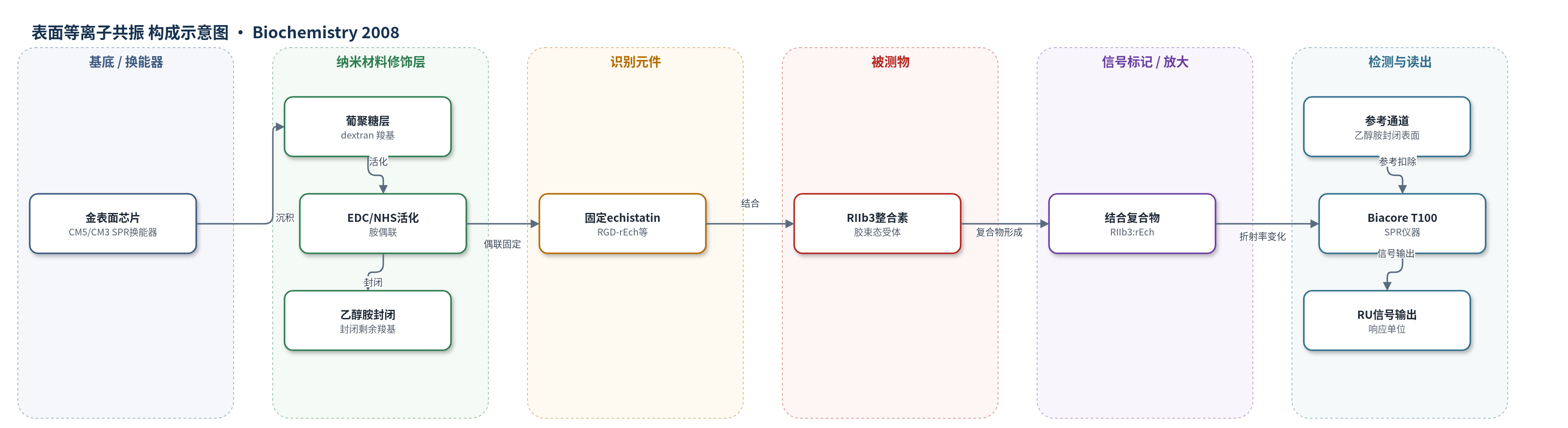
点击图片查看大图 · 依据论文自动绘制
传感器类型
表面等离子共振(SPR)生物传感器
检测对象
整合素αIIbβ3(RIIb3/GPIIb/IIIa);样品基质:HSCM-OG缓冲液中的胶束态纯化血小板来源整合素
检测原理
重组echistatin通过EDC/NHS胺偶联固定于CM5/CM3芯片的羧甲基葡聚糖层,样品通道形成识别配体,参考通道仅封闭。胶束态RIIb3在HSCM-OG缓冲液中流经表面,其RGD结合位点与固定echistatin的RGD环及MIDAS二价阳离子形成静电/离子对相互作用。结合事件增加金表面附近质量与折射率,使SPR共振角偏移,Biacore T100以响应单位(RU)实时读出;参考通道扣除非特异结合和溶剂折射率变化。随RIIb3浓度增加,结合RU上升,经1:1可逆模型拟合得到ka、kd和Kd;温度变化进一步给出平衡与过渡态热力学参数。
检测灵敏度
未报告LOD、线性范围、灵敏度斜率或相关系数。
效应效果
该SPR方法表现出良好选择性与稳定性:RIIb3仅与RGD-rEch和RGDF-rEch结合,RGA/AGD突变体几乎无结合;100 μM tirofban可显著抑制中浓度RIIb3结合,提示特异性。CM3芯片固定RGDF-rEch经36个结合-解离-再生循环后信号仍保持约80%,动力学参数相似。25°C下RGD-rEch的Kd为2.56×10^-7 mol/L;RGDF-rEch与RGD-rEch的Kd分别为240±49 nM和289±45 nM,差异无统计学意义(p>0.08)。拟合信噪比在15–35°C为300:1至100:1,40°C约70:1;有无质量传递项拟合的速率常数相差小于5%。作者认为该结果有助于理解整合素配体识别和心血管药物设计。
传感器的构成
- 基底/换能器:CM5/CM3 金表面生物传感器芯片(Biacore),提供 SPR 倏逝场换能界面
- 功能化层:芯片表面羧甲基葡聚糖(dextran)层,提供羧基用于 EDC/NHS 胺偶联
- 偶联层:EDC/NHS 活化羧基,形成可胺偶联的 NHS 酯
- 识别配体层:重组 echistatin 变体(RGD-rEch、RGDF-rEch、RGA-rEch、AGD-rEch)固定于样品通道,捕获 RIIb3
- 封闭层:乙醇胺封闭剩余活化羧基,降低非特异结合
- 参考通道:仅活化并用乙醇胺封闭,用于扣除非特异结合与折射率变化
- 流动相:HSCM-OG 缓冲液(NaCl、HEPES、辛基-β-D-葡萄糖苷、CaCl2/MgCl2),维持胶束态 RIIb3
中文摘要
本研究利用表面等离子共振(SPR)光谱,考察整合素αIIbβ3(RIIb3)高效、紧密且选择性结合RGD解整合素echistatin的分子机制。将重组echistatin及其点突变体(RGD-rEch、RGDF-rEch、RGA-rEch、AGD-rEch)固定于生物传感器芯片表面,检测胶束态RIIb3与配体的结合速率、程度和稳定性。结果显示,RIIb3可与野生型RGD-rEch及RGDF-rEch紧密结合,但不与RGA-rEch或AGD-rEch结合,表明RGD环上的正负电荷基团均参与整合素识别。对RGD-rEch的Kd温度依赖性进行van't Hoff分析,得到不利焓变ΔH°=14±3 kcal/mol,被有利熵项TΔS°=23±3 kcal/mol抵消;Eyring分析表明结合形成受约9±2 kcal/mol活化焓垒限制,活化熵贡献较小。因此,平衡热力学数据说明熵是稳定整合素-echistatin复合物的主要因素,而过渡态参数表明复合物形成速率受焓限制。当静电接触是受体-配体稳定性的主要来源时,有利的离子对去溶剂化熵常驱动分子识别。
英文摘要
This investigation examined the molecular mechanisms that enable the alphaIIbbeta3 integrin to bind efficiently, tightly, and selectively to echistatin, an RGD disintegrin. We used surface plasmon resonance spectroscopy to measure the rate, extent, and stability of complexes formed between micellar alphaIIbbeta3 and recombinant echistatin (rEch) mutants, immobilized on the surface of a biosensor chip. alphaIIbbeta3 bound readily and tightly to wild-type RGD-rEch and RGDF-rEch but not to RGA-rEch or AGD-rEch, demonstrating that both of those charged moieties contribute to integrin recognition. van't Hoff analysis of the temperature dependence of the RGD-rEch K d data yielded an unfavorable enthalpy change, Delta H degrees = 14 +/- 3 kcal/mol, offset by a favorable entropy term, TDelta S degrees = 23 +/- 3 kcal/mol. Eyring analysis of the temperature dependence of the kinetic parameters yielded Delta H a degrees (++) = 9 +/- 2 kcal/mol and TDelta S a degrees (++) = -4 +/- 2 kcal/mol, indicating that a substantial activation enthalpy barrier and a smaller activation entropy hinder assembly of the encounter complex. Thus, equilibrium thermodynamic data demonstrate that entropy is the dominant factor stabilizing integrin:echistatin binding, while transition-state thermodynamic parameters indicate that the rate of complex formation is enthalpy-limited. When electrostatic contacts are the major source of receptor:ligand stability, theory and experiment indicate that entropy-favorable ion-pair desolvation often provides the driving force for molecular recognition.