组成图示
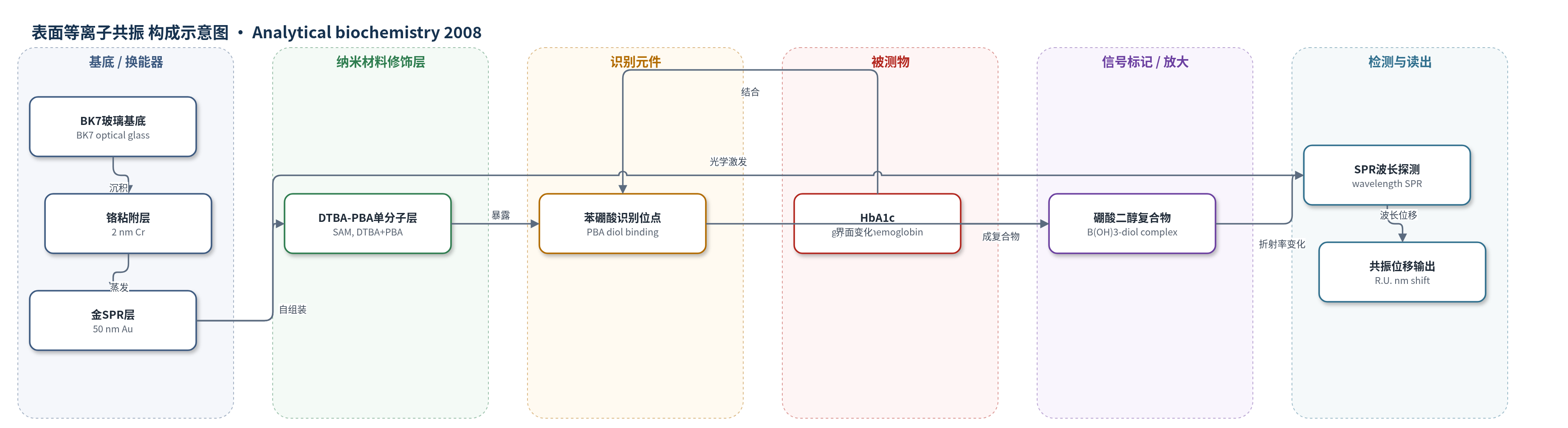
点击图片查看大图 · 依据论文自动绘制
传感器类型
表面等离子共振(SPR)生物传感器
检测对象
糖化血红蛋白(HbA1c);样品基质:HbA1c校准品/缓冲液稀释样品,文中提及稀释血液样品
检测原理
传感器以金膜上的DTBA-PBA自组装单分子层为识别界面。碱性pH 9条件下,苯硼酸(PBA)由B(OH)2形式转变为B(OH)3阴离子/立体构型,与HbA1c糖基化位点的1,2-或1,3-二醇形成可逆硼酸酯复合物。HbA1c结合后使金表面界面质量与折射率增加,改变表面等离子共振条件,导致SPR共振波长/角度发生位移。HbA1c浓度越高,结合量越大,共振位移越大,从而在0.43–3.49 μg/ml范围内线性响应。Lewis碱可改变苯硼酸构型并增强结合;高盐浓度会屏蔽静电作用并增强疏水非特异吸附,因此低盐pH 9缓冲液为最佳检测条件。该方法无需标记,直接通过SPR信号读出。
检测灵敏度
LOD: 0.01 μg/ml(原文作0.01 lg/ml);线性范围: 0.43–3.49 μg/ml(原文作0.43–3.49 lg/ml);斜率: 2.49 nm/(μg/ml);R = 0.992(P < 0.0001)
效应效果
选择性方面,10 μg/ml BSA非特异响应相当于1.7 μg/ml HbA1c,SPR传感图可区分,表明DTBA-PBA单分子层对糖化蛋白特异。pH 9/50 mM PB最佳,最大SPR位移约10 nm;pH 9加300 mM NaCl最大约7 nm,HbA1c高于22 nM出现双层/多层吸附;pH 5/50 mM PB高于50 nM也出现多层吸附。动力学拟合:pH 9时ka=1.99×10^5 M^-1 s^-1、kd=1.23×10^-4 s^-1、Ka=1.6×10^9 M^-1、Rmax=12.8 nm;pH 5/NaCl时kd=0.324×10^-4 s^-1。与传统方法相比,样品浓度降低约1000倍,减少血样用量和基质干扰,提高信噪比,作者认为具临床诊断潜力。未报告RSD和实际样品回收率。
传感器的构成
- 基底:BK7光学玻璃,作为SPR传感器芯片载体
- 粘附层:2 nm铬(Cr),增强金层与玻璃附着
- 换能层:50 nm金(Au),热蒸发形成SPR活性层
- 修饰层:DTBA-PBA自组装单分子层(SAM),由4,4'-二硫代丁酸(DTBA)与3-氨基苯硼酸半硫酸盐(PBA)经EDC偶联合成
- 识别元件:苯硼酸基团(PBA),与HbA1c糖基化位点二醇形成可逆硼酸酯复合物
- 读出:自研波长探测SPR生物传感器,四通道Teflon流池,监测共振波长位移
中文摘要
糖化血红蛋白(HbA1c)由葡萄糖与成人血红蛋白β链N端缬氨酸发生非酶促糖基化反应形成,其含量可反映过去2至3个月的平均血糖水平,是糖尿病长期血糖控制的重要临床指标。苯硼酸衍生物因能与二醇结构特异性结合,常被用于HbA1c检测,但其识别性能受苯硼酸衍生物与二醇比例、溶液pH及苯硼酸立体结构等因素影响。本研究采用表面等离子共振(SPR)技术,直接无标记评估上述因素对苯硼酸单分子层与HbA1c识别相互作用的影响。结果表明,pH是影响HbA1c与苯硼酸形成稳定复合物的关键因素;碱性条件下苯硼酸可转变为B(OH)3构型,更易与糖基化位点结合。在0.43–3.49 μg/ml范围内,HbA1c浓度与SPR信号呈线性关系,检测限为0.01 μg/ml。研究证明SPR生物传感器可敏感、准确地用于HbA1c定量检测,具有临床应用潜力。
英文摘要
Glycated hemoglobin (HbA1c) is formed by a nonenzymatic reaction of glucose with the N-terminal valine of adult hemoglobin's beta-chain. The amount of HbA1c reflects the average concentration of glucose variation level over the preceding 2 to 3 months. Because the boronate has antibody mimicking for HbA1c, often it is used to detect HbA1c. However, factors such as the ratio of the phenylboronic acid derivatives and diol composition, the pH of the solution, and the stereostructure of phenylboronic acid derivatives could influence the interactions between phenylboronic acid derivatives and diol composition. In this study, the factors were evaluated using surface plasmon resonance (SPR). The results show that pH value is an important factor affecting HbA1c and phenylboronic acid to form the complex and Lewis bases. This could change the stereostructure of phenylboronic acid to form B(OH)(3) for binding with saccharine easily. In addition, linear response appeared in HbA1c in the range of 0.43 to 3.49 mug/ml, and the detection limit was 0.01 microg/ml. The results also demonstrated that an SPR biosensor can be used as a sensitive technique for improving the accuracy and correctness of HbA1c measurement.