组成图示
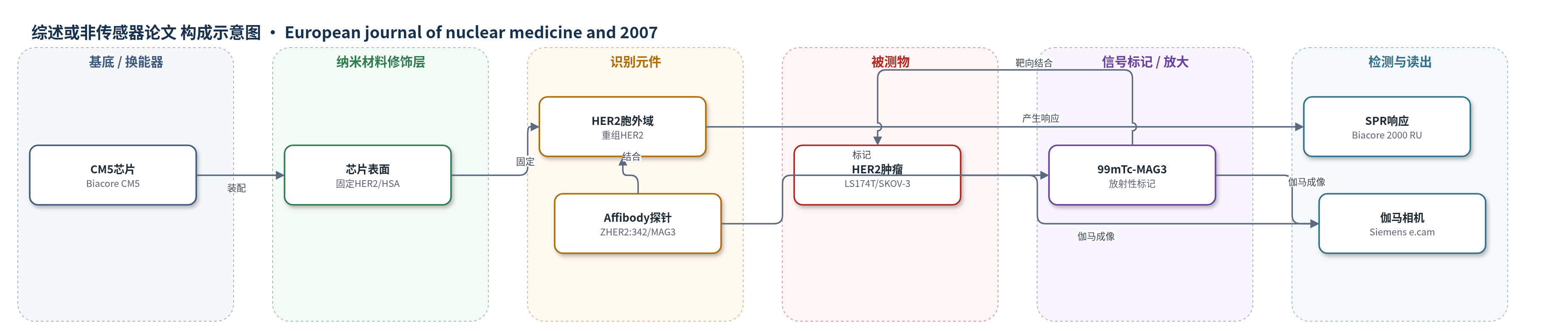
点击图片查看大图 · 依据论文自动绘制
传感器类型
综述或非传感器论文
检测对象
HER2(人表皮生长因子受体2,HER2/ErbB2);样品基质:HER2阳性SKOV-3细胞、LS174T/SKOV-3异种移植瘤、小鼠组织/血液、小鼠血清。
检测原理
本文并非传统生物传感器,而是放射性分子影像探针。合成Affibody分子ZHER2:342通过三螺旋结构域特异性识别HER2胞外域;MAG3序列在N端位点特异性螯合99mTc,形成99mTc-MAG3-ZHER2:342。探针与肿瘤细胞表面HER2结合后,放射性核素99mTc衰变发射γ光子,被伽马相机探测;HER2表达越高,结合探针越多,肿瘤局部γ计数越高,从而形成肿瘤-背景对比。SPR表征中,HER2或HSA固定于CM5芯片,Affibody流过时结合引起界面折射率变化,Biacore 2000以响应单位RU读出结合动力学。该体系无酶催化或核酸放大,信号放大主要依赖放射性标记与高亲和力识别。
检测灵敏度
原文未报告 LOD、线性范围、灵敏度斜率或相关系数。
效应效果
MAG3-ZHER2:342纯度>90%,SPR Kd 200 pM。99mTc标记效率82±12%,胶体<2%,纯化后放射性纯度>98%;300倍半胱氨酸1 h后87.5±1.8%仍结合,血清1 h后>90%完整。SKOV-3细胞结合可被未标记ZHER2:342阻断,从50.4±0.2%降至1.5±0.02%,ABC 86±1%;24 h细胞滞留55%,高于125I-PIB约40%。LS174T瘤2–6 h摄取约7%IA/g,阻断组4 h由6.12±2.02降至0.28±0.05%IA/g(p=0.001),瘤/血比2、4、6 h为12.5、23.8、39.3。与125I-PIB相比肿瘤摄取相近;6 h显影清晰,24 h肿瘤/肾显影。作者认为可用于HER2肿瘤显像及治疗选择。
传感器的构成
- 非传感器基底:Biacore 2000 SPR 仪器与 CM5 传感器芯片,仅用于结合表征
- 非传感器固定层:CM5 芯片表面,固定重组 HER2 胞外域或 HSA
- 非传感器识别元件:重组 HER2 胞外域(HER2)或 HSA,用于捕获 Affibody 分子
- 非传感器分析物:ZHER2:342 或 MAG3-ZHER2:342 Affibody 分子,作为结合探针
- 非传感器信号标记:99mTc-MAG3-ZHER2:342 放射性标记物,用于伽马相机成像
- 非传感器读出:SPR 响应单位(RU)或伽马相机 γ 计数,反映结合量或放射性分布
中文摘要
人表皮生长因子受体2(HER2)在恶性肿瘤中的表达具有明确的预后和预测价值,非侵入性显像可为患者管理提供重要诊断信息。本研究旨在开发一种利用含锝-99m螯合序列巯基乙酰-甘氨酰-甘氨酰-甘氨酰(MAG3)标记抗HER2 Affibody分子ZHER2:342的方法,并评价其靶向性能。作者采用Fmoc/tBu固相肽合成组装MAG3-ZHER2:342,通过反相高效液相色谱、电喷雾质谱、生物传感器分析和圆二色光谱进行生化表征,并建立含钠/钾酒石酸的99mTc标记流程。结果显示,合成MAG3-ZHER2:342对HER2受体的亲和力为0.2 nM,99mTc标记效率约75–80%;标记物在体外仍特异性结合HER2阳性SKOV-3细胞。在携带LS174T异种移植瘤的小鼠中,99mTc-MAG3-ZHER2:342表现出与放射性碘类似物相近的特异性肿瘤靶向和对比度,伽马相机显像可清晰、特异性地显示HER2表达。结论表明,在化学合成中引入含巯基乙酰的螯合序列可实现ZHER2:342的位点特异性99mTc标记,并保持靶向能力。
英文摘要
PURPOSE: Expression of human epidermal growth factor receptor type 2 (HER2) in malignant tumours possesses well-documented prognostic and predictive value. Non-invasive imaging of expression can provide valuable diagnostic information, thereby influencing patient management. Previously, we reported a phage display selection of a small (about 7 kDa) protein, the Affibody molecule Z(HER2:342), which binds HER2 with subnanomolar affinity, and demonstrated the feasibility of targeting of HER2-expressing xenografts using radioiodinated Z(HER2:342). The goal of this study was to develop a method for (99m)Tc labelling of Z(HER2:342) using the MAG3 chelator, which was incorporated into Z(HER2:342) using peptide synthesis, and evaluate the targeting properties of the labelled conjugate.
METHODS: MAG3-Z(HER2:342) was assembled using Fmoc/tBu solid phase peptide synthesis. Biochemical characterisation of the agent was performed using RP-HPLC, ESI-MS, biosensor studies and circular dichroism. A procedure for (99m)Tc labelling in the presence of sodium/potassium tartrate was established. Tumour targeting was evaluated by biodistribution study and gamma camera imaging in xenograft-bearing mice. Biodistribution of (99m)Tc-MAG3-Z(HER2:342) and (125)I-para-iodobenzoate -Z(HER2:342) was compared 6 h p.i.
RESULTS: Synthetic MAG3-Z(HER2:342) possessed an affinity of 0.2 nM for HER2 receptors. The peptide was labelled with (99m)Tc with an efficiency of about 75-80%. Labelled (99m)Tc-MAG3-Z(HER2:342) retained capacity to bind specifically HER2-expressing SKOV-3 cells in vitro. (99m)Tc-MAG3-Z(HER2:342) showed specific tumour targeting with a contrast similar to a radioiodinated analogue in mice bearing LS174T xenografts. Gamma camera imaging demonstrated clear and specific visualisation of HER2 expression.
CONCLUSION: Incorporation of a mercaptoacetyl-containing chelating sequence during chemical synthesis enabled site-specific (99m)Tc labelling of the Z(HER2:342) Affibody molecule with preserved targeting capacity.