组成图示
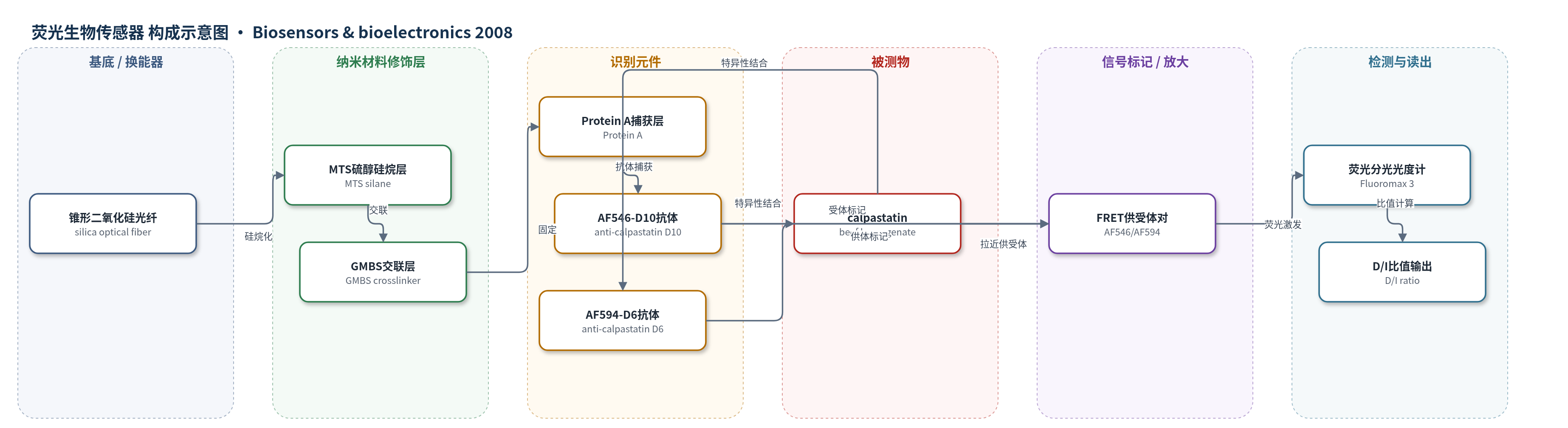
点击图片查看大图 · 依据论文自动绘制
传感器类型
荧光生物传感器
检测对象
calpastatin(钙蛋白酶抑制蛋白);样品基质:牛肉背最长肌匀浆/肉提取物(柱前与DEAE-Sephacel柱后洗脱液)
检测原理
该传感器采用非竞争性双结合FRET机制。锥形二氧化硅光纤表面经MTS和GMBS修饰后固定Protein A,再捕获AF546标记的抗calpastatin抗体D10。样品中的calpastatin先与D10结合,随后AF594标记的抗calpastatin抗体D6结合到calpastatin上,使AF546供体与AF594受体在空间上靠近。当供体与受体距离满足FRET条件时,546 nm激发下供体发射能量部分转移至受体,导致供体峰/等吸收点(D/I)比值发生可测量变化。calpastatin浓度越高,双结合事件越多,D/I变化百分比越大。该法以比率测量降低背景干扰,无需酶催化放大。
检测灵敏度
LOD: 120 ng/mL(前文溶液法,Grant et al. 2005);本光纤传感器未报告LOD、线性范围、灵敏度斜率或R^2。
效应效果
在21头牛肉胴体的背最长肌匀浆中,传感器对calpastatin具有选择性:与BSA相比,calpastatin使D/A比值下降10.05%(S.D. 0.05),BSA仅下降0.55%(S.D. 0.019)。与传统calpastatin活性测定相比,48 h柱前传感器读数相关性最高(r=0.597,P≤0.01),48 h柱后为r=0.501(P=0.03),36 h柱前与48 h传统法相关系数达r=0.656。与14 d Warner–Bratzler剪切力无显著相关,WBSF均值33.12,范围21.07–54.10。未报告RSD与长期稳定性。作者认为48 h是用于在线嫩度分级的最佳取样时间,传感器适合实验室判断生物活性calpastatin浓度。
传感器的构成
- 基底/换能器:锥形二氧化硅光纤(silica optical fiber,600 μm core diameter),作为荧光捕获与导光换能器
- 硅烷化修饰层:3-mercaptopropyltrimethoxysilane(MTS),通过硅氧键结合到光纤表面羟基,提供硫醇端基
- 交联层:N-gamma-maleimidobutyryloxy-succinimide ester(GMBS),双官能交联剂,连接MTS与Protein A
- 抗体捕获层:Protein A,特异性结合抗体Fc区,使抗体表位保持可用
- 识别元件:AF546标记小鼠抗calpastatin抗体D10(donor-labeled antibody),结合calpastatin
- 识别元件:AF594标记小鼠抗calpastatin抗体D6(acceptor-labeled secondary antibody),与calpastatin形成双结合
- 信号标记物:Alexa Fluor 546(AF546)供体与Alexa Fluor 594(AF594)受体,通过FRET产生荧光变化
- 封闭剂:nonfat dry milk blocking agent in PBS,减少非特异性吸附
中文摘要
本研究开发并评估了一种用于检测钙蛋白酶抑制蛋白(calpastatin)的光纤生物传感器,作为牛肉嫩度在线检测仪器开发的初步步骤。从21头牛肉胴体中于屠宰后0、24、36和48 h采集背最长肌样品,制备肌肉匀浆,并分别用传统calpastatin活性测定法和光纤生物传感器进行检测;同时于屠宰后14 d对每头胴体牛排进行Warner–Bratzler剪切力测定。结果表明,传统calpastatin测定与光纤传感器读数相关性最高的时间点为屠宰后48 h(r=0.597,P≤0.01),提示该时间最适合作为在线分级系统中使用此传感器的取样时间。该工作推进了calpastatin生物传感器的发展,可用于实验室判断生物活性calpastatin浓度。
英文摘要
An optical fiber biosensor to detect calpastatin has been investigated as a preliminary step in developing tenderness detection instrumentation. Longissimus dorsi samples were taken from beef carcasses (n=21) at 0, 24, 36 and 48h postmortem. Muscle homogenates were assayed for calpastatin activity using traditional methods and an optical fiber biosensor. Warner-Bratzler shear force was also performed on a steak from each carcass at 14d postmortem. Results demonstrated that the measurements with highest correlation between traditional calpastatin assays and optical biosensor readings were taken at 48h postmortem (r=0.597, P< or =0.01), suggesting that this is the best time for use of this biosensor in an on-line grading system. This research further advances the development of a calpastatin biosensor and would be useful in laboratory determination of the presence of biologically active calpastatin concentrations.