组成图示
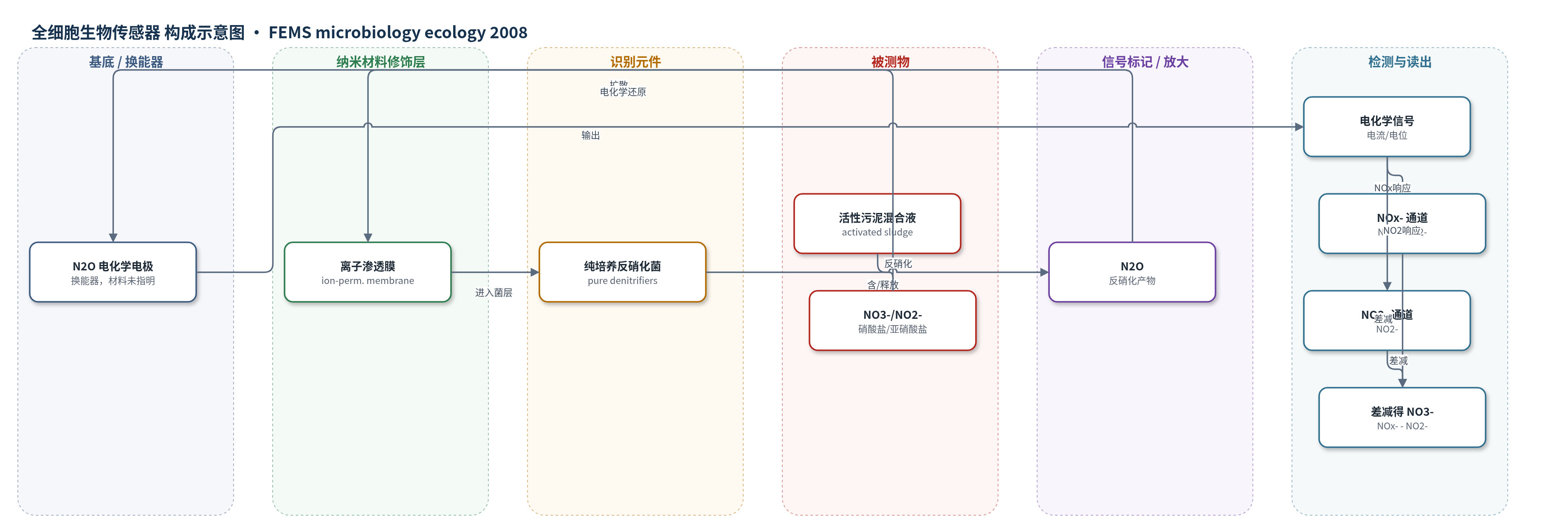
点击图片查看大图 · 依据论文自动绘制
传感器类型
全细胞生物传感器
检测对象
硝酸盐(nitrate, NO3-)、亚硝酸盐(nitrite, NO2-);样品基质:活性污泥混合液(activated sludge mixed liquor)
检测原理
硝酸盐/亚硝酸盐(NO3-/NO2-)从活性污泥中扩散穿过离子渗透膜,进入纯培养反硝化菌层。在厌氧条件下,反硝化菌将 NO3- 依次还原为 NO2- 并进一步转化为 N2O;N2O 扩散至 N2O 电化学电极并被电化学还原,产生与 N2O 生成速率相关的电流/电位信号。NO2- 传感器仅响应亚硝酸盐,NOx- 传感器同时响应硝酸盐和亚硝酸盐,因此硝酸盐浓度由 NOx- 信号减去 NO2- 信号得到。被测物浓度越高,单位时间进入菌层的 NO3-/NO2- 越多,N2O 生成与电化学信号越强;在低浓度(<0.8 mM NOx--N)下信号随浓度线性下降,可用于原位测定消耗速率。
检测灵敏度
LOD: 0–2.9 mg N-NOx- L-1 at 10°C;0–14 mg N-NOx- L-1 at 20°C
效应效果
NO2- 传感器仅响应亚硝酸盐,NOx- 传感器同时响应两者,差减提高硝酸盐选择性;亚硝酸盐<7 mg NO2--N L-1 以避免毒性。无底物硝酸盐消耗速率1.0±0.2 mg NO3--N gVSS-1 h-1(n=5),后续校正1.3±0.4(NO3-)和1.7±0.5(NO2-)mg N gVSS-1 h-1。乙酸及乙酸+酪蛋白水解物最高3–6 mg N gVSS-1 h-1,天冬氨酸/苯丙氨酸<1。重复批次无显著差异,新鲜与4°C保存1天污泥无差异;酸处理前后复杂底物速率3.9±2.1与2.9±0.9 mg N gVSS-1 h-1,P=0.25。传感器可在<11 mg NOx--N L-1(800 μM)原位测量,较常规20–60 mg NO3--N L-1低3–6倍。
传感器的构成
- 换能器电极:N2O 电化学电极(原文未指明具体材料),将 N2O 电化学还原并产生电信号
- 扩散/隔离层:离子渗透膜(ion-permeable membrane),允许 NO3-/NO2- 扩散进入菌层并阻挡污泥颗粒
- 生物识别/转化层:纯培养反硝化菌(pure culture of denitrifiers),在厌氧条件下将 NO3-/NO2- 转化为 N2O
- 双通道传感单元:NOx- 生物传感器(NOx- biosensor, Unisense A/S),同时响应 NO3- 与 NO2-
- 双通道传感单元:NO2- 生物传感器(NO2- biosensor, Unisense A/S),仅响应 NO2-,用于差减计算 NO3-
中文摘要
本研究在两个脱氮污水处理厂活性污泥中添加不同底物,评估不同系统发育细菌群的反硝化能力。硝酸盐和亚硝酸盐消耗速率(CRs)由硝酸盐/亚硝酸盐生物传感器原位测量计算。速率依赖所加底物,乙酸单独或与其他底物组合时最高,达3–6 mg N gVSS-1 h-1;多数底物下硝酸盐消耗速率与亚硝酸盐相近。采用异养CO2微放射自显影(HetCO2-MAR)与荧光原位杂交(FISH)分析活性反硝化群体结构。探针定义的反硝化菌表现为底物专化利用者,尽管多数优先利用乙酸。Azoarcus和Accumulibacter的丰度差异与两污泥中底物特异性硝酸盐/亚硝酸盐速率差异相关。Aquaspirillum相关菌是最丰富的潜在反硝化菌(约20%生物体积),但Accumulibacter(3–7%)和Azoarcus(2–13%)可能通过利用丙酮酸、乙醇和乙酸主要驱动反硝化。结果表明,活性污泥反硝化由多样且多功能的群体执行,除Betaproteobacteria(Aquaspirillum、Thauera、Accumulibacter、Azoarcus)外,还包括部分Alphaproteobacteria和Gammaproteobacteria。
英文摘要
The denitrification capacity of different phylogenetic bacterial groups was investigated on addition of different substrates in activated sludge from two nutrient-removal plants. Nitrate/nitrite consumption rates (CRs) were calculated from nitrate and nitrite biosensor, in situ measurements. The nitrate/nitrite CRs depended on the substrate added, and acetate alone or combined with other substrates yielded the highest rates (3-6 mg N gVSS(-1) h(-1)). The nitrate CRs were similar to the nitrite CRs for most substrates tested. The structure of the active denitrifying population was investigated using heterotrophic CO2 microautoradiography (HetCO2-MAR) and FISH. Probe-defined denitrifiers appeared as specialized substrate utilizers despite acetate being preferentially used by most of them. Azoarcus and Accumulibacter abundance in the two different sludges was related to differences in their substrate-specific nitrate/nitrite CRs. Aquaspirillum-related bacteria were the most abundant potential denitrifiers (c. 20% of biovolume); however, Accumulibacter (3-7%) and Azoarcus (2-13%) may have primarily driven denitrification by utilizing pyruvate, ethanol, and acetate. Activated sludge denitrification was potentially conducted by a diverse, versatile population including not only Betaproteobacteria (Aquaspirillum, Thauera, Accumulibacter, and Azoarcus) but also some Alphaproteobacteria and Gammaproteobacteria, as indicated by the assimilation of 14CO2 by these probe-defined groups with a complex substrate mixture as an electron donor and nitrite as an electron acceptor in HetCO2-MAR-FISH tests.