组成图示
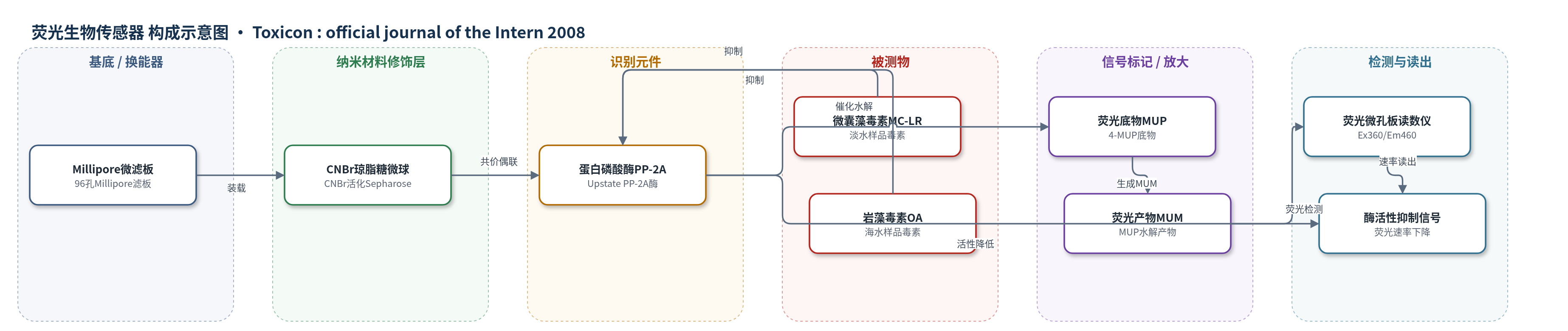
点击图片查看大图 · 依据论文自动绘制
传感器类型
荧光生物传感器
检测对象
微囊藻毒素LR(microcystin LR, MC-LR)、岩藻毒素(okadaic acid, OA);样品基质为淡水(MC-LR)和过滤/紫外灭菌海水(OA)
检测原理
OA和MC-LR是蛋白磷酸酶的强效非竞争性抑制剂,可与PP-2A活性位点结合并改变酶构象,降低其磷酸酶活性。固定化PP-2A在微滤板中催化荧光底物MUP去磷酸化,生成荧光产物MUM。无毒素时,酶活性高,MUM生成速率高;加入毒素后,酶活性被抑制,荧光生成速率随毒素浓度增加而下降。微孔板荧光仪在Ex 360 nm/Em 460 nm下实时监测荧光动力学,通过反应速率、剂量-响应曲线和Hill图计算IC50与LoD。该体系未使用HCR、RCA或CRISPR-Cas等核酸放大,信号放大主要依赖酶催化连续产生荧光产物;固定化载体提高反应基质的可重复使用潜力。
检测灵敏度
LOD: 1 nM (MC-LR, 原文作1 mg l-1,应为1 μg/L); LOD: 3 nM (OA, 原文作3.5 mg l-1,应为3.5 μg/L); IC50: 12.5 nM (OA), 11 nM (MC-LR) for immobilised PP-2A; standard curve range: 0–1000 nM
效应效果
三种固定化酶中PP-2A对OA和MC-LR最敏感,rec PP-1次之,PP-2Ana最弱。洗涤去除>70%抑制后,20次洗涤仅保留<50%原始活性,1 M NaCl不能恢复活性。4 ℃储存3个月活性损失约5%。加标回收率约96%:淡水MC-LR 5.5和11.0 μg/L分别回收5.3±0.1和10.8±0.2 μg/L(96%、98%);海水OA 6.0和12.0 μg/L分别回收6.5±0.1和11.5±0.1 μg/L(108%、96%)。MC-LR检出限达WHO饮用水1 μg/L,OA灵敏度3.5 μg/L可在水华高峰期检测DSP,但不足以检测水华初期。
传感器的构成
- 反应容器:Millipore Multiscreen 96孔微滤板,承载固定化酶微球并允许液体过滤与反应
- 固定化载体:CNBr-activated Sepharose 6 MB微球(200–300 μm),通过CNBr活化基团共价偶联蛋白磷酸酶
- 识别/换能元件:蛋白磷酸酶PP-2A(Upstate Biotechnology,人红细胞来源),被OA/MC-LR特异性抑制并催化底物水解
- 荧光底物:4-methylumbelliferyl phosphate(MUP),被PP-2A水解生成荧光产物MUM
- 金属辅助因子:NiCl2(PP-2A体系)或MnCl2(rec PP-1体系),维持酶催化活性
- 反应缓冲液:50 mM Tris buffer(pH 8)含0.1 mM CaCl2,维持酶反应环境
- 信号读出:BMG Lab Technologies微孔板荧光读数仪,Ex 360 nm/Em 460 nm实时监测荧光速率
中文摘要
本研究评估了固定化蛋白磷酸酶(PP)生物传感器检测微囊藻毒素和岩藻毒素的可行性。将PP固定化于CNBr活化琼脂糖微球,并置于Millipore微滤板孔中,在优化条件下以荧光底物MUP实时监测酶活性。固定化PP-2A被岩藻毒素(OA)和微囊藻毒素LR(MC-LR)抑制,IC50分别为12.5和11 nM;固定化重组PP-1对MC-LR和OA的IC50分别为150和>1000 nM。游离PP-2A对OA和MC-LR的IC50为2.5和3.5 nM,游离重组PP-1为0.7和200 nM;游离与固定化PP-2Ana对OA的IC50为0.45和>1000 nM。三种固定化体系中PP-2A最敏感。洗涤去除>70%抑制后,20次洗涤仅保留<50%原始活性,1 M NaCl不能恢复活性。固定化PP-2A对MC-LR的检出限满足WHO饮用水1 μg/L指南,对OA的灵敏度为3.5 μg/L,可在部分浮游植物水华高峰期检测腹泻性贝毒。
英文摘要
The feasibility of developing an immobilised protein phosphatase (PP) biosensor was tested by immobilising PP onto CNBr-activated Sepharose beads placed in Millipore microfilter plate wells. Under optimised immobilised enzyme assay conditions, okadaic acid (OA) and microcystin LR (MC-LR) inhibited Upstate Biotechnology PP (PP-2A), with IC50 values of 12.5 and 11nM respectively. Similarly, immobilised recombinant PP type 1 (rec PP-1) was inhibited by MC-LR and OA, with IC50 values of 150 and >1000nM respectively. The IC50 values for free PP-2A against OA and MC-LR were 2.5 and 3.5nM, and 0.7nM and 200nM for rec PP-1 against the same substrates respectively. For free and immobilised Neptunea arthritic PP (PP-2Ana) against OA the IC50 values were 0.45 and >1000nM respectively. Of the three immobilised enzyme systems, PP-2A showed greatest sensitivity to OA and MC-LR followed by rec PP-1 and PP-2Ana. In assessments for re-usability (determined by removal of > or =70% OA or MC-LR inhibition of PP-2A by washing), <50% of the original activity remained after 20 washings. Including 1M NaCl in the wash buffer did not increase enzyme activity with wash frequency, but rather "salted in" the inhibitor. The LoD of immobilised PP-2A to MC-LR meets the WHO guideline of 1microgl(-1) for drinking water, and the sensitivity to OA (3.5microgl(-1)) would allow detection of DSP during the peak of some phytoplankton blooms.