组成图示
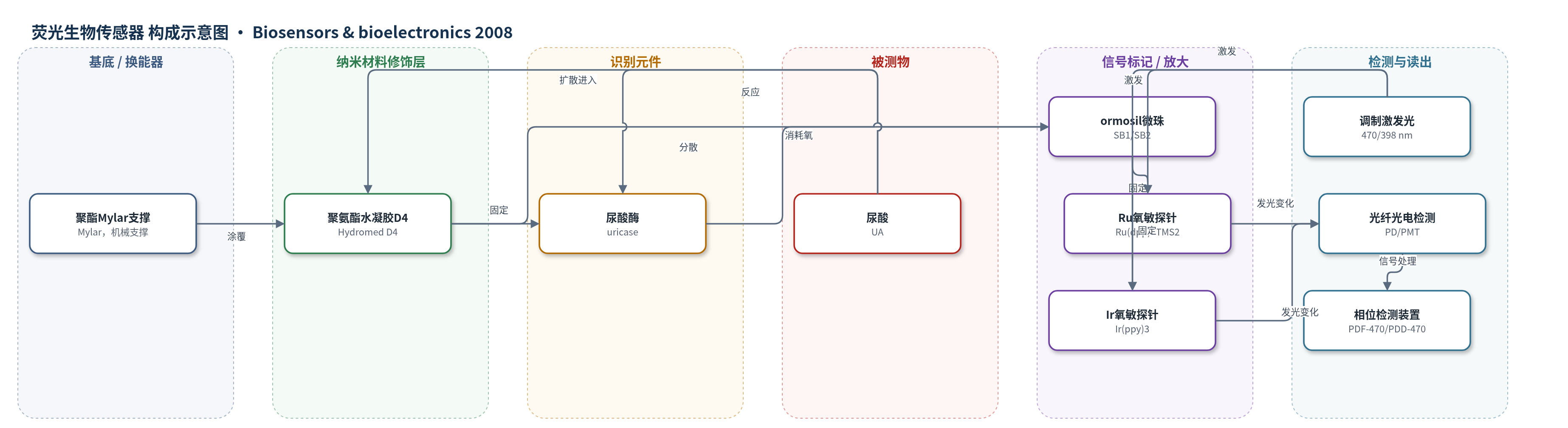
点击图片查看大图 · 依据论文自动绘制
传感器类型
荧光生物传感器
检测对象
尿酸(uric acid, UA);样品基质:人血血清(稀释)、缓冲液标准液,亦可用于血液/血清
检测原理
尿酸从样品扩散进入聚氨酯水凝胶传感膜,被其中固定的尿酸酶催化氧化为尿囊素和过氧化氢,同时消耗溶解氧。氧分压下降使分散在膜中的疏水ormosil微珠内Ru(dpp)3TMS2或Ir(ppy)3探针的发光猝灭减弱,发光强度或寿命增加。用470 nm或398 nm调制光激发,经光纤收集发射光,由光电二极管或光电倍增管检测强度/相移,按Stern–Volmer或双位点猝灭模型将发光变化换算为氧消耗量,从而定量尿酸。洗去样品后氧恢复,信号可逆。
检测灵敏度
LOD: 50 μM(BSM1,S/N=3);20 μM(BSM2,S/N=3);分析范围: 0–2 mM;信号变化至 0.8 mM;t90: 1.2 min(BSM1)、1.3 min(BSM2);基线恢复: 1.9 min;摘要响应时间: 80–100 s;表1另列: 动态范围 5–600 μM(BSM2/Ir(ppy)3)、5–800 μM(BSM1/Ru(dpp)3),LOD 2 μM(BSM2)、5 μM(BSM1)。
效应效果
两种膜对氧选择性响应,不受抗坏血酸、人血清白蛋白和半胱氨酸干扰,选择性优于非酶伏安法;动态范围较宽于部分伏安/荧光法。BSM1和BSM2在4℃ MOPS缓冲液中至少稳定1个月;前2天对1 mM尿酸响应略降,随后3周稳定。10个连续制备膜的校准曲线几乎一致,n=5误差较小。BSM1用于稀释人血清,结果与商品比色/分光光度法一致。t90约1.2 min(BSM1)和1.3 min(BSM2),基线恢复约1.9 min;分析范围约0–2 mM,适合稀释血清/血液临床范围。
传感器的构成
- 支撑基底:聚酯Mylar支撑,提供机械支撑且光学透明
- 传感膜基质:聚氨酯水凝胶Hydromed D4,固定酶与微珠,允许尿酸和氧透过并阻挡大分子
- 识别元件:尿酸酶uricase(EC 1.7.3.3),催化尿酸氧化并消耗氧
- 交联剂:戊二醛glutaraldehyde,交联尿酸酶形成网络防止酶泄漏
- 信号微珠:有机改性溶胶-凝胶ormosil微珠SB1/SB2,疏水固定氧探针并允许氧扩散
- 信号探针:Ru(dpp)3TMS2(SB1)或Ir(ppy)3(BSM2),其发光被氧猝灭
- 读出装置:470/398 nm LED或单色器激发、光纤、光电二极管/光电倍增管及相位检测装置PDF-470/PDD-470,测量发光强度、相移或寿命
中文摘要
本文报道一种用于连续测定尿酸的全可逆光学生物传感器。该方案基于尿酸酶催化尿酸氧化过程中溶解氧的消耗:尿酸酶被固定于聚氨酯水凝胶中,并与氧敏感金属有机探针相邻;探针的发光可被氧猝灭。通过监测两种探针发光强度的变化来跟踪氧消耗,并将其与尿酸浓度相关联。研究考察了分析范围(0–2 mM)、响应时间(80–100 s)、重现性和长期稳定性。传感器在4℃缓冲液中至少稳定1个月,且不受常见干扰物影响。其中一种传感器用于人血血清中尿酸的测定,结果与商品比色检测试剂盒一致。
英文摘要
An optical biosensor is presented for continuous determination of uric acid. The scheme is based on the measurement of the consumption of oxygen during the oxidation of uric acid that is catalyzed by the enzyme uricase. The enzyme is immobilized in a polyurethane hydrogel next to a metal-organic probe whose fluorescence is quenched by oxygen. The consumption of oxygen was followed by measurement of changes of luminescence intensity of two kind of probes and can be related to the concentration of uric acid. Analytical ranges (0-2mM), the response times (80-100s), reproducibility, and long-term stability were investigated. The biosensors are stable for at least 1 month and are not interfered by common interferents. One kind of biosensor was applied to the determination of uric acid in human blood serum. The results agree with those of a commercial colorimetric detection kit.