组成图示
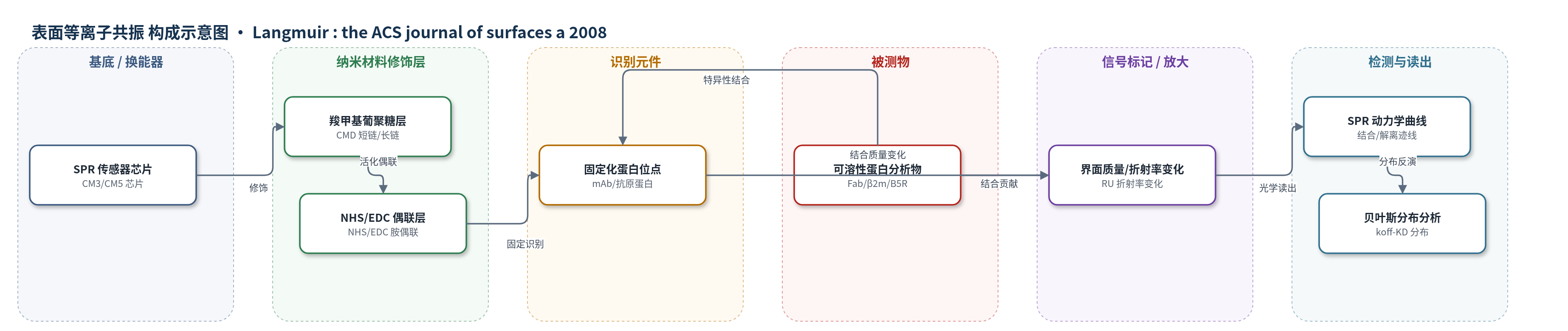
点击图片查看大图 · 依据论文自动绘制
传感器类型
表面等离子共振(SPR)生物传感器
检测对象
可溶性蛋白分析物:β2-微球蛋白(β2-microglobulin, β2m)、B5R 抗原、单克隆 Fab 片段(monoclonal Fab)等;样品基质:SPR 运行缓冲液(HEPES 生理盐水,3 mM EDTA,0.005% P20)
检测原理
将纯化蛋白通过 NHS/EDC 胺偶联固定于 CM3/CM5 羧甲基葡聚糖表面,形成表面结合位点;可溶性蛋白分析物在流动相中注入并与固定化配体结合。结合事件增加界面质量并改变局部折射率,使 SPR 共振信号以共振单位(RU)变化。不同浓度下记录结合与解离曲线,信号上升反映结合量随浓度增加,解离按各亚群速率常数衰减。数据用连续分布模型 P(koff, KD) 拟合,贝叶斯先验假设位点接近单峰,正则化在保持拟合质量前提下给出最窄的 koff-KD 分布,从而识别微异质性和低/高亲和亚群。
检测灵敏度
未报告 LOD、线性范围、灵敏度斜率或 R^2。
效应效果
方法在模拟与实验数据中显示:低信噪比时常规正则化给出宽峰,贝叶斯先验可聚焦分布,但错误先验可能仅由尾部补偿;高信噪比时数据可推翻错误先验。对 β2-微球蛋白/抗体体系,拟合 rmsd 为 0.31 RU,主峰约占总结合容量 64/125 RU;B5R/抗体体系 rmsd 0.31 RU,保留 4.8 与 20 nM 两个亚群。重复固定化表面给出相似峰型,如 40/560 nM 与 61/620 nM 双峰。固定化密度升高可使 220–250 nM 高亲和位点从 71 RU 增至 148 RU。作者认为该方法有助于研究表面固定化与天然异质分子集合。
传感器的构成
- 换能基底:Biacore 3000 SPR 传感器芯片(CM3/CM5),提供表面等离子共振光学换能界面
- 聚合物修饰层:羧甲基葡聚糖(carboxymethyl dextran, CMD)短链/长链矩阵,承载并固定蛋白
- 化学偶联层:N-羟基琥珀酰亚胺(NHS)与 N-乙基-N′-(3-二甲基氨基丙基)碳二亚胺(EDC)介导胺偶联,共价连接蛋白
- 封闭层:乙醇胺盐酸盐(ethanolamine HCl)封闭未反应羧基,减少非特异结合
- 识别元件:固定化单克隆抗体(mAb/IgG)或抗原蛋白(如 B5R、β2-微球蛋白对应抗原),作为表面结合位点
- 信号读出:SPR 共振单位(RU)随结合蛋白质量/界面折射率变化,输出结合与解离动力学曲线
中文摘要
当均一蛋白配体从溶液固定化到表面后,由于表面粗糙度、局部微环境差异、聚合物连接链密度不均以及化学偶联导致的蛋白取向和构象不同,表面结合位点常呈现异质性。作者此前提出一种计算方法,通过分析实验表面结合数据确定表面位点亲和力和速率常数分布,充分利用表面等离子共振等光学生物传感器的高信噪比和重现性。由于该计算问题病态,原方法采用正则化并先验假设所有结合参数等概率,得到与数据一致的最宽分布。本文将其扩展为贝叶斯方法,引入相反先验:表面位点预期在自由溶液中是均一的,从而得到在实验数据允许下尽可能接近单分散的分布。利用固定在羧甲基葡聚糖表面的多种模型蛋白体系,并以表面等离子共振检测,结果显示表面位点除微异质性外,还存在亲和力显著改变的宽分布群体;所得分布高度可重复,固定化条件和总表面密度可显著影响结合位点的功能分布。
英文摘要
Once a homogeneous ensemble of a protein ligand is taken from solution and immobilized to a surface, for many reasons the resulting ensemble of surface binding sites to soluble analytes may be heterogeneous. For example, this can be due to the intrinsic surface roughness causing variations in the local microenvironment, nonuniform density distribution of polymeric linkers, or nonuniform chemical attachment producing different protein orientations and conformations. We previously described a computational method for determining the distribution of affinity and rate constants of surface sites from analysis of experimental surface binding data. It fully exploits the high signal/noise ratio and reproducibility provided by optical biosensor technology, such as surface plasmon resonance. Since the computational analysis is ill conditioned, the previous approach used a regularization strategy assuming a priori all binding parameters to be equally likely, resulting in the broadest possible parameter distribution consistent with the experimental data. We now extended this method in a Bayesian approach to incorporate the opposite assumption, i.e., that the surface sites a priori are expected to be uniform (as one would expect in free solution). This results in a distribution of binding parameters as close to monodispersity as possible given the experimental data. Using several model protein systems immobilized on a carboxymethyl dextran surface and probed with surface plasmon resonance, we show microheterogeneity of the surface sites in addition to broad populations of significantly altered affinity. The distributions obtained are highly reproducible. Immobilization conditions and the total surface density of immobilized sites can have a substantial impact on the functional distribution of the binding sites.