组成图示
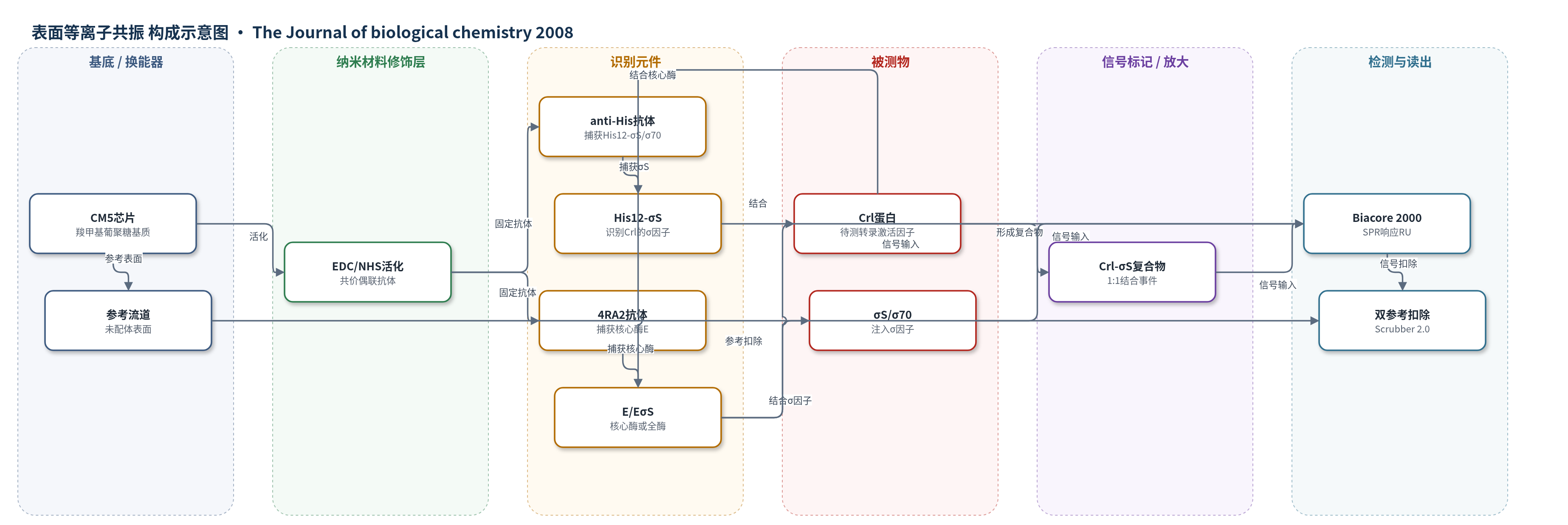
点击图片查看大图 · 依据论文自动绘制
传感器类型
表面等离子共振(SPR)生物传感器
检测对象
Crl 蛋白(Crl)、σS 因子(σS)、σ70 因子(σ70);样品基质:重组蛋白缓冲液(Hepes/MgCl2/钾谷氨酸,Tween 20)
检测原理
CM5 芯片表面经 EDC/NHS 活化后共价固定 anti-His 或 4RA2 单克隆抗体,再非共价定向捕获 His12-σS/His12-σ70 或核心 RNA 聚合酶 E/EσS。当注入 Crl 或 σ 因子时,识别分子与靶标发生特异性结合,界面质量与局部折射率增加,引起表面等离子体共振信号变化,Biacore 2000 以响应单位(RU)实时记录结合与解离曲线。结合量随分析物浓度升高而增加并趋于饱和;通过未配体参考流道和空白实验双参考扣除,再用 Langmuir 或构象变化模型拟合 kon、koff、Kd 与化学计量。Crl 与 σS 形成 1:1 复合物,提高 σS 与 E 的结合速率;Crl 也可结合 E 或 EσS,形成稳定三元复合物。该体系无酶或核酸信号放大。
检测灵敏度
原文未报告 LOD、线性范围、灵敏度斜率或相关系数。
效应效果
SPR 显示 Crl 特异性结合 σS,Kd 2.46±0.13 μM,1:1,koff 约 0.3 s⁻¹,kon 1.5×10⁵ M⁻¹ s⁻¹;对 σ70 无结合,Kd 阈值约 750 μM。Crl 使 σS-E Kd 从 68.2±8.4 nM 降至 9.41±1.86 nM(5 μM Crl),结合速率提高约 7 倍,Rmax 从 205±9 RU 增至 285±13 RU。Crl 与 E、Eσ70 的 Kd 分别为 13.8±1.8 μM、27.5±1.8 μM;与 EσS 呈 2:1 结合,Kd1 227±27 nM、Kd2 40±9 μM,三元复合物半衰期约 50 s,比 Crl-σS 约 3 s 高 15 倍。Crl 使 EσS 与 katN 启动子结合提高 2–3 倍,并促进开放复合物形成。
传感器的构成
- 基底/换能器:CM5 传感器芯片(carboxymethyl-dextran matrix),提供 SPR 检测表面
- 化学活化层:EDC/NHS 胺偶联试剂,活化芯片羧基以共价固定抗体
- 捕获抗体层:penta-His 单克隆抗体(anti-His5)或 4RA2 单克隆抗体,分别非共价定向捕获 His12-σS/His12-σ70 或核心 RNA 聚合酶 E
- 识别元件层:His12-σS、His12-σ70、E、EσS 或 Eσ70,作为与 Crl 或 σ 因子结合的识别分子
- 参考/封闭层:未配体参考流道与乙醇胺失活,用于双参考扣除非特异信号
- 再生/清洗层:glycine-HCl 与 SDS,用于解离结合物并再生芯片表面
中文摘要
小型调控蛋白 Crl 可结合 RNA 聚合酶静息期 σ 因子 σS,促进 σS 相关全酶 EσS 的形成,从而激活 σS 依赖性基因。本研究利用实时表面等离子共振(SPR)生物传感器,进一步表征 Crl 的特异性与作用方式。结果表明,Crl 与 σS 特异性形成 1:1 复合物,使 σS 与核心 RNA 聚合酶 E 的结合速率提高,但不改变 EσS 的解离速率。Crl 还能以高于游离 σS 的亲和力结合预先形成的 EσS。即使在 σS 饱和浓度下,Crl 仍显著增强 EσS 与 katN 启动子的结合,并促进 EσS-katN 复合物的有效异构化,支持 Crl 直接参与转录起始。最后,Crl 不结合 σ70 本身,但高浓度下可与核心 RNA 聚合酶及 σ70 相关全酶形成弱而短暂的 1:1 复合物,提示其可能对非 σS 全酶的转录活性发挥旁路调控作用。
英文摘要
The small regulatory protein Crl binds to sigmaS, the RNA polymerase stationary phase sigma factor. Crl facilitates the formation of the sigmaS-associated holoenzyme (EsigmaS) and thereby activates sigmaS-dependent genes. Using a real time surface plasmon resonance biosensor, we characterized in greater detail the specificity and mode of action of Crl. Crl specifically forms a 1:1 complex with sigmaS, which results in an increase of the association rate of sigmaS to core RNA polymerase without any effect on the dissociation rate of EsigmaS. Crl is also able to associate with preformed EsigmaS with a higher affinity than with sigmaS alone. Furthermore, even at saturating sigmaS concentrations, Crl significantly increases EsigmaS association with the katN promoter and the productive isomerization of the EsigmaS-katN complex, supporting a direct role of Crl in transcription initiation. Finally, we show that Crl does not bind to sigma70 itself but is able at high concentrations to form a weak and transient 1:1 complex with both core RNA polymerase and the sigma70-associated holoenzyme, leaving open the possibility that Crl might also exert a side regulatory role in the transcriptional activity of additional non-sigmaS holoenzymes.