组成图示
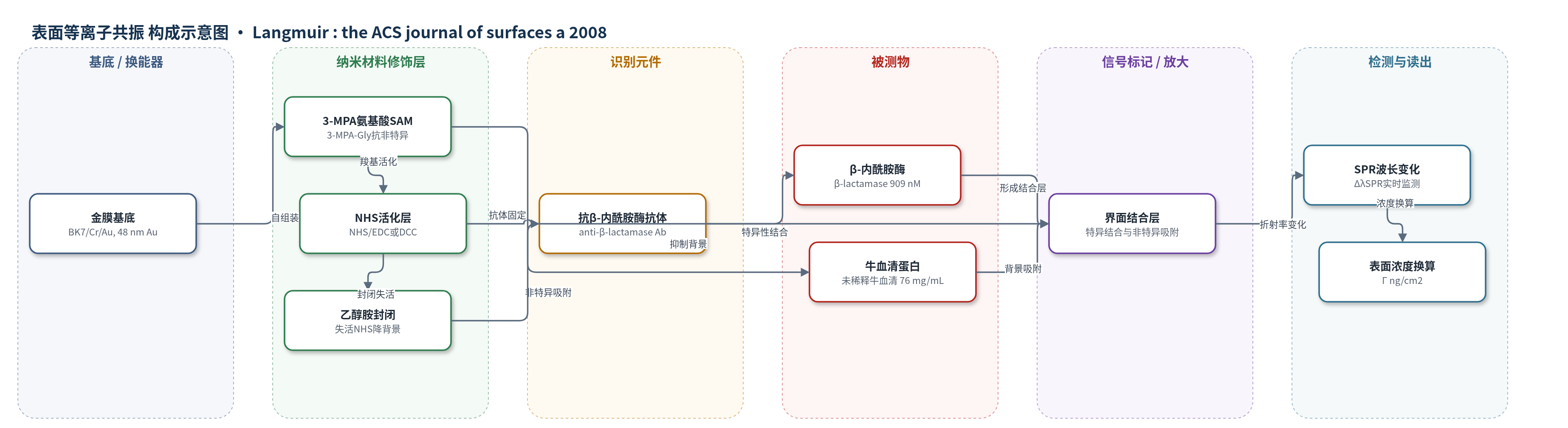
点击图片查看大图 · 依据论文自动绘制
传感器类型
表面等离子共振(SPR)生物传感器
检测对象
β-内酰胺酶(β-lactamase,PBS溶液)、牛血清蛋白(bovine serum proteins,未稀释牛血清)
检测原理
SPR生物传感器以金膜为换能器,3-MPA氨基酸SAM通过硫醇-Au自组装形成亲水/离子化界面,降低血清蛋白非特异吸附。3-MPA-Gly末端羧基经NHS/EDC或NHS/DCC活化为NHS酯,抗β-内酰胺酶抗体共价固定,乙醇胺封闭未反应位点。当PBS中的β-内酰胺酶流过表面时,抗体-抗原特异性结合在界面形成结合层,使近场折射率升高,导致SPR共振波长红移ΔλSPR。结合量随抗原浓度增加而增加,ΔλSPR相应增大,并按Jung方程换算为表面浓度Γ。非特异吸附的血清蛋白也会引起类似折射率变化,因此低非特异吸附SAM是获得清晰特异信号的关键;SPR灵敏度为1765 nm/RIU,提供纳摩尔级检测能力。
检测灵敏度
SPR灵敏度: 1765 ± 100 nm/RIU
效应效果
该SAM抗非特异吸附能力与侧链亲水性、电荷和尺寸相关:总吸附量从3-MPA-Asp的416±121 ng/cm2到3-MPA-Tyr的808±51 ng/cm2,平均551±59 ng/cm2;极性446±31、离子性474±67,均低于疏水性656±68 ng/cm2。PBS洗涤后约95%非特异蛋白保留,1 M NaCl-PBS可去除约50%,说明离子相互作用显著。PBS接触角越低表现越好,Asp为32±2°。与MHA(428±16 ng/cm2)相比,最佳3-MPA氨基酸达到相当水平。抗β-内酰胺酶抗体固定于3-MPA-Gly后,909 nM β-内酰胺酶产生可测SPR信号,作者认为可用于快速诊断抗生素耐药。
传感器的构成
- 基底/换能器:BK7玻璃载玻片、5 nm Cr粘附层和48 nm Au金膜,提供SPR换能表面
- 自组装单分子层:3-巯基丙基氨基酸(3-MPA-amino acid)SAM,通过硫醇-Au自组装,降低血清蛋白非特异吸附并提供羧基固定位点
- 免疫检测修饰层:3-巯基丙基甘氨酸(3-MPA-Gly)SAM,作为抗体共价固定载体
- 活化层:N-羟基琥珀酰亚胺(NHS)与EDC或DCC活化3-MPA-Gly末端羧基,形成NHS酯
- 识别元件:抗β-内酰胺酶抗体(anti-β-lactamase antibody),共价固定于NHS酯位点,特异性识别β-内酰胺酶
- 封闭/失活剂:1 M乙醇胺盐酸盐(ethanolamine hydrochloride,pH 8.5),失活未反应NHS位点,减少非特异结合
- 样品基质:PBS缓冲液中的β-内酰胺酶溶液;非特异吸附评价使用未稀释牛血清(bovine serum,76 mg/mL蛋白)
- 读出层:SPR波长探测系统,通过p偏振实时监测SPR波长变化ΔλSPR并换算表面浓度
中文摘要
在表面等离子共振(SPR)生物传感器中,生物样品中的血清蛋白易非特异性吸附于传感表面,产生难以区分的背景响应,限制生物标志物定量。为降低该问题,作者以19种天然氨基酸与3-巯基丙酸偶联,制备N-3-巯基丙基氨基酸(3-MPA-氨基酸)自组装单分子层(SAM),并采用SPR和Ge衰减全反射傅里叶变换红外光谱(GATR FTIR)表征。密集单分子层表面浓度约为10^15分子/cm^2。未稀释牛血清暴露后,极性/离子性氨基酸表面的非特异蛋白吸附约400 ng/cm^2,疏水性氨基酸约800 ng/cm^2,吸附量顺序为Asp<Asn<Ser<Met<Glu<Gln<Thr<Gly<His<Cys<Arg<Phe<Trp<Val<Pro<Ile<Leu<Ala<Tyr。吸附-解吸曲线显示蛋白吸附强不可逆。PBS接触角越小,表面抗非特异吸附性能越好。抗β-内酰胺酶抗体共价固定于3-MPA-甘氨酸SAM后,可在纳摩尔范围检测β-内酰胺酶,为抗生素耐药标志物的快速SPR检测提供表面策略。
英文摘要
Monolayers prepared with polar or ionic amino acids with short side chains have a reduced nonspecific adsorption of serum proteins compared to that of hydrophobic amino acids and organic monolayers immobilized on the gold surface of surface plasmon resonance (SPR) biosensors. Proteins contained in biological samples adsorb on most surfaces, which in the case of biosensors causes a nonspecific response that hinders the quantification of biomarkers in these biological samples. To circumvent this problem, self-assembled monolayers (SAM) of N-3-mercaptopropyl-amino acids (3-MPA-amino acids) were prepared from 19 natural amino acids. These SAM were investigated to limit the nonspecific adsorption of proteins contained in biological fluids and to immobilize molecular receptors (i.e., antibodies) that are necessary in the construction of biosensors. SPR and Ge attenuated total reflection (GATR) FTIR spectroscopy were employed to characterize the formation of the amino acid SAMs. Monolayers of 3-MPA-amino acids densely packed on the surface of the SPR biosensors result in a surface concentration of approximately 10 (15) molecules/cm (2). SPR also quantifies the surface concentration of serum proteins nonspecifically adsorbed on 3-MPA-amino acids following the exposure of the biosensor to undiluted bovine serum. The concentration of nonspecifically bound proteins ranged from approximately 400 ng/cm (2) with polar and ionic amino acids to approximately 800 ng/cm (2) with amino acids of increased hydrophobicity. The nonspecific adsorption of serum proteins on the 3-MPA-amino acids increases in the following order: Asp < Asn < Ser < Met < Glu < Gln < Thr < Gly < His < Cys < Arg < Phe < Trp < Val < Pro < Ile < Leu < Ala < Tyr. The analysis of the adsorption and desorption curves for serum proteins on the SPR sensorgram has demonstrated the strong irreversibility of the protein adsorption on each surface. The effective hydrophilicity of the SAMs was measured from the contact angle with a saline buffer and has demonstrated that surfaces minimizing the contact angle with PBS performed better in serum. The antibody for beta-lactamase was immobilized on a 3-MPA-glycine SAM, and beta-lactamase was detected in the nanomolar range. The presence of beta-lactamase is an indicator of antibiotic resistance.