组成图示
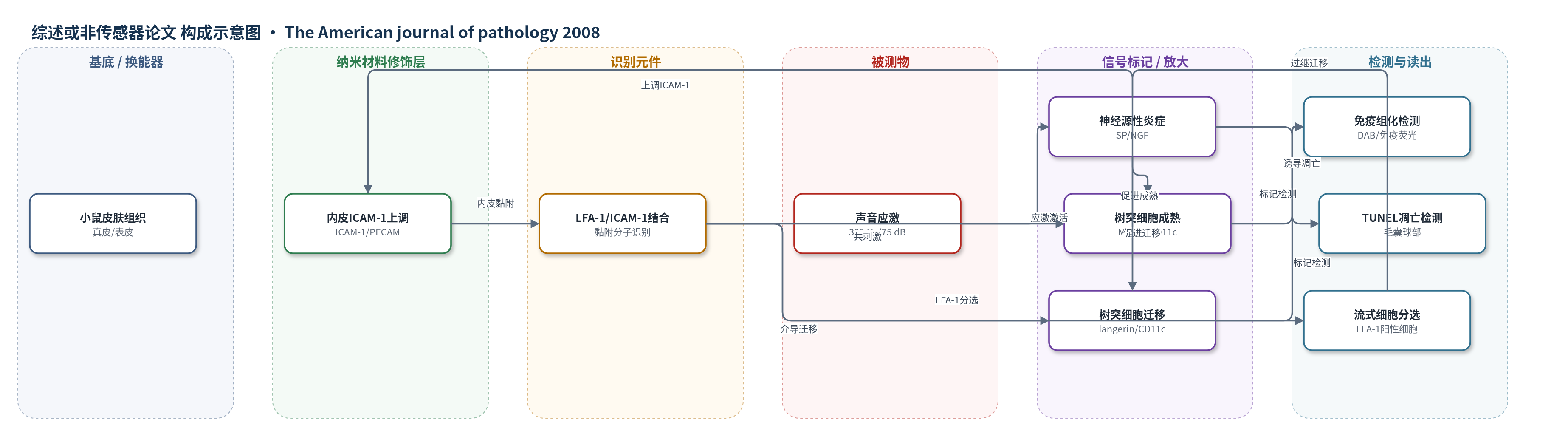
点击图片查看大图 · 依据论文自动绘制
传感器类型
综述或非传感器论文
检测对象
声音应激(sound stress);样品基质:小鼠皮肤组织、脾细胞悬液
检测原理
本文并非基于浓度响应的传感检测,而是以小鼠皮肤为组织基质研究声音应激诱导的神经源性炎症。声音应激激活皮肤神经-免疫通路,促进SP、NGF等介质参与,使真皮血管内皮和抗原呈递细胞上调ICAM-1。LFA-1阳性白细胞通过LFA-1/ICAM-1黏附与信号传导进入皮肤,并与树突细胞发生共刺激,推动CD11c、MHC II、ICAM-1表达升高,表现为DC成熟和迁移。实验通过免疫组化、免疫荧光、TUNEL和流式细胞术读取MHC II、ICAM-1、CD11c、langerin及凋亡信号;抗LFA-1/ICAM-1阻断可削弱上述变化,说明该过程依赖黏附分子相互作用。
检测灵敏度
原文未报告LOD、线性范围、灵敏度斜率或相关系数。
效应效果
实验采用C57/BL6小鼠,每组n=10,经脱毛同步毛周期后给予24小时声音应激。与对照相比,应激组真皮MHC II、ICAM-1、CD11c和langerin阳性细胞簇数量显著增加(P<0.001),提示DC成熟和聚集。抗LFA-1/ICAM-1阻断使应激组langerin和CD11c阳性细胞簇降至接近对照水平,并显著降低MHC II和ICAM-1阳性细胞簇。皮下高ICAM-1阳性血管比例在应激后升高,阻断后明显下降;毛囊球部和球茎TUNEL阳性比例升高也被阻断。过继转移显示LFA-1阳性细胞24小时内进入皮肤并邻近CD11c阳性DC。作者认为该机制可解释应激诱发或加重特应性皮炎、慢性荨麻疹、银屑病等免疫性皮炎。
传感器的构成
- 不适用:本文未报道生物传感器,无基底或换能器电极材料。
- 不适用:本文未报道纳米材料修饰层或信号放大材料。
- 不适用:本文未报道抗体/适配体/酶等识别元件或信号标记物。
中文摘要
皮肤持续作为多种外源应激的生物传感器,并将应激反应与个体中枢和周围内源应激系统整合,同时抵御损伤和感染。此前研究显示,小鼠中应激可诱导依赖神经生长因子和P物质(SP)的神经源性炎症,并出现MHC II阳性细胞显著聚集。由于树突细胞(DC)在应激反应中的作用尚不清楚,本研究采用成熟的小鼠声音应激模型,考察DC在皮肤神经源性炎症中的作用。结果显示,声音应激增加真皮内langerin阳性和CD11c阳性DC数量,并诱导DC成熟,表现为CD11c、MHC II和细胞间黏附分子-1(ICAM-1)表达上调。阻断ICAM-1与白细胞功能相关抗原-1(LFA-1)相互作用,可显著消除应激诱导的皮肤DC数量增加、成熟和迁移,并降低应激诱导的角质形成细胞凋亡及内皮细胞ICAM-1表达。结论认为,应激暴露使皮肤处于免疫警戒状态;此类适应过程可能有助于在应激造成损伤时防御感染,但现代应激源可能使该反应过度,破坏皮肤稳态并诱发免疫性皮炎。
英文摘要
The skin continuously serves as a biosensor of multiple exogenous stressors and integrates the resulting responses with an individual's central and peripheral endogenous response systems to perceived stress; it also acts to protect against external challenges such as wounding and infection. We have previously shown in mice that stress induces nerve growth factor- and substance P-dependent neurogenic inflammation, which includes the prominent clustering of MHC class II(+) cells. Because the contribution of dendritic cells (DCs) in response to stress is not well understood, we examined the role of DCs in neurogenic inflammation in murine skin using a well-established murine stress model. We show that sound stress increases the number of intradermal langerin(+) and CD11c(+) DCs and induces DC maturation, as indicated by the up-regulated expression of CD11c, MHC class II, and intercellular adhesion molecule-1 (ICAM-1). Blocking of ICAM-1/leukocyte function-associated antigen-1 interactions significantly abrogated the stress-induced numeric increase, maturation, and migration of dermal DCs in vivo and also reduced stress-induced keratinocyte apoptosis and endothelial cell expression of ICAM-1. In conclusion, stress exposure causes a state of immune alertness in the skin. Such adaptation processes may ensure protection from possible infections on wounding by stressors, such as attack by predators. However, present-day stressors have changed and such adaptations appear redundant and may overrun skin homeostasis by inducing immune dermatoses.