组成图示
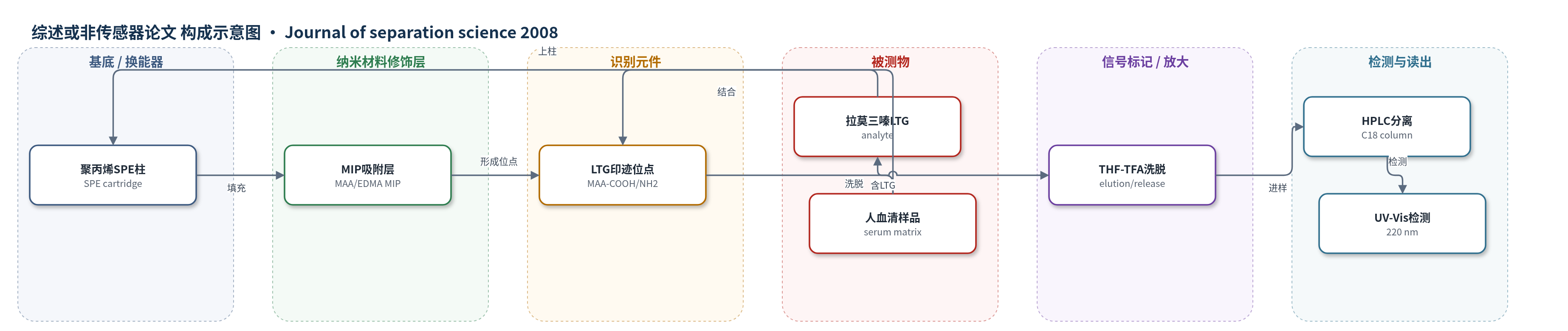
点击图片查看大图 · 依据论文自动绘制
传感器类型
综述或非传感器论文
检测对象
拉莫三嗪(lamotrigine, LTG);样品基质:人血清
检测原理
本方法基于分子印迹识别与HPLC-UV读出。以LTG为模板、MAA为功能单体、EDMA为交联剂制备的MIP中,MAA羧基与LTG氨基形成离子相互作用并依靠形状互补,使LTG选择性结合;血清经ACN沉淀蛋白后上柱,ACN洗去其他抗癫痫药和基质干扰物;随后用THF–TFA 90%(50:50 v/v)洗脱LTG。洗脱液经HPLC C18柱分离,UV-Vis在220 nm检测,LTG峰面积随其浓度线性增加。该方法无酶或荧光标记放大,选择性主要来自印迹空腔的形状与功能基团互补。
检测灵敏度
LOD: 0.03 μg/mL;LOQ: 0.2 μg/mL;线性范围: 0.5–10 μg/mL;斜率: 381.0 ± 19.2;R^2 = 0.999;移动相标准曲线斜率: 426.7 ± 26;R^2 = 0.999;与LLE比较斜率: 1.09,相关系数: 0.996
效应效果
MISPE-HPLC法对人血清LTG的回收率为84%–89%,日内变异为1.7%和2.8%(2、5 μg/mL),日间变异为1.4%和3.4%。选择性方面,ACN洗涤后95%–100%的苯巴比妥、苯妥英、扑米酮和卡马西平被去除,而LTG损失小于5%;结构类似物洗涤后残留分别为12%、16%和27.4%,LTG仍保留91%。与21例患者血清LLE法比较,回归斜率为1.09,相关系数0.996,t检验p=0.58,差异无统计学意义。作者认为该MIP可用于血清LTG前处理,也可作为LTG选择性生物传感器受体层。
传感器的构成
- SPE柱基底:聚丙烯SPE小柱,承载MIP并实现固相萃取
- 分子印迹聚合物层:以LTG为模板、MAA为功能单体、EDMA为交联剂、AIBN引发聚合的MIP,提供LTG选择性结合空腔
- 识别元件:MIP中由MAA羧基与LTG氨基互补形成的印迹位点,选择性吸附LTG
- 样品基质处理:ACN用于沉淀血清蛋白,减少基质干扰
- 洗脱/信号释放剂:THF–TFA 90%(50:50 v/v)用于破坏结合并洗脱LTG
- 分离与检测:HPLC C18柱和UV-Vis 220 nm检测器,将洗脱LTG转化为峰面积信号
中文摘要
本文报道了一种针对抗癫痫药拉莫三嗪(LTG)的分子印迹聚合物(MIP)的制备与表征,并将其与空白非印迹聚合物(NIP)进行比较。Scatchard分析表明MIP中存在高亲和(KD=16.2 μM)和低亲和(KD=161.3 μM)两类结合位点。选择性实验显示,结构相似物中氨基的存在影响结合,但分子整体形状同样重要;在优化条件下,其他抗癫痫药基本不结合MIP。作者进一步建立了分子印迹固相萃取(MISPE)方法,用于人血清中LTG的富集,回收率为84%–89%,日内变异小于2.8%,日间变异小于3.4%。与常规液液萃取(LLE)-HPLC法比较,MISPE法结果无显著差异,表明该MIP对LTG具有良好选择性和较高亲和力,可用于血清样品前处理,也可作为LTG选择性生物传感器的受体层。
英文摘要
A molecularly imprinted polymer (MIP) against lamotrigine (LTG) was prepared, characterized, and its recognition properties were compared with a blank nonimprinted polymer (NIP). Two classes of binding sites were found in the MIP--high affinity (K(D) = 16.2 microM) and low affinity (K(D) = 161.3 microM). Selectivity of the synthesized MIP was examined using compounds with similar structures or therapeutic uses to LTG. In compounds which had structural similarity to LTG, the presence of amine groups appeared to affect binding to the MIP, however overall shape of the molecule was also important. Under the optimal conditions developed, other anticonvulsant drugs tested did not bind the MIP. A molecularly imprinted SPE (MISPE) procedure was developed which had a recovery of 84-89%, interday variation of less than 3.4% and intraday variation of less than 2.8%. The MISPE procedure was compared with a routine liquid-liquid extraction (LLE) procedure used for the HPLC determination of LTG in serum from patients. The data indicated that the MIP synthesized showed both good selectivity and high affinity for LTG and could be used for the extraction of the drug from serum samples or as the receptor layer for an LTG selective biosensor.