组成图示
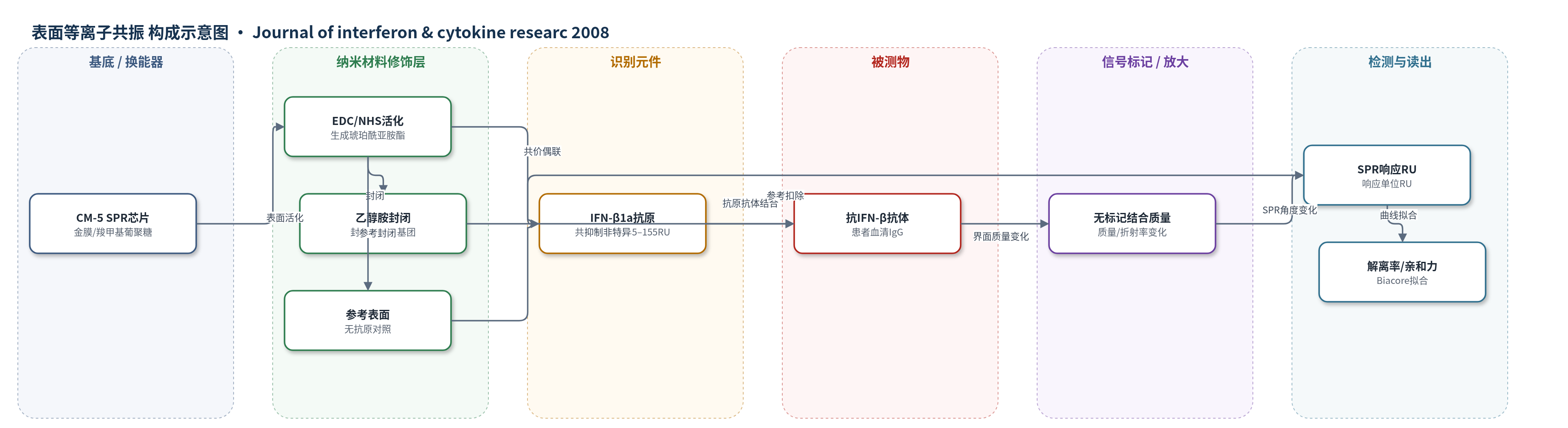
点击图片查看大图 · 依据论文自动绘制
传感器类型
表面等离子共振(SPR)生物传感器
检测对象
抗干扰素-β抗体(anti-IFN-β antibodies,含结合抗体BAb与中和抗体NAb);样品基质:IFN-β1a/IFN-β1b治疗的多发性硬化症患者血清
检测原理
将高纯度重组IFN-β1a抗原通过EDC/NHS共价偶联到CM-5 SPR芯片的羧甲基葡聚糖表面,并用乙醇胺封闭。患者血清中的抗IFN-β抗体作为分析物流经芯片,与固定化IFN-β1a特异性结合。SPR利用760 nm光在金膜/液体界面产生共振;抗体结合使界面质量与折射率增加,导致SPR角度改变,以响应单位(RU)实时记录结合曲线。结合相反映抗体浓度与结合强度,解离相用Langmuir 1:1模型拟合得到解离率(s−1);解离率越低,相对亲和力越高。低密度抗原与较高流速有利于高亲和抗体选择性结合,在线参考表面和空白扣除减少非特异信号。
检测灵敏度
相关系数:Spearman’s correlation, R2 = −0.374, p < 0.001;Spearman’s correlation, R2 = 0.537, p < 0.001
效应效果
该SPR方法可区分健康供体与IFN-β治疗患者:43例健康供体无检测结合,11例治疗患者中5例阳性;阳性血清1:160稀释仍高于阴性。方法能区分NAb+与NAb−患者,结合响应在第6、48、60个月差异显著(p=0.044、0.017、0.021);解离率在第24、36、60个月差异显著(p=0.030、0.025、0.014)。NAb+患者解离率由0.00118±0.00030 s−1降至0.00021±0.00008 s−1,NAb−患者由0.00130±0.00025 s−1升至0.00244±0.00099 s−1。NAb滴度峰值3800±1371 TRU,与解离率负相关、与Biacore响应正相关,可补充ELISA和生物测定,用于抗IFN-β抗体全面表征。
传感器的构成
- 基底/换能器:CM-5 SPR传感器芯片(金膜/羧甲基葡聚糖基质),提供光学共振界面与羧基偶联位点
- 表面活化层:EDC/NHS活化羧基生成琥珀酰亚胺酯,用于共价偶联IFN-β1a
- 识别元件:重组IFN-β1a抗原(Avonex),低密度固定化135–155 RU,捕获血清抗IFN-β抗体
- 封闭层:1 M乙醇胺(pH 8.5),封闭未反应琥珀酰亚胺基,降低非特异结合
- 参考表面:仅EDC/NHS活化后乙醇胺封闭,用于在线参考扣除非特异信号
- 样品介质:HBS-EP 0.05% P-20运行缓冲液及含1 mg/mL CM-D的样品稀释液,维持流动并减少非特异吸附
- 再生剂:50 mM NaOH脉冲,去除结合抗体,恢复芯片表面
中文摘要
本研究针对接受干扰素-β(IFN-β)治疗的多发性硬化症(MS)患者,评估18例连续治疗66至198个月患者的血清样本,利用基于表面等离子共振(SPR)的生物传感器(Biacore)表征抗IFN-β抗体的亲和力成熟。Biacore通过抗原-抗体结合后解离相动力学数据反映相对抗体亲和力,解离率越低表示亲和力越高。结果显示,中和抗体阳性(NAb+)患者平均抗体解离率从第6个月的0.00118±0.00030 s−1降至第36个月的0.00021±0.00008 s−1,随后略升至第60个月的0.00027±0.00003 s−1;NAb−患者仅从0.00130±0.00025 s−1轻微降至第18个月的0.00105±0.00020 s−1,后逐渐升至第60个月的0.00243±0.00099 s−1。研究提示NAb−患者抗体亲和力改善有限,而NAb+患者随治疗时间出现显著亲和力成熟,且NAb滴度与相对抗体解离率呈显著负相关(Spearman R2=−0.374,p<0.001)。相对抗体亲和力评估有助于全面理解抗IFN-β免疫应答。
英文摘要
The study of antibodies against Interferon-beta (IFN-beta) in treated multiple sclerosis (MS) patients has focused primarily on detection and quantification, with no single method of detection providing a comprehensive characterization. We assessed serial samples of 18 MS patients, treated with IFN-beta for between 66 and 198 months, to characterize the affinity maturation of these antibodies using a biosensor-based approach (Biacore). Biacore utilizes the principles of surface plasmon resonance (SPR) with data from the dissociation phase of the antigen-antibody reaction being inversely proportional to relative antibody affinity. In patients with neutralizing antibodies (NAbs+), mean antibody dissociation rates decreased from 0.00118 +/- 0.00030 s(-1) at month 6 to 0.00021 +/- 0.00008 s(-1) at month 36, followed by a slight increase to 0.00027 +/- 0.00003 s(-1) at month 60. In NAb- patients, mean antibody dissociation rates decreased only very slightly from 0.00130 +/- 0.00025 s(-1) to 0.00105 +/- 0.00020 s(-1) at month 18, followed by a gradual increase to 0.00243 +/- 0.00099 s(-1) at month 60. Our study shows little improvement in antibody affinity in NAb- patients, in contrast to a marked increase in antibody affinity over time in NAb+ patients with a significant correlation between NAb titers and relative antibody dissociation rates (Spearman's correlation, R(2) = -0.374, p < 0.001). The evaluation of relative antibody affinities will contribute to a thorough understanding of the anti-IFN-beta antibody response.