组成图示
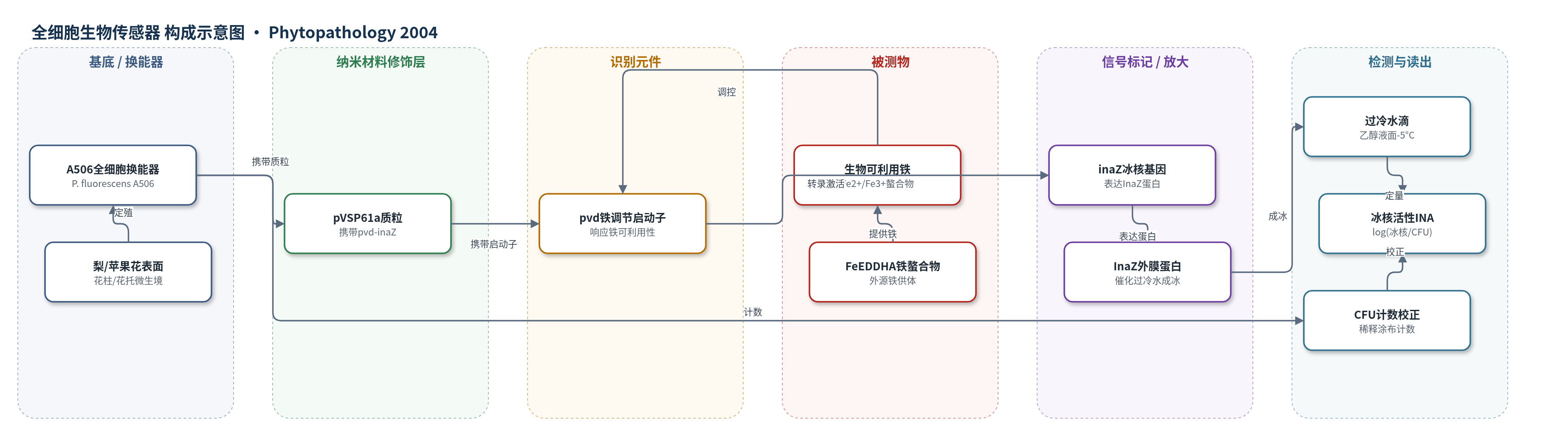
点击图片查看大图 · 依据论文自动绘制
传感器类型
全细胞生物传感器
检测对象
生物可利用铁(bioavailable iron, Fe;以FeEDDHA、FeDTPA、FeSO4等形式提供),样品基质为梨/苹果花柱与花托表面
检测原理
A506(pvd-inaZ)先定殖于梨/苹果花柱与花托表面。pvd为铁调节启动子,当生物可利用铁不足时激活,铁充足时受抑制;其下游连接无启动子inaZ基因。低铁条件下pvd驱动inaZ转录,表达InaZ外膜蛋白;InaZ作为冰核蛋白催化过冷水在-2至-10°C成冰。检测时取花洗液稀释滴于-5°C过冷乙醇液面,记录冻结比例,按最可能数法计算冰核/CFU,并以CFU校正。铁可利用性越低,pvd-inaZ转录越强,INA越高;加入3 mM FeEDDHA等螯合铁后铁可利用性升高,pvd被抑制,INA显著下降。
检测灵敏度
LOD: 1 × 10⁻⁶ log10 [ice nuclei/CFU]
效应效果
传感器构建体在梨/苹果花上稳定定殖,种群为10^4–10^6 CFU/flower,与正负对照无显著差异。A506 Ice–的INA接近检测限1×10^-6 log10(冰核/CFU),A506 IceC为-0.2至-2.0;A506(pvd-inaZ)接种48 h后升至-1.5至-0.3,表明花表面铁限制。3 mM FeEDDHA或FeDTPA显著降低INA(合并均值约-4.2和-3.9,水对照-1.4),0.3 mM FeEDDHA效果不一致;FeSO4降低INA但弱于螯合物,18 mM FeSO4使种群减少约3000倍并出现药害。作者认为FeEDDHA可增强铁可利用性并可能提高火疫病生物防治效果。
传感器的构成
- 全细胞换能器:Pseudomonas fluorescens A506,定殖梨/苹果花表面并作为铁感知与信号表达主体
- 识别/调控元件:pvd铁调节启动子,响应生物可利用铁,低铁时激活下游转录
- 信号报告元件:inaZ冰核基因,表达InaZ外膜蛋白,催化过冷水成冰并产生可定量冰核活性
- 遗传载体:pVSP61a质粒,携带pvd-inaZ融合构建体并赋予卡那霉素抗性
- 正对照元件:A506 IceC,inaZ由原生组成型启动子表达,提供高冰核活性对照
- 负对照元件:A506 Ice-,inaZ反向插入不转录,提供低冰核活性对照
- 检测基质:梨/苹果花柱与花托表面,作为传感器定殖和铁微环境
- 信号读出介质:过冷乙醇液面水滴,用于-5°C滴冻法测定冰核活性
中文摘要
在定义培养基中添加0.1 mM FeCl3可诱导细菌表生菌荧光假单胞菌A506产生对火疫病菌Erwinia amylovora有毒的抗生素。由于A506已作为商业产品用于梨和苹果花前抑制火疫病,铁在梨苹果花表面的相对生物可利用性具有重要意义。作者通过转化将铁调节启动子pvd与无启动子冰核报告基因inaZ融合,构建了A506铁生物传感器A506(pvd-inaZ)。该构建体在梨和苹果花上建立10^4–10^6 CFU/flower的高种群。在七次梨苹果树试验中,A506(pvd-inaZ)在花上表达高冰核活性(INA),表明铁生物可利用性有限,低铁环境不太可能诱导抗生素产生。当与FeSO4或铁螯合物FeEDDHA、FeDTPA混合时,构建体仍能定殖花。3 mM FeEDDHA或FeDTPA处理显著降低INA,而0.3 mM FeEDDHA不能一致抑制。结果表明梨苹果花对A506是铁限制环境,需3 mM FeEDDHA显著提高铁可利用性。
英文摘要
ABSTRACT The addition of 0.1 mM FeCl(3) to a defined culture medium induces the bacterial epiphyte Pseudomonas fluorescens strain A506 (A506) to produce an antibiotic toxic to the fire blight pathogen, Erwinia amylovora. Consequently, because A506 is registered and applied as a commercial product to suppress E. amylovora before floral infection of pear and apple, the relative availability of iron to A506 on surfaces of pear and apple flowers is of potential significance. An 'iron biosensor' construct of A506 was developed by transformation with an iron-regulated promoter (pvd) fused to a promoterless ice nucleation reporter gene (inaZ). This construct, A506 (pvd-inaZ), established high populations on pear and apple flowers, ranging from 10(4) to 10(6) CFU/flower. In seven trials on pear and apple trees, A506 (pvd-inaZ) expressed high ice nucleation activity (INA) on flowers, indicating limited iron bioavailability or a low-iron environment unlikely to induce antibiotic production by A506. A506 (pvd-inaZ) also colonized flowers when mixed with chemicals containing iron: FeSO(4) or the iron chelates ferric ethylenediaminedi-(o-hydroxyphenyl-acetic) acid (FeEDDHA) and ferric diethylenetriamine pentaacetate (FeDTPA). These compounds represent an array of commercial iron formulations applied to foliage to avert iron chlorosis. Treatment of flowers with a mixture of A506 (pvd-inaZ) and 3 mM FeEDDHA or FeDTPA significantly decreased INA compared with flowers treated with A506 (pvd-inaZ) in water. Lower concentrations (0.3 mM) of FeEDDHA, however, did not consistently suppress INA. These results indicate that apple and pear flowers represent an iron-limited environment to A506 and that treatment with 3 mM FeEDDHA is needed to increase significantly the level of iron available to this bacterium.