组成图示
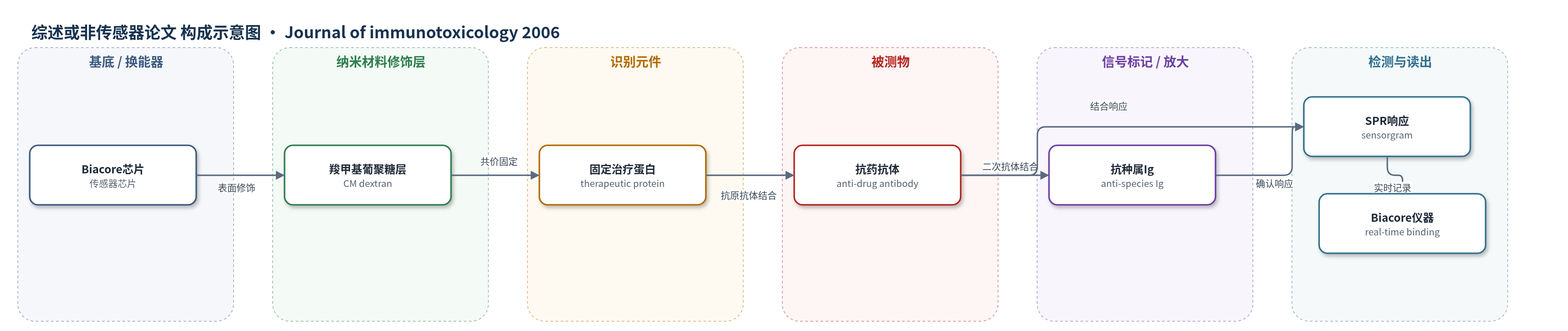
点击图片查看大图 · 依据论文自动绘制
传感器类型
综述或非传感器论文
检测对象
抗药抗体(anti-therapeutic antibodies),样品基质:人血清
检测原理
该检测基于表面等离子共振(SPR)原理。治疗性蛋白药物通过共价结合固定在Biacore芯片的羧甲基葡聚糖表面,作为捕获配体。稀释人血清流经芯片时,若存在抗药抗体,则与固定药物发生抗原-抗体结合,使芯片界面质量或折射率发生变化。Biacore实时监测结合与解离过程,生成传感器曲线(sensorgram),响应大小随抗体浓度、亲和力和结合动力学变化。随后加入抗种属特异性免疫球蛋白,与已捕获抗体结合,用于确认信号来自免疫球蛋白并增强响应。为验证特异性,可用过量可溶药物竞争固定位点,若结合被抑制则支持特异性抗体结合。该方法无需化学放大,但可实时检测快速解离的低亲和力抗体。
检测灵敏度
原文未报告具体LOD、线性范围、灵敏度斜率或相关系数数值。
效应效果
文中比较了多种抗药抗体检测平台。RIP为液相试验,可检测低ng/ml抗体,但Protein A/G对IgM捕获弱,可能漏检早期IgM,并有放射性负担和非特异沉淀假阳性风险。ELISA灵敏、可自动化高通量,但洗涤孵育可能使快速解离/低亲和力抗体脱落,bridging ELISA最易漏检。ECL动态范围更大、更灵敏,但高浓度抗体可能出现hook effect而假阴性。Biacore可实时获得结合数据,无需放大,能检测高低亲和力抗体,并便于确认免疫球蛋白结合及表征浓度、同种型、亲和力与表位;缺点是仪器贵、需专人、通量低、灵敏度一般。另提到抗EPO抗体以IgG1/IgG4为主,浓度约4-44 μg/ml。
传感器的构成
- 基底/换能器:Biacore传感器芯片,用于实时监测结合事件。
- 修饰层:羧甲基葡聚糖(carboxymethyl dextran)表面,支持配体共价固定。
- 识别/捕获层:治疗性蛋白药物(therapeutic protein)共价固定于表面,捕获抗药抗体。
- 信号确认层:抗种属特异性免疫球蛋白(anti-species-specific immunoglobulin)结合捕获抗体,确认免疫球蛋白结合。
- 特异性竞争层:过量可溶药物(excess soluble drug)竞争固定药物位点,验证结合特异性。
- 读出层:Biacore仪器记录传感器曲线(sensorgram),响应反映结合量。
中文摘要
免疫原性是蛋白治疗药物开发中必须考虑的重要因素,需在临床前和临床阶段充分理解新蛋白的免疫原性。本文概述了制造商应关注的问题,包括某些蛋白诱导免疫反应的可能原因、当前用于评估免疫原性的方法,以及已上市蛋白治疗药物出现免疫原性问题的实例。随着监管机构对免疫原性评估方式审查加强,检测和表征针对蛋白治疗药物产生的抗体策略日益重要。通常先对试验中采集的所有血清样本进行筛选检测,以发现能结合治疗蛋白的抗体。现有平台包括放射免疫沉淀试验(RIP)、酶联免疫吸附试验(ELISA)、电化学发光试验(ECL)和基于生物传感器的检测(如Biacore)。各平台各有优缺点,需针对特定治疗蛋白评估最优平台。识别抗体后,需进行确证试验以验证和表征抗体,并进一步用生物试验检测抗体是否能中和药物的生物效应。中和抗体阳性提示抗体可能影响患者从治疗蛋白中获益,并可能涉及患者安全。
英文摘要
Immunogenicity is an important factor that manufacturers must consider as they develop new protein therapeutics. It is important to understand the immunogenicity of new proteins both at the preclinical phase and in the clinical phase of development. This paper provides an overview of the issues that manufacturers should consider including some of the potential reasons that some proteins induce an immune response, a discussion regarding current methodology used to understand immunogenicity, and some examples of marketed protein therapeutics with immunogenicity issues. Given the increasing scrutiny from regulatory agencies around the way immunogenicity is assessed by manufacturers, the strategy of detecting and characterizing antibodies that are formed against protein therapeutics is becoming an important topic. Screening assays are typically performed first on all serum samples collected in the course of a trial to detect the presence of antibodies that can bind to the protein therapeutic. There are several platforms in use: radioimmune precipitation assays (RIP), enzyme linked immunosorbent assays (ELISA), electrochemiluminescent assays (ECL), and biosensor-based assays. Each has its advantages and disadvantages, and needs to be evaluated to identify the optimal platform for a specific therapeutic protein. Once antibodies are identified, a confirmatory assay is performed to verify and characterize the antibodies. A biological assay should be used next to test if these antibodies are capable of neutralizing the biological effect of the drug. Any sample that is positive for neutralizing antibodies, indicates that the antibody is probably having an impact on the patient's ability to derive full benefit from the therapeutic protein, and may be critical for patient safety.