组成图示
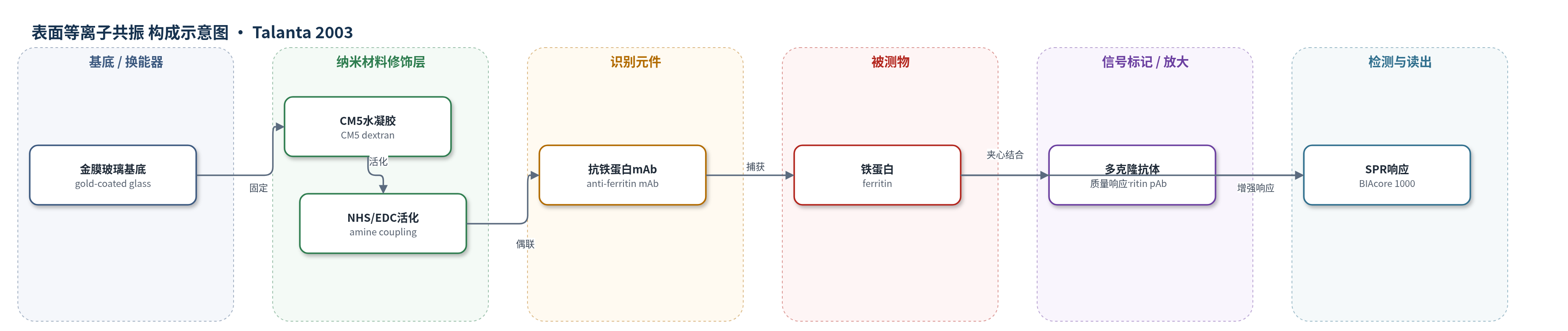
点击图片查看大图 · 依据论文自动绘制
传感器类型
表面等离子共振(SPR)生物传感器
检测对象
铁蛋白(ferritin);样品基质:HBS-EP缓冲液、血清(胎牛血清稀释)
检测原理
抗铁蛋白单克隆抗体经NHS/EDC胺偶联固定于CM5金表面。样品中铁蛋白与固定抗体特异性结合,使金膜界面质量与折射率发生变化,SPR共振响应随之改变。随后注入抗铁蛋白多克隆抗体,与已结合铁蛋白形成夹心复合物,进一步增加界面质量并排除非特异结合,SPR响应增强。响应变化ΔRU与铁蛋白浓度在一定范围内呈线性关系,从而实现实时、无标记定量。pH 2.0甘氨酸/HCl可再生表面。
检测灵敏度
血清夹心增强法:LOD: 28 ng ml^-1;线性范围: 30–300 ng ml^-1;灵敏度: 1.288 RU (ng ml^-1)^-1;R = 0.9985。HBS-EP缓冲液夹心增强法:LOD: 18 ng ml^-1;线性范围: 20–200 ng ml^-1;灵敏度: 1.712 RU (ng ml^-1)^-1;R = 0.9995。
效应效果
在HBS-EP缓冲液中,夹心增强使灵敏度由0.9939提高到1.712 RU (ng ml^-1)^-1,但RSD由0.1–2.2%升至1.3–10.7%,LOD由15升至18 ng ml^-1,主要因放大抗体非特异吸附。血清中非特异吸附约300 RU,夹心增强虽响应低于一次响应,但灵敏度由0.8899提高到1.288 RU (ng ml^-1)^-1,RSD由11.8–12.7%降至4.5–5.7%,LOD为28 ng ml^-1,线性范围30–300 ng ml^-1,并提高特异性。同一固定面经pH 2.0甘氨酸/HCl再生50次,基线漂移约600 RU,响应下降约15.6%,每次再生平均活性损失0.31%。与颗粒增强比浊法LOD 3 ng ml^-1相比灵敏度较低,但可快速、无标记直接检测血清铁蛋白,覆盖正常范围15–300 ng ml^-1。
传感器的构成
- 基底/换能器:金膜玻璃基底(gold-coated glass surface),提供SPR换能界面
- 修饰层:羧甲基葡聚糖水凝胶(carboxymethyl dextran, CM5),提供羧基用于胺偶联
- 活化/封闭:NHS/EDC活化羧基,乙醇胺(ethanolamine)封闭剩余活性酯
- 识别元件:抗铁蛋白单克隆抗体(anti-ferritin mAb),固定于CM5表面捕获铁蛋白
- 信号放大元件:抗人铁蛋白多克隆抗体(anti-human ferritin polyclonal antibody),与捕获的铁蛋白形成夹心复合物增强SPR响应
- 再生/清洗:甘氨酸盐酸缓冲液(glycine/HCl, pH 2.0),洗脱结合物再生表面
- 运行缓冲液:HBS-EP缓冲液(HEPES/NaCl/EDTA/Polysorbate 20),维持流动并降低非特异吸附
中文摘要
本文报道了一种基于表面等离子共振(SPR)技术的实时铁蛋白免疫分析方法。将抗铁蛋白单克隆抗体通过胺偶联法固定于羧甲基葡聚糖修饰的金表面,利用BIAcore系统实时监测抗体与抗原的结合过程。为提升灵敏度和特异性,采用夹心放大策略,在铁蛋白结合后注入抗铁蛋白多克隆抗体,使SPR响应增强。该方法首次用于HBS-EP缓冲液和血清中铁蛋白浓度的测定。血清中增强免疫分析的线性范围超过30–200 ng ml^-1,检出限为28 ng ml^-1,灵敏度、特异性和重现性均令人满意。结合表面可用pH 2.0甘氨酸/HCl缓冲液再生,同一抗体固定表面可重复使用50次以上。
英文摘要
A surface plasmon resonance (SPR) biosensor was used for the first time to determine the concentration of ferritin in both HBS-EP buffer and serum. The monoclonal antibody was immobilized on the carboxymethyl dextran-modified gold surface by an amine coupling method. The interaction of antibody with antigen was monitored in real-time. The signal was enhanced by sandwich amplification strategy to improve the sensitivity and specificity of the immunoassay, especially in serum. The linear range of the assay in serum is over 30-200 ng ml(-1) with the detection limit of 28 ng ml(-1). The sensitivity, specificity, and reproducibility of the assay are satisfactory. The analyte and enhancement antibody-binding surface could be regenerated by pH 2.0 glycine-HCl buffer and the same antibody-immobilized surface could be used for more than 50 cycles of ferritin binding and regeneration.