组成图示
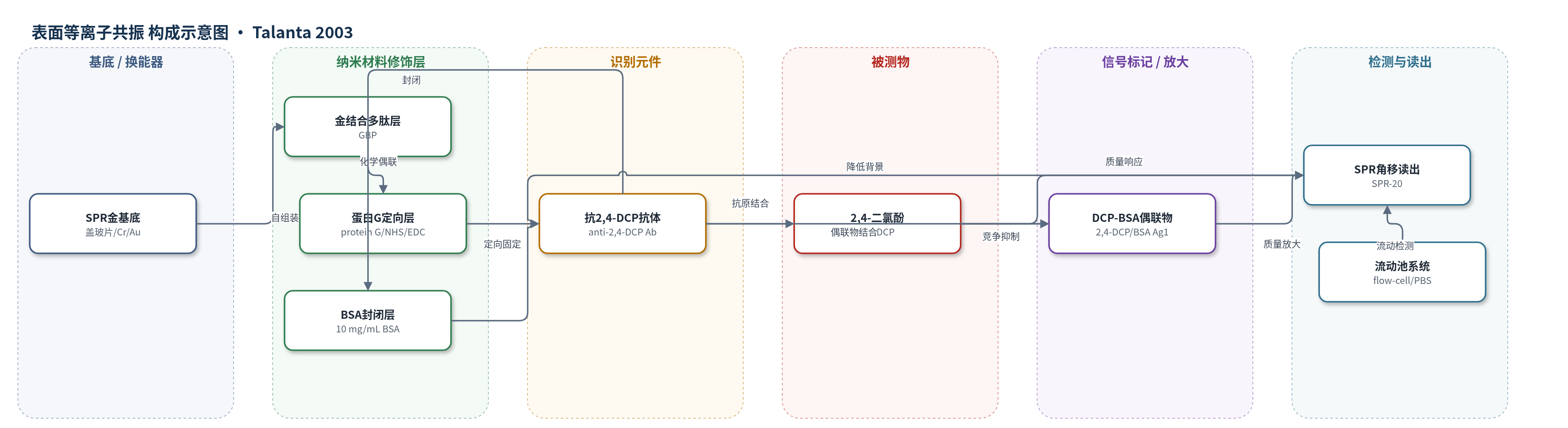
点击图片查看大图 · 依据论文自动绘制
传感器类型
表面等离子共振(SPR)生物传感器
检测对象
2,4-二氯酚(2,4-dichlorophenol, 2,4-DCP),样品基质为PBS缓冲液(模拟环境水样)
检测原理
该传感器以SPR共振角移作为读出信号。GBP在金表面形成三维多肽层,蛋白G通过NHS/EDC偶联到GBP上,并捕获抗2,4-DCP抗体的Fc段,使抗体定向固定,提高有效识别位点密度。检测时,样品中的2,4-DCP与固定在芯片上的抗体结合;由于2,4-DCP分子量小,直接结合引起的表面质量变化很小,SPR角移仅约0.0018°(25 ppm)。为放大信号,采用2,4-DCP–BSA偶联物进行间接竞争免疫分析:偶联物与游离2,4-DCP竞争同一抗体结合位点。游离2,4-DCP浓度升高时,大分子偶联物结合量减少,芯片表面质量下降,SPR角移随之降低。该过程可用Langmuir吸附模型描述,并通过BSA大分子质量实现信号放大。
检测灵敏度
检出限(LOD): 20 ppb
效应效果
GBP膜抗体固定角移变异系数为7.4%(n=5),重现性可接受。与BSA对照相比,GBP膜蛋白G和抗体固定量更高(抗体约8 ng/mm²),说明GBP三维固定增强抗体密度和灵敏度。直接法25 ppm 2,4-DCP仅产生0.0018°角移,难以ppb级检测;竞争法检出限估计为20 ppb,灵敏度显著提高。估算抗体对2,4-DCP–BSA偶联物亲和常数为1.5×10^6 M^-1,对2,4-DCP为5×10^7 M^-1,后者约为前者33倍。论文未报告实际样品回收率、选择性或长期稳定性,但作者认为该方法可克服GC-MS昂贵耗时和ELISA繁琐,适用于二噁英前体快速筛查与环境监测。
传感器的构成
- 基底/换能器:SPR传感器芯片,盖玻片(cover glass)18×18×0.15 mm,3 nm铬层和45 nm金层,提供SPR换能表面
- 多肽修饰层:金结合多肽(GBP),由E. coli pSB3053表达纯化,含碱性磷酸酶,通过金亲和力三维固定并提高抗体密度
- 定向偶联层:蛋白G(protein G),用NHS和EDC偶联到GBP,结合抗体Fc段实现定向固定
- 识别元件:抗2,4-二氯酚抗体(anti-(2,4-dichlorophenol) antibody,多克隆抗体),识别2,4-DCP及其BSA偶联物
- 封闭剂:牛血清白蛋白(BSA,10 mg/mL),封闭未修饰位点,减少非特异吸附
- 竞争信号/放大元件:2,4-二氯酚–BSA偶联物(2,4-dichlorophenol/BSA conjugate, Ag1),作为大分子抗原竞争结合抗体并放大SPR质量响应
中文摘要
本文报道了一种基于表面等离子共振(SPR)的免疫传感器,用于监测二噁英前体2,4-二氯酚(2,4-dichlorophenol, 2,4-DCP)。传感器芯片由盖玻片、铬层和金层构成,利用金结合多肽(GBP)和蛋白G将抗2,4-二氯酚抗体定向固定于金表面,以提高抗体固定密度和有效结合位点。在流动系统中注入样品后,通过抗原–抗体反应引起的SPR共振角移进行实时检测。直接免疫分析中,注入25 ppm 2,4-DCP时SPR角移小于0.0018°,信号不显著。为提高灵敏度,采用2,4-DCP–牛血清白蛋白(BSA)偶联物进行间接竞争免疫分析:将含不同浓度2,4-DCP(10–250 ppb)的350 ppm 2,4-DCP/BSA偶联物注入SPR系统,游离2,4-DCP竞争抑制偶联物与抗体结合,使角移下降。该方法灵敏度显著高于直接法,估计检出限为20 ppb。通过与用BSA替代GBP固定抗体的对照比较,验证GBP可增强传感器灵敏度。研究还根据SPR响应估算了2,4-DCP及其BSA偶联物与抗体的亲和常数。
英文摘要
A surface plasmon resonance (SPR) based biosensor was developed for monitoring 2,4-dichlorophenol, a known dioxin precursor, using an indirect competitive immunoassay. The SPR sensor was fabricated by immobilizing a gold-thin layer on the surface of an SPR sensor chip with an anti-(2,4-dichlorophenol) antibody using a gold binding polypeptide (GBP) and protein G. The SPR response based on the antigen-antibody reaction in a flow system was measured by injecting a 2,4-dichlorophenol sample solution into the flow system in which the SPR sensor was located. In a direct immunoassay system using the modified sensor chip, no significant SPR angle shift less than 0.001 degrees was observed when a 25 ppm of 2,4-dichlorophenol solution was injected. In order to improve the sensitivity of the SPR sensor, an indirect competitive immunoassay method was used in conjunction with the SPR sensor system using 2,4-dichlorophenol conjugated with bovine serum albumin (BSA). In the competitive assay, a 350 ppm 2,4-dichlorophenol-BSA conjugate solution containing 2,4-dichlorophenol at various concentrations (10-250 ppb) were injected into the SPR sensor system. The sensitivity of this indirect immunoassay was found to be extremely sensitive, compared to the direct one, and a detection limit of 20 ppb was estimated. Verification that the use of GBP for immobilizing the antibody on the sensor chip enhanced the sensitivity to 2,4-dichlorophenol was obtained by comparing the procedure with another modification, in which BSA was used instead of GBP for immobilizing the antibody on the sensor chip. The affinity constant of 2,4-dichlorophenol and its conjugate to the antibody were estimated form the SPR response.