组成图示
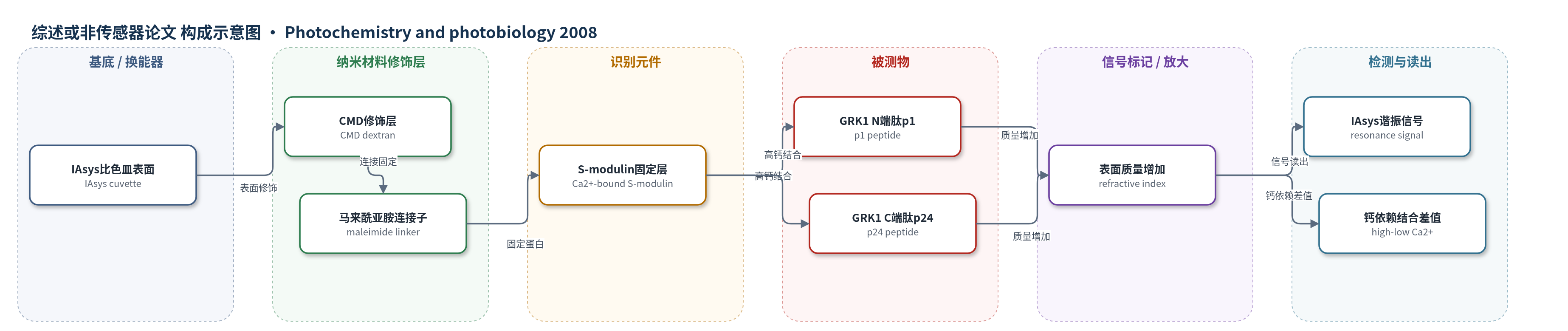
点击图片查看大图 · 依据论文自动绘制
传感器类型
综述或非传感器论文
检测对象
GRK1/GRK7 部分肽(GRK1/GRK7 partial peptides,p1、p24 等),样品基质:HEPES 缓冲液(低钙/高钙条件)
检测原理
该研究将 S-modulin 通过羧甲基化葡聚糖(CMD)和马来酰亚胺连接子固定于 IAsys 谐振镜比色皿表面。在高钙缓冲液中,S-modulin 结合 Ca2+ 并暴露与 GRK1/GRK7 相互作用的结合位点;加入 GRK1/GRK7 部分肽后,肽与钙结合型 S-modulin 发生特异性结合。结合使传感器表面质量与局部折射率增加,IAsys 谐振镜检测到谐振信号上升。低钙条件下主要反映非特异吸附或背景,高钙信号减去低钙信号可获得钙依赖结合。信号幅度与结合到表面的肽分子数/质量成正比,因此可比较不同肽及突变肽的结合能力,并推断其与抑制 S-modulin 活性的关系。未使用酶催化或核酸扩增等放大策略。
检测灵敏度
原文未报告 LOD、线性范围、灵敏度斜率或相关系数。
效应效果
磷酸化抑制实验中,p1 将 S-modulin 活性降至对照约 25%,p24 降至约 62%;p1 与 p24 同时存在时实测为 17.7±10%(n=3),接近独立作用预测值 16%,说明二者结合不同区域。IAsys 结合测量中,p1 结合最强,p24 和 p3 有中等结合,p28 无显著结合;结合量与抑制程度总体相关良好。突变分析显示 L6A、N12A、Y15A 均降低结合和抑制,其中 L6 对结合尤为关键。实验通过低钙/高钙比较体现钙依赖性,结果以标准差报告(n=1–6),未给出 RSD、LOD 或回收率。作者认为该结果鉴定了 GRK1/GRK7 与 S-modulin/recoverin 相互作用的 N 端和 C 端区域。
传感器的构成
- 基底/换能器:IAsys 谐振镜比色皿表面(resonant mirror biosensor cuvette),提供光学谐振信号读出
- 修饰层:羧甲基化葡聚糖(CMD)表面,用于固定 S-modulin
- 连接层:磺基琥珀酰亚胺酯活化 CMD 与硫醇反应,经 linker sulfosuccinimidyl 4-(N-maleimidomethyl)cyclohexane-1-carboxylate 连接 S-modulin 的 Cys(C39/C107)
- 识别元件:S-modulin(钙结合形式),识别并结合 GRK1/GRK7 部分肽
- 信号读出:IAsys 谐振信号变化,反映表面结合质量/折射率变化
中文摘要
GRK1 是视杆细胞中负责灭活光激活视紫红质的视觉色素激酶,其活性可被 S-modulin/recoverin 的钙结合形式结合而抑制。作者此前已鉴定 S-modulin/recoverin 上与 GRK1 相互作用的氨基酸残基。本研究旨在鉴定 GRK1 中的对应结合位点。作者合成了覆盖 GRK1/GRK7 全序列的 29 个部分肽,并检测这些肽是否通过预先占据 GRK1 结合位点而抑制 S-modulin/recoverin 活性。结果显示,N 端肽 p1(GRK7 中 aa 3–23)抑制作用最强。对 p1 区域在 10 多个直系同源物中高度保守的 8 个残基逐一突变后,Leu6、Asn12 和 Tyr15 突变显著降低抑制作用。进一步利用谐振镜生物传感器检测野生型及突变肽与 S-modulin/recoverin 的结合,发现结合程度与肽的抑制程度良好相关,表明抑制源于激酶肽直接结合到活性 S-modulin/recoverin 的结合位点。此外,GRK1 靠近 C 端的区域也似乎是 S-modulin/recoverin 的结合位点。
英文摘要
GRK1 is a visual pigment kinase in rods and is essential for inactivation of light-activated rhodopsin. The GRK1 activity is inhibited by binding of the Ca(2+)-bound form of S-modulin/recoverin. We previously identified the S-modulin/recoverin site to interact with GRK1. In the present study, we identified its counterpart in GRK1. We synthesized 29 of GRK1 or GRK7 partial peptides that cover the entire sequence of GRK1/GRK7, and examined whether these peptides inhibit S-modulin/recoverin activity most probably by preoccupying the binding site for GRK1. The inhibition was the greatest with the N-terminal peptide (p1, aa 3-23 in GRK7). On mutation of each of eight amino acid residues highly conserved in the p1 region of more than 10 orthologs, the inhibition was significantly reduced in the mutation of Leu(6), Asn(12) and Tyr(15). We further examined the binding of the peptides, including mutated ones, to S-modulin/recoverin with a resonance mirror biosensor. The binding correlated well with the degree of the inhibition by a peptide. The inhibition, therefore, seemed to be due to a direct binding of the kinase peptide to the binding site of active S-modulin/recoverin. A GRK1 region close to its C-terminus also seemed to be the binding site for S-modulin/recoverin.