组成图示
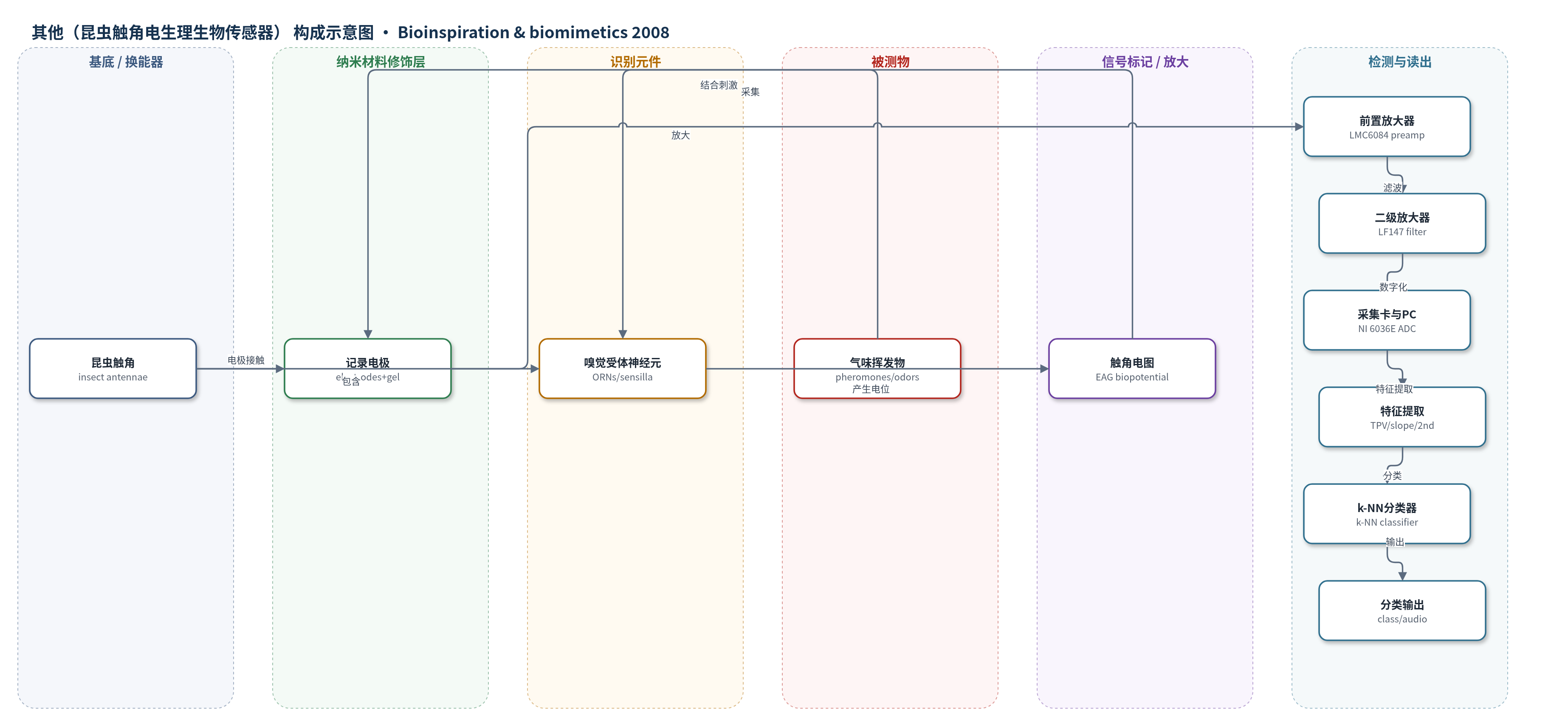
点击图片查看大图 · 依据论文自动绘制
传感器类型
其他(昆虫触角电生理生物传感器)
检测对象
空气/风洞气味羽流中的挥发物:(Z)-11-十六碳烯醛(Z11–16:Ald)、(Z)-11-十四碳烯基乙酸酯(Z11–14:Ac)、(E,E)-8,10-十二碳二烯-1-醇(E8,E10–12:OH)、(E)-11-十四碳烯-1-醇(E11–14:OH)、吲哚(indole)、丁酸(butyric acid)、香叶醛(citronellal)、侧柏酮(thujone)、1-苯基乙醇(acetophenol)、水杨酸甲酯(methyl salicylate)、苯乙醇(phenethyl alcohol)、(Z)-3-己烯基乙酸酯(Z3–6:Ac)
检测原理
气味分子进入昆虫触角感觉器(sensilla)的淋巴液,经气味结合蛋白递送至嗅觉受体神经元(ORN)膜受体,激活G蛋白偶联级联并引起膜电位去极化。大量ORN的总和响应在触角两端形成触角电图(EAG)生物电位。不同物种和性别触角对同一挥发物的响应幅度、上升斜率和波形二阶导数不同,构成多通道特征向量。系统以约100 Sa s−1采样,检测去极化事件,进行通道时间对齐,提取谷峰电压(TPV)、最大斜率和二阶导数。半参数检测器先剔除背景/噪声事件,k-NN分类器再对事件分类,并用模糊拒绝阈值丢弃不确定响应。信号随气味丝浓度变化主要体现在EAG幅度和特征值变化,但本系统主要用于实时分类而非绝对定量。
检测灵敏度
原文未报告LOD、线性范围、灵敏度斜率或相关系数。
效应效果
系统可在约1秒内完成从EAG去极化到分类报告,EAG生物响应本身约15–75毫秒,显著快于通常需数十秒至分钟达到稳态的人工鼻。4通道和8通道配置分别可训练并区分4种和8种气味,训练时间约20秒/气味和40秒/气味。在模糊拒绝参数0.6下,实验A、B、C的实时经验错误率分别为0.006、0.12、0.17,交叉验证为0.032、0.15、0.25,整体错误率低于0.2。与最小条件风险分类器相比,实验A中后者更优,实验B和C在较宽损失/收益范围内性能相当。系统通过带通滤波、两级分类和模糊拒绝抑制背景气味与噪声,但离体触角寿命通常30–90分钟,需更换并重新训练。
传感器的构成
- 生物识别/换能层:昆虫触角(insect antennae)及嗅觉受体神经元(ORNs),识别挥发物并产生电生理响应。
- 电极接触层:记录电极与公共接地电极(recording/ground electrodes)配合导电凝胶(conductive gel),采集触角两端EAG生物电位。
- 前置放大层:四通道前置放大器(LMC6084 CMOS op-amp),低噪声、低偏置电流,放大微弱EAG信号。
- 信号调理层:二级放大器(LF147 JFET op-amp)与直流阻断/抗混叠滤波器(fc=0.14 Hz, 34 Hz),抑制基线漂移和噪声。
- 数据采集层:16通道ADC(National Instruments 6036E)与便携式PC(Dell Inspiron 8200, LabVIEW 6.1),数字化并实时处理。
- 计算分类层:半参数检测器与k-NN分类器(k=10),提取TPV、斜率、二阶导数特征并实时分类/拒绝模糊事件。
中文摘要
当前人工鼻研究深受生物嗅觉系统启发。昆虫在数百万年进化中形成高灵敏、快速响应的嗅觉系统,可在与其运动能力匹配的时间尺度上识别挥发物。本研究利用昆虫触角这一生物嗅觉感觉器官构建混合器件生物传感器,展示在亚秒时间尺度上识别经过传感器的气味羽流中单个气味丝的能力。作者设计了便携式系统,利用由4或8种不同昆虫的雄性或雌性触角组成的传感器阵列,同步记录多通道触角电图(EAG)电生理响应。文中详细描述了用于实时气味区分的计算分析策略:经过训练后,采用半参数分类器和k近邻(k-NN)分类器,并引入模糊响应拒绝机制,对最多8种气味进行分类。对气味羽流中单个气味丝的分类或拒绝延迟约为1秒。研究还分析了分类错误率对训练点数、模糊拒绝参数等因素的依赖,并将实时方法性能与最小条件风险分类器进行比较。
英文摘要
Current trends in artificial nose research are strongly influenced by knowledge of biological olfactory systems. Insects have evolved over millions of years to detect and maneuver toward a food source or mate, or away from predators. The insect olfactory system is able to identify volatiles on a time scale that matches their ability to maneuver. Here, biological olfactory sense organs, insect antennae, have been exploited in a hybrid-device biosensor, demonstrating the ability to identify individual strands of odor in a plume passing over the sensor on a sub-second time scale. A portable system was designed to utilize the electrophysiological responses recorded from a sensor array composed of male or female antennae from four or eight different species of insects (a multi-channel electroantennogram, EAG). A computational analysis strategy that allows discrimination between odors in real time is described in detail. Following a training period, both semi-parametric and k-nearest neighbor (k-NN) classifiers with the ability to discard ambiguous responses are applied toward the classification of up to eight odors. EAG responses to individual strands in an odor plume are classified or discarded as ambiguous with a delay (sensor response to classification report) on the order of 1 s. The dependence of classification error rate on several parameters is described. Finally, the performance of the approach is compared to that of a minimal conditional risk classifier.