组成图示
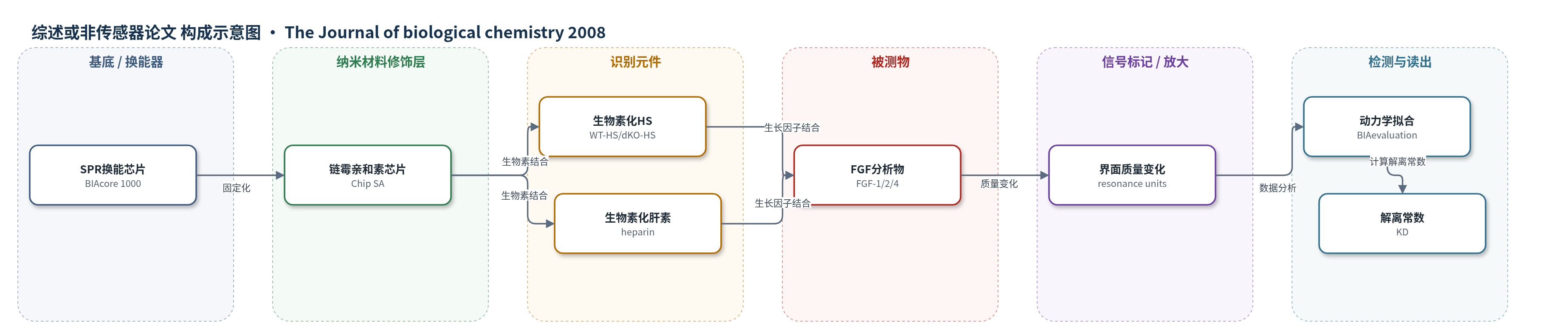
点击图片查看大图 · 依据论文自动绘制
传感器类型
综述或非传感器论文
检测对象
FGF-1(FGF-1)、FGF-2(FGF-2)、FGF-4(FGF-4);样品基质为重组蛋白 PBST 缓冲液
检测原理
本文以 BIAcore 1000 表面等离子共振(SPR)系统检测 FGF 与硫酸乙酰肝素(HS)的结合。链霉亲和素修饰的 Chip SA 通过生物素-链霉亲和素作用固定 NHS-LS-Biotin 标记的 WT-HS、dKO-HS 或肝素;重组 FGF-1、FGF-2 或 FGF-4 在 PBST 中流过芯片表面,与 GAG 结合后引起界面折射率/质量变化,产生共振单位(RU)响应。根据平衡响应 Scatchard 分析或动力学模型拟合得到结合/解离速率与 KD。HS 的 6-O-硫酸化缺失改变糖链硫酸化模式,使 FGF-1 和 FGF-4 亲和力下降,而 FGF-2 因 2-O-硫酸化增加亲和力升高,进而影响 FGF-FGFR-HS 三元复合物形成和 ERK 磷酸化。
检测灵敏度
原文未报告 LOD、线性范围、灵敏度斜率或 R^2。SPR 报告 KD:FGF-1/WT-HS 194 nM;FGF-1/dKO-HS 553 nM;FGF-1/heparin 98 nM;FGF-2/WT-HS 14.7 nM;FGF-2/dKO-HS 5.57 nM;FGF-2/heparin 3.82 nM;FGF-4/dKO-HS 449 nM;FGF-4/heparin 9.80 nM。
效应效果
SPR 至少两次独立实验。dKO-HS 对 FGF-1 KD 升高 2.8 倍,对 FGF-4 亲和力降至约 1/5,对 FGF-2 KD 降低 2.5 倍。heparitinase 去除细胞表面 HS 后,FGF-1/2/4 诱导的 FGFR1 磷酸化显著下降,提示 HS 介导信号。dKO-MEF 中 FGF-4 诱导 ERK 磷酸化降至 WT 的 15–40%,FGF-2 约 60%,FGF-1 低浓度约 70%。BrdUrd 掺入在 1 ng/ml FGF-1/2/4 下 dKO/WT 为 0.43/0.81/0.38,5 ng/ml FGF-4 为 0.29。100 ng/ml 肝素可恢复 dKO-MEF 的 FGF-4 信号,WT-HS/dKO-HS 不能。
传感器的构成
- 换能器芯片:BIAcore 1000 SPR 芯片,通过表面等离子共振检测结合事件
- 固定化界面:streptavidin-conjugated sensor Chip SA,提供链霉亲和素-生物素固定化位点
- 配体/识别层:biotinylated WT-HS 或 dKO-HS,经 NHS-LS-Biotin 标记后固定,用于结合 FGF
- 对照配体层:biotinylated heparin,作为高亲和力 GAG 对照
- 分析物:重组 FGF-1、FGF-2、FGF-4,在 PBST 中流动
- 运行/再生缓冲液:PBST 运行,2 M NaCl/PBST 再生芯片
- 读出系统:BIAevaluation 软件分析 sensorgrams,计算 KD
中文摘要
硫酸乙酰肝素(HS)通过与肝素结合生长因子相互作用调控其生物活性,这种作用依赖硫酸化模式和糖醛酸异构体结构。HS 6-O-硫酸化由三种 HS6-O-硫酸基转移酶催化。作者构建了 HS6ST-1 和/或 HS6ST-2 缺陷小鼠。取自 E14.5 双敲除(dKO)小鼠的胚胎成纤维细胞(MEF)产生的 HS 几乎不含 6-O-硫酸基,而 2-O-硫酸化增加 1.9 倍;dKO-MEF 中 HS6ST 活性几乎检测不到,HS2ST 活性较野生型高 1.5 倍。dKO-MEF 对成纤维细胞生长因子(FGF)的响应与野生型不同:FGF-4 和 FGF-2 依赖信号分别降至野生型的约 30% 和 60%,FGF-1 信号仅在低浓度时中度降低。表面等离子共振分析显示,dKO-HS 对 FGF-4 的表观亲和力显著降低,对 FGF-1 也降低,而对 FGF-2 的亲和力较野生型 HS 高 2.5 倍。结果表明,HS 中 6-O-硫酸基可能通过诱导配体与受体之间的不同相互作用,调控包括 FGF 在内的多种肝素结合生长因子信号。
英文摘要
Heparan sulfate (HS) interacts with diverse heparin-binding growth factors and thereby regulates their bioactivities. These interactions depend on the structures characterized by the sulfation pattern and isomer of uronic acid residues. One of the biosynthetic modifications of HS, namely 6-O-sulfation, is catalyzed by three isoforms of HS6-O-sulfotransferase. We generated HS6ST-1- and/or HS6ST-2-deficient mice (6ST1-KO, 6ST2-KO, and double knock-out (dKO)) that exhibited different phenotypes. We examined the effects of HS 6-O-sulfation in heparin-binding growth factor signaling using fibroblasts derived from these mutant mice. Mouse embryonic fibroblasts (MEF) prepared from E14.5 dKO mice produced HS with little 6-O-sulfate, whereas 2-O-sulfation in HS from dKO-MEF (dKO-HS) was increased by 1.9-fold. HS6-O-sulfotransferase activity in the dKO-MEF was hardly detected, and HS2-O-sulfotransferase activity was 1.5-fold higher than that in wild type (WT)-MEFs. The response of dKO-MEFs to fibroblast growth factors (FGFs) was distinct from that of WT-MEFs; in dKO-MEFs, FGF-4- and FGF-2-dependent signalings were reduced to approximately 30 and 60% of WT-MEFs, respectively, and FGF-1-dependent signaling was moderately reduced compared with that of WT-MEFs but only at the lower FGF-1 concentrations. Analysis with a surface plasmon resonance biosensor demonstrated that the apparent affinity of dKO-HS for FGF-4 was markedly reduced and was also reduced for FGF-1. In contrast, the affinity of dKO-HS for FGF-2 was 2.5-fold higher than that of HS from WT-MEFs. Thus, 6-O-sulfate in HS may regulate the signalings of some of HB-GFs, including FGFs, by inducing different interactions between ligands and their receptors.