组成图示
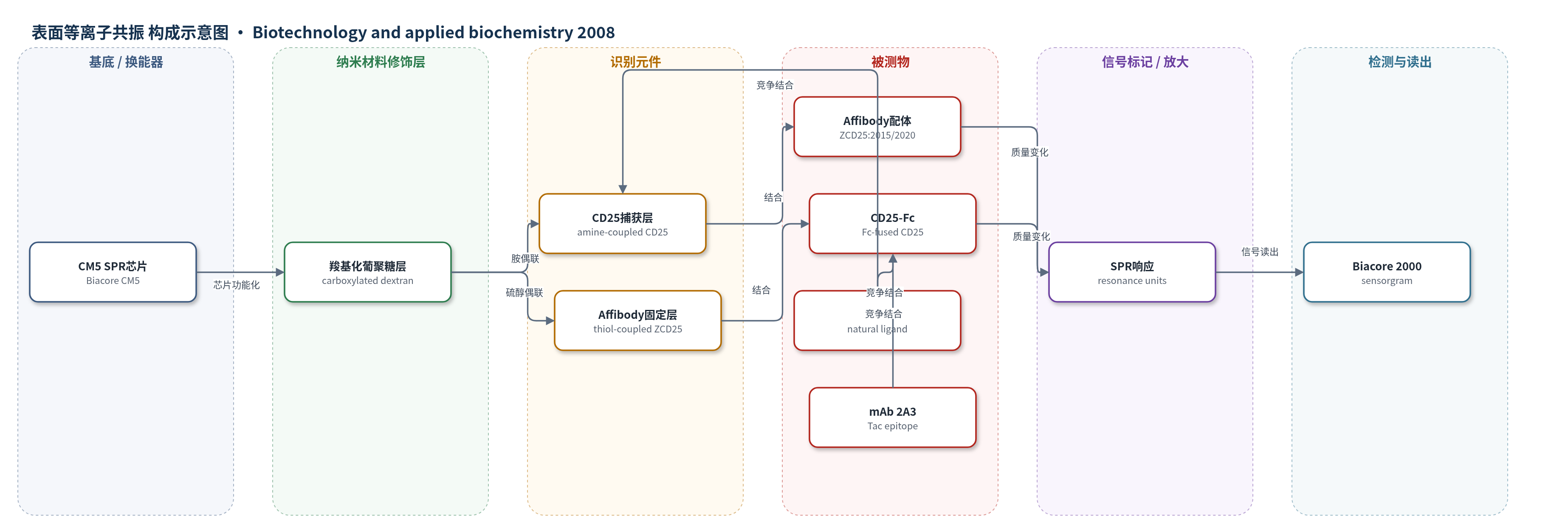
点击图片查看大图 · 依据论文自动绘制
传感器类型
表面等离子共振(SPR)生物传感器
检测对象
人白细胞介素-2受体α/CD25(IL-2Rα/CD25)、Affibody配体(ZCD25:2015/ZCD25:2020)、IL-2、抗CD25单抗;样品基质:重组蛋白溶液(HBS-EP缓冲液)、细胞表面(PBMC、NK92、PHA激活PBMC)
检测原理
将重组CD25或CD25-Fc经胺偶联固定于CM5芯片,或将C端半胱氨酸Affibody二聚体经硫醇偶联固定,形成识别界面。Affibody单体/二聚体、CD25-Fc、IL-2或单抗在HBS-EP缓冲液中流过芯片,与固定层发生特异性结合。结合事件改变芯片表面质量/折射率,引起表面等离子共振角位移,以共振单位(RU)实时记录。分析物浓度越高,结合量越大,响应信号越强;通过结合与解离曲线拟合得到KD。竞争实验中,IL-2或mAb 2A3与CD25-Fc预混或共注射,若占据同一Tac表位则降低Affibody结合响应,从而判断表位重叠。二聚体Affibody通过亲合力增强表观结合。
检测灵敏度
KD: 240 nM(ZCD25:2015);KD: 130 nM(ZCD25:2020);动力学分析浓度: 5–640 nM
效应效果
筛选获16个独特CD25结合Affibody分子,Z2磁珠阳性克隆约42%,Protein A约8%;5个候选中4个SPR显著结合CD25。ZCD25:2020与ZCD25:2015的KD为130和240 nM,二聚体解离更慢,预期表观亲和力提高5–10倍。对9种人血清蛋白及Fc、链霉亲和素仅极低背景,人CD25与鼠CD25响应差近100倍。竞争实验示与IL-2和mAb 2A3竞争Tac表位,不与ON94或M-A251竞争。免疫荧光和流式证实结合NK92、CD4+CD25+ PBMC及PHA激活PBMC,不结合CD25−细胞,可用于医学影像和治疗。
传感器的构成
- 换能器基底:Biacore 2000 SPR 芯片(CM5),提供表面等离子共振检测界面
- 功能化层:CM5 芯片羧基化葡聚糖层(carboxylated dextran layer),用于胺偶联或硫醇偶联固定蛋白
- 捕获识别层:重组人 IL-2Rα/CD25 或 CD25-Fc 经胺偶联固定于 CM5 表面,作为捕获靶标
- 定向捕获层:Protein A 固定于 CM5 表面,用于定向捕获 CD25-Fc 并验证固定方式不影响结合
- 配体固定层:C 端半胱氨酸 Affibody 二聚体(His6-(ZCD25:2015)2-Cys、His6-(ZCD25:2020)2-Cys)经硫醇偶联固定,用于特异性和竞争分析
- 分析物/识别配体:His6 标记 Affibody 单体/二聚体(ZCD25:2015、ZCD25:2020)、CD25-Fc、IL-2 及抗 CD25 单抗,作为流动相结合物
- 缓冲与再生体系:HBS-EP 缓冲液(Hepes、NaCl、EDTA、P20)维持结合环境;10 mM HCl 用于表面再生,参考通道扣除背景
中文摘要
本研究利用噬菌体展示技术,从基于58个氨基酸Protein A衍生Z结构域的组合蛋白库中筛选出特异性结合人白细胞介素-2受体α亚基(IL-2Rα/CD25)的Affibody®分子。IL-2R系统参与T细胞活化与免疫应答调节,CD25在器官排斥、自身免疫病和T细胞恶性肿瘤中过表达。以Fc融合靶蛋白进行噬菌体展示筛选,共获得16个独特CD25结合Affibody分子。对两个最优结合物进行生物传感器分析,显示其强且选择性结合CD25;动力学分析表明两个单体Affibody分子与CD25的表观亲和力分别为130和240 nM。生物传感器竞争实验显示,这些Affibody分子与自然配体IL-2及IL-2阻断性单抗2A3竞争同一结合位点,推测其与靶向Tac表位的抗体(如Daclizumab、Basiliximab)结合位点重叠。免疫荧光显微镜和流式细胞术进一步证明所选Affibody分子可结合CD4+CD25+外周血单个核细胞、IL-2依赖细胞系NK92及植物血凝素激活的外周血单个核细胞。作者讨论了CD25结合Affibody分子用于医学影像和治疗的潜力。
英文摘要
Affibody molecules specific for human IL-2Ralpha, the IL-2 (interleukin-2) receptor alpha subunit, also known as CD25, were selected by phage-display technology from a combinatorial protein library based on the 58-residue Protein A-derived Z domain. The IL-2R system plays a major role in T-cell activation and the regulation of cellular immune responses. Moreover, CD25 has been found to be overexpressed in organ rejections, a number of autoimmune diseases and T-cell malignancies. The phage-display selection using Fc-fused target protein generated 16 unique Affibody molecules targeting CD25. The two most promising binders were characterized in more detail using biosensor analysis and demonstrated strong and selective binding to CD25. Kinetic biosensor analysis revealed that the two monomeric Affibody molecules bound to CD25 with apparent affinities of 130 and 240 nM respectively. The Affibody molecules were, on biosensor analysis, found to compete for the same binding site as the natural ligand IL-2 and the IL-2 blocking monoclonal antibody 2A3. Hence the Affibody molecules were assumed to have an overlapping binding site with IL-2 and antibodies targeting the IL-2 blocking Tac epitope (for example, the monoclonal antibodies Daclizumab and Basiliximab, both of which have been approved for therapeutic use). Furthermore, immunofluorescence microscopy and flow-cytometric analysis of CD25-expressing cells demonstrated that the selected Affibody molecules bound to CD4+ CD25+ PMBCs (peripheral-blood mononuclear cells), the IL-2-dependent cell line NK92 and phytohaemagglutinin-activated PMBCs. The potential use of the CD25-binding Affibody molecules as targeting agents for medical imaging and for therapeutic applications is discussed.