组成图示
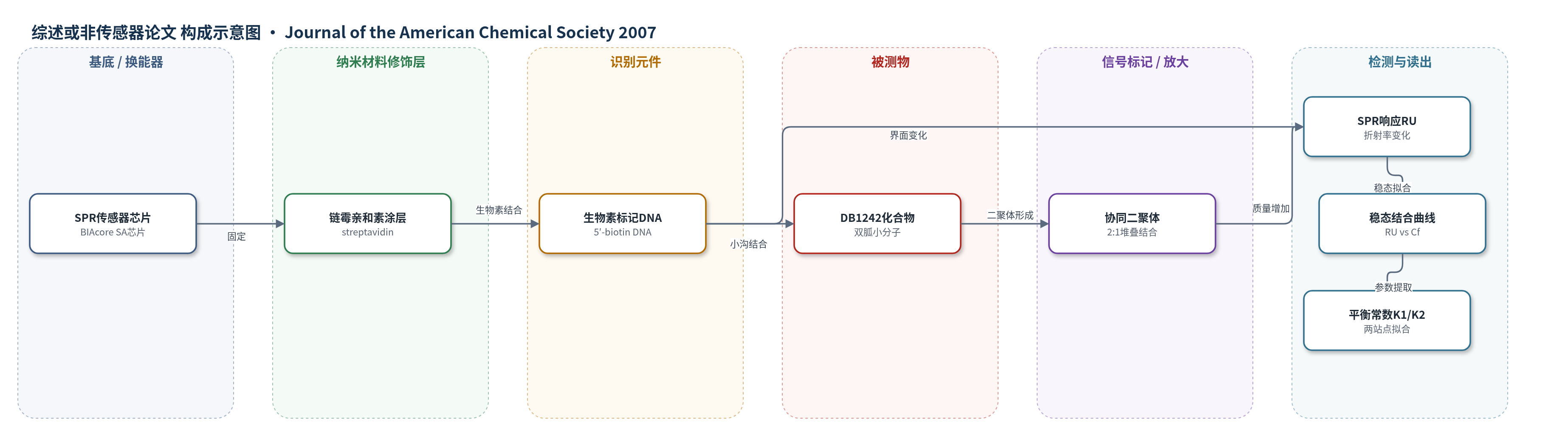
点击图片查看大图 · 依据论文自动绘制
传感器类型
综述或非传感器论文
检测对象
DNA小沟结合双胍化合物(DB1242、DB1111、DB1164);样品基质:10 mM cacodylic acid buffer, pH 6.25, 100 mM NaCl, 1 mM EDTA 溶液;固定化靶标:-GCTCG- 或 -AATT- DNA 发夹
检测原理
SPR 芯片表面经链霉亲和素固定 5′-生物素标记 DNA 发夹双链。当含 DB1242 等双胍化合物的缓冲液流过芯片时,化合物进入 DNA 小沟并与特定序列结合。结合事件使芯片表面质量/折射率增加,SPR 共振角偏移,以响应单位 RU 读出。稳态 RU 随游离化合物浓度 Cf 增加而上升;对 -GCTCG- 序列,DB1242 呈两站点强正协同结合,第一分子结合后促进第二分子形成堆叠二聚体,K2 远大于 K1,因此曲线呈协同弯曲。对 -AATT- 序列仅弱非特异结合。该过程无酶或荧光放大,信号放大主要来自二聚体协同结合和双分子界面质量增加。
检测灵敏度
未报告 LOD、线性范围、灵敏度斜率、相关系数。SPR 稳态分析浓度:0.1, 0.3, 0.5, 1.0, 1.4, 1.8, 2.2, 2.4, 2.8, 3.5, to 4.0 µM;DB1242–GCTCG: K1 = 2.0 × 10^4 M^-1, K2 = 9.1 × 10^6 M^-1;DB1242–AATT: K = 3.1 × 10^5 M^-1。
效应效果
SPR 三次独立实验可重复。DB1242 对 -GCTCG- 呈强协同二聚体结合,K1 = 2.0 × 10^4 M^-1、K2 = 9.1 × 10^6 M^-1,K2/K1 超 500 倍;对 -AATT- 仅 K = 3.1 × 10^5 M^-1。DB1111/DB1164 对 -AATT- 更强(2.1 × 10^6、5.8 × 10^6 M^-1),对 -GCTCG- 弱于 2.0 × 10^5 M^-1。DNase I 足迹显示 DB1242 在 -GCTCG- 强保护,DB75 无足迹;netropsin 对 -AATT- K = 3.6 × 10^7 M^-1,对 -GCTCG- 无显著结合。ITC 第二结合焓约 -15.7 kcal/mol,CD 呈正诱导信号。作者认为其是首个特异性识别 GC 富集序列的非聚酰胺合成化合物,具药物设计价值。
传感器的构成
- 基底/换能器:BIAcore 2000 光学生物传感器系统中的 SPR 传感器芯片(BIAcore SA),提供表面等离子共振信号读出
- 修饰层:链霉亲和素(streptavidin)涂层,用于捕获生物素标记 DNA
- 识别元件:5′-生物素标记 DNA 发夹双链(含 -GCTCG- 或 -AATT- 序列),作为固定化靶标序列
- 信号标记物:无外源标记;DB1242、DB1111、DB1164 等双胍化合物直接结合 DNA,引起界面折射率变化
- 缓冲介质:10 mM cacodylic acid buffer, pH 6.25, 100 mM NaCl, 1 mM EDTA,维持结合条件
中文摘要
传统 DNA 小沟结合剂模型要求分子呈新月形以匹配小沟螺旋曲率,但近年发现一些相对线性且二面角扭转较大的化合物也能强结合小沟,这促使研究者考察曲率要求可放宽的程度。作为实验分析的第一步,作者合成了线性三苯基双胍 DB1111 及一系列含氮三环类似物,旨在将 GC 结合选择性引入可进入细胞并发挥生物效应的杂环化合物。这些化合物从胍基碳到胍基碳的曲率半径为零,但在三环与胍基环连接处存在显著二面角扭转,按形状匹配标准不应良好结合 DNA 小沟。DNase I 足迹实验显示,嘧啶杂环衍生物 DB1242 特异性结合富含 GC 的序列 -GCTCG-,且结合强于弯曲小沟结合剂通常识别的 AT 序列;其他类似衍生物未显示该 GC 特异性。生物传感器表面等离子共振和等温滴定量热实验表明,DB1242 以高度协同的堆叠二聚体形式结合 GC 序列;圆二色性结果支持其结合于小沟。分子模拟支持小沟复合物,并从分子间及化合物-DNA 氢键角度解释了异常 GC 特异性和嘧啶杂环的必要性。该化合物代表 DNA 序列特异性试剂开发的新方向,是首个特异性识别以 GC 碱基对为主的 DNA 序列的非聚酰胺合成化合物。
英文摘要
The classical model of DNA minor groove binding compounds is that they should have a crescent shape that closely fits the helical twist of the groove. Several compounds with relatively linear shape and large dihedral twist, however, have been found recently to bind strongly to the minor groove. These observations raise the question of how far the curvature requirement could be relaxed. As an initial step in experimental analysis of this question, a linear triphenyl diamidine, DB1111, and a series of nitrogen tricyclic analogues were prepared. The goal with the heterocycles is to design GC binding selectivity into heterocyclic compounds that can get into cells and exert biological effects. The compounds have a zero radius of curvature from amidine carbon to amidine carbon but a significant dihedral twist across the tricyclic and amidine-ring junctions. They would not be expected to bind well to the DNA minor groove by shape-matching criteria. Detailed DNase I footprinting studies of the sequence specificity of this set of diamidines indicated that a pyrimidine heterocyclic derivative, DB1242, binds specifically to a GC-rich sequence, -GCTCG-. It binds to the GC sequence more strongly than to the usual AT recognition sequences for curved minor groove agents. Other similar derivatives did not exhibit the GC specificity. Biosensor-surface plasmon resonance and isothermal titration calorimetry experiments indicate that DB1242 binds to the GC sequence as a highly cooperative stacked dimer. Circular dichroism results indicate that the compound binds in the minor groove. Molecular modeling studies support a minor groove complex and provide an inter-compound and compound-DNA hydrogen-bonding rational for the unusual GC binding specificity and the requirement for a pyrimidine heterocycle. This compound represents a new direction in the development of DNA sequence-specific agents, and it is the first non-polyamide, synthetic compound to specifically recognize a DNA sequence with a majority of GC base pairs.