组成图示
点击图片查看大图 · 依据论文自动绘制
传感器类型
综述或非传感器论文
检测对象
短小芽孢杆菌芽孢(Bacillus atrophaeus spores,旧称 B. globigii/B. subtilis var. Niger)、荧光微球(FluoSpheres);样品基质:自来水管网水/氯胺自来水(chloraminated tap water)
检测原理
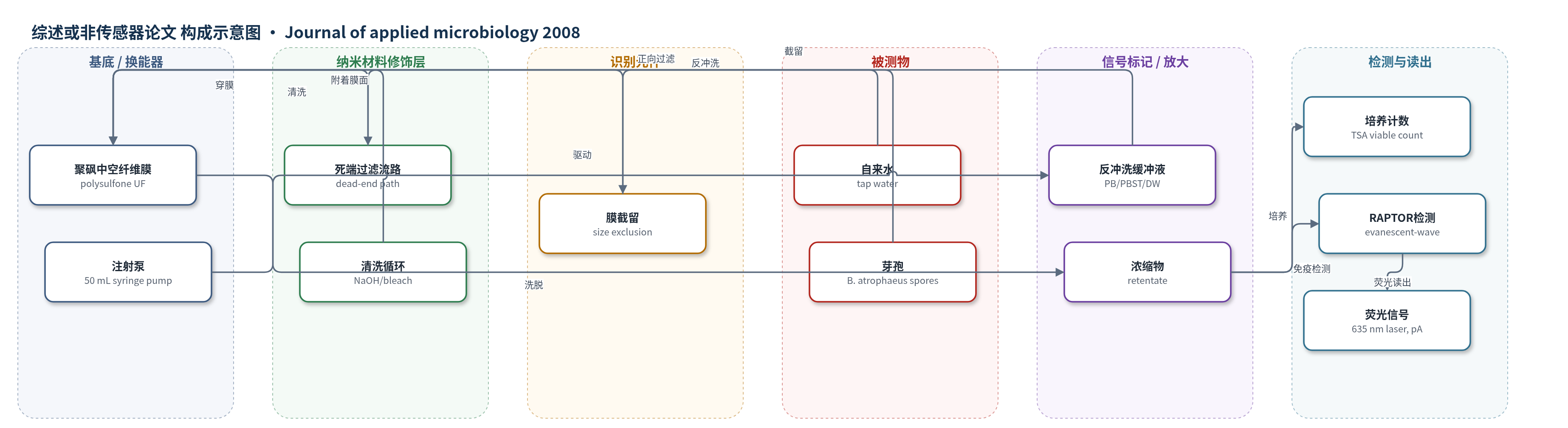
系统利用供水压力或泵驱动自来水进入死端中空纤维超滤膜,水和小分子透过膜排出,微生物及颗粒被25–30 nm膜孔截留并富集在纤维内。随后注射泵将缓冲液反向注入,从膜外到膜内反冲洗,将截留的芽孢洗脱为小体积浓缩物,使目标浓度提高。浓缩物可送培养计数,或接入RAPTOR消逝波免疫传感器:波导表面固定兔抗B. atrophaeus多克隆抗体捕获目标,再用Cy5标记抗体形成夹心复合物,635 nm激光激发后荧光强度变化(pA)随目标浓度增加。该策略以物理浓缩为主,免疫夹心检测为辅。
检测灵敏度
R^2 = 0.852
效应效果
半自动试验微球回收率98%±59%,芽孢81%±38%;PB反冲洗94%±48%,PBST 71%±32%,DW显著更低(P=0.007)。全自动现场9次平均回收率36%±18%,高加标2.9×10^7–1.0×10^9 CFU时浓缩物3.2×10^4–1.4×10^6 CFU/mL,回收率21%–68%;低水平<10 CFU/L、加标338–997 CFU、处理109–116 L时平均回收率30%±9%,浓缩物0.78–1.56 CFU/mL。RAPTOR对1.8×10^6 CFU/mL浓缩物给出63.5 pA正信号。作者认为检测灵敏度是主要限制,装置为在线监测提供前处理。
传感器的构成
- 过滤基底:聚砜中空纤维超滤膜(polysulfone hollow-fibre ultrafilter),截留尺寸25–30 nm、表面积0.07 m²,用于截留微生物和颗粒。
- 流路结构:死端过滤路径(dead-end filtration path),末端封闭,水在压力或泵驱动下穿过纤维,渗透液排至排水。
- 驱动组件:供水压力或泵(water line pressure/pump),提供正向过滤动力,平均流速约1.2–1.9 L/min。
- 回收组件:50 mL注射泵(syringe pump)驱动反冲洗缓冲液(PB、PBST、DW或PB-NaPP),从外到内洗脱截留物并收集浓缩物。
- 清洗组件:热0.1 N NaOH或100 ppm缓冲漂白液循环清洗,1%亚硫酸氢盐储存,用于去除残留微生物并抑制生长。
- 检测接口:可选电子信号触发连接RAPTOR消逝波免疫传感器(evanescent-wave biosensor),用于后续免疫检测。
中文摘要
目的:稀释于大量水中的病原体需先浓缩才能检测,部署在饮用水管网中的自动浓缩系统有助于快速发现污染并降低公共卫生风险。方法:作者基于死端中空纤维超滤开发了原型自动浓缩装置,直接从自来水中浓缩短小芽孢杆菌(Bacillus atrophaeus)芽孢,并通过反冲洗回收膜上截留的颗粒。结果:在供水管网现场试验中,当向系统加入2.9×10^7–1.0×10^9 CFU芽孢时,从滤器中回收3.2×10^4–1.4×10^6 CFU/mL(共6.1×10^6–3.0×10^8 CFU),处理水量15–21 L时回收率为21%–68%;当进水芽孢水平低于10 CFU/L(加标少于1000 CFU)时,处理超过100 L水样的回收率为23%–40%。结论:该自动死端中空纤维超滤系统可直接从自来水中浓缩低水平芽孢,为在线自主监测提供关键样品前处理步骤,回收样品可用标准方法或快速生物传感器分析。
英文摘要
AIMS: Concentration of pathogens diluted in large volumes of water is necessary for their detection. An automated concentration system placed online in drinking water distribution systems would facilitate detection and mitigate the risk to public health.
METHODS AND RESULTS: A prototype concentrator based on dead-end hollow fibre ultrafiltration was used to concentrate Bacillus atrophaeus spores directly from tap water. Backflush was used to recover accumulated particulates for analysis. In field tests conducted on a water utility distribution system, 3.2 x 10(4)-1.4 x 10(6) CFU ml(-1) (6.1 x 10(6)-3.0 x 10(8) CFU) were recovered from the filter when 2.9 x 10(7)-1.0 x 10(9) CFU were spiked into the system. Per cent recovery ranged from 21% to 68% for flow volumes of 15-21 l. Tests using spore influent levels <10 CFU l(-1) (spike < 1000 CFU) yielded 23-40% recovery for volumes >100 l.
CONCLUSIONS: B. atrophaeus spores at levels <10 CFU l(-1) were concentrated directly from tap water using an automated dead-end hollow-fibre ultrafiltration system.
SIGNIFICANCE AND IMPACT OF THE STUDY: The prototype concentrator represents a critical step towards an autonomous system that could be installed in drinking water distribution lines or other critical water lines to facilitate monitoring. Recovered samples can be analysed using standard or rapid biosensor methods.