组成图示
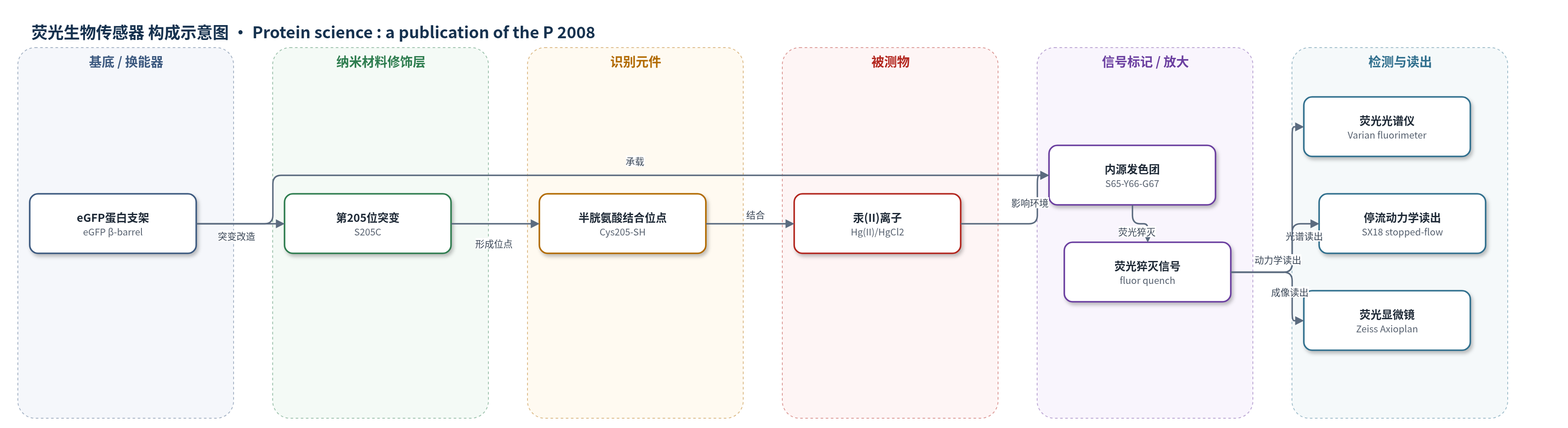
点击图片查看大图 · 依据论文自动绘制
传感器类型
荧光生物传感器
检测对象
汞(II)离子(Hg(II),以HgCl2形式);样品基质:标准缓冲液(50 mM Tris-HCl pH 8.0、100 mM NaCl)、LB培养基、大肠杆菌/线虫等活体样品
检测原理
eGFP205C将识别与报告功能直接偶联:第205位半胱氨酸(Cys205)位于GFP内源发色团(S65-Y66-G67)附近,Hg(II)与巯基快速、近乎不可逆地1:1结合(质谱增加约199 Da)。结合事件改变发色团周围氢键网络和电子环境,使吸收峰由489 nm红移至约498 nm,并在中性pH下引起荧光猝灭。随着Hg(II)浓度升高,荧光下降呈S型结合曲线,低纳摩尔范围即可检测。停流实验显示结合为单指数过程,200 µM HgCl2时约80 ms内大部分荧光猝灭,速率常数约1.05 s^-1。在活菌或线虫中遗传表达该蛋白后,细胞内Hg(II)结合传感器导致荧光降低,可用荧光显微镜实时成像。
检测灵敏度
LOD: low nanomolar range; ~2 nM HgCl2
效应效果
该传感器对Hg(II)选择性高:在Fe、Co、Zn、Cu、Ni、Cd等金属存在下,仅Hg引起显著荧光猝灭,约70%猝灭;eGFP205C比eGFP203C灵敏度约高150倍(75 nM蛋白)。结合快速且不可逆,β-巯基乙醇、谷胱甘肽或EDTA不能恢复荧光。停流动力学显示200 µM HgCl2下约80 ms内大部分猝灭,k≈1.05 s^-1。活菌过表达eGFP205C后,暴露20 µM Hg(II)数秒内荧光猝灭,60–120 min内细菌仍存活;作者认为低表达水平可进一步提高体内检测限至纳摩尔范围,适用于活体组织汞摄取与积累的实时监测。
传感器的构成
- 蛋白支架/换能器:增强型绿色荧光蛋白(eGFP)β-桶状蛋白,提供稳定支架并承载内源发色团
- 识别元件:第205位半胱氨酸突变(eGFP205C,Cys205),位于发色团附近,作为Hg(II)特异性结合位点
- 信号标记物:GFP内源发色团(S65-Y66-G67),汞结合后吸收红移并引起荧光猝灭
- 表达载体:pET151质粒(Invitrogen)与pBAD模板,用于突变GFP基因克隆和表达
- 表达宿主:大肠杆菌BL21-AI(E. coli BL21-AI),用于蛋白过表达及活菌传感演示
- 应用基质:LB培养基、细菌细胞或线虫(C. elegans)等活体样品,用于非侵入荧光成像
中文摘要
汞是广泛存在且毒性极强的污染物,汞(II)可经肠道、肾脏和肝脏快速吸收,干扰多种生化过程。本研究报道一种基于绿色荧光蛋白(GFP)的新型荧光生物传感器,用于在非侵入性体内条件下直接监测汞的摄取与分布。研究者在位于发色团附近的位置205引入半胱氨酸,将水母绿色荧光蛋白(GFP)改造为对Hg(II)具有高特异性的传感器。突变蛋白eGFP205C在中性pH下发生汞化后,吸收光谱和荧光光谱均发生显著变化;吸收与荧光响应随汞浓度呈S型结合行为,检出限处于低纳摩尔范围。时间分辨结合实验表明金属与蛋白结合为亚秒级快速过程。eGFP205C晶体结构提示汞可能通过蛋白核心通道进入并结合。该工程蛋白据作者所知是首个可用于活细胞汞摄取非侵入、实时成像的生物传感器,其表达可遗传控制,有利于开展组织特异性汞摄取研究。
英文摘要
Mercury is a ubiquitous pollutant that when absorbed is extremely toxic to a wide variety of biochemical processes. Mercury (II) is a strong, "invisible" poison that is rapidly absorbed by tissues of the intestinal tract, kidneys, and liver upon ingestion. In this study, a novel fluorescence-based biosensor is presented that allows for the direct monitoring of the uptake and distribution of the metal under noninvasive in vivo conditions. With the introduction of a cysteine residue at position 205, located in close proximity to the chromophore, the green fluorescent protein (GFP) from Aequorea victoria was converted into a highly specific biosensor for this metal ion. The mutant protein exhibits a dramatic absorbance and fluorescence change upon mercuration at neutral pH. Absorbance and fluorescence properties with respect to the metal concentration exhibit sigmoidal binding behavior with a detection limit in the low nanomolar range. Time-resolved binding studies indicate rapid subsecond binding of the metal to the protein. The crystal structures obtained of mutant eGFP205C indicate a possible access route of the metal into the core of the protein. To our knowledge, this engineered protein is a first example of a biosensor that allows for noninvasive and real-time imaging of mercury uptake in a living cell. A major advantage is that its expression can be genetically controlled in many organisms to enable unprecedented studies of tissue specific mercury uptake.