组成图示
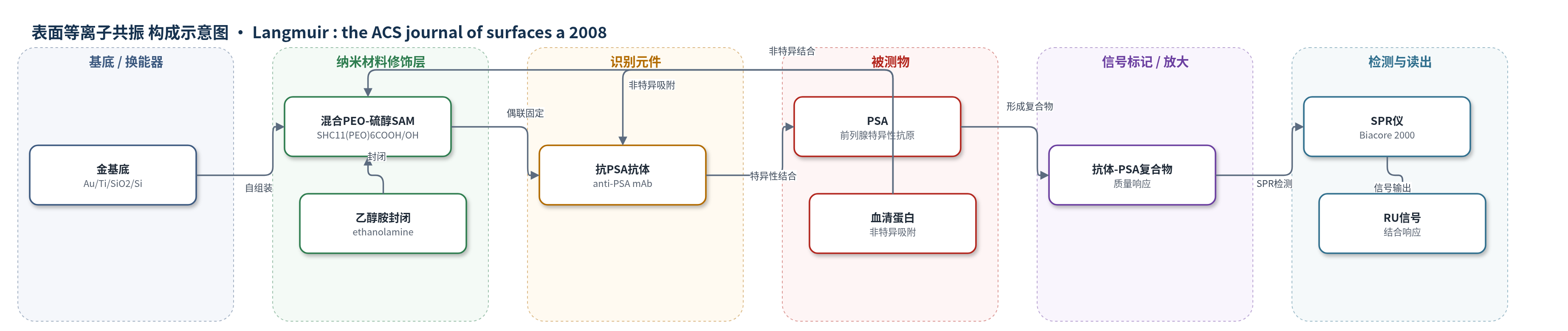
点击图片查看大图 · 依据论文自动绘制
传感器类型
表面等离子共振(SPR)生物传感器
检测对象
前列腺特异性抗原(PSA, prostate specific antigen),样品基质为 HBS 缓冲液;另以 2× 稀释正常女性血清(normal female serum)评估非特异吸附。
检测原理
金表面混合 PEO-硫醇 SAM 同时提供羧基(COOH)和 PEO/OH 抗非特异层。EDC/NHS 活化 SAM 上的 COOH 后,与抗 PSA 单克隆抗体的氨基形成酰胺键,实现随机共价固定;乙醇胺封闭剩余活化基团,甘氨酸-HCl 去除非共价结合抗体。PSA 在 HBS 中流过表面时与抗体特异性结合,形成抗体-PSA复合物,使金表面质量增加并改变表面等离子体共振条件,SPR 仪以响应单位(RU)记录结合信号,PSA 浓度越高,识别信号越大。未结合位点或 SAM 缺陷处可发生血清蛋白非特异吸附,形成背景。该体系无酶或核酸放大,信号直接来自抗原-抗体结合质量;SAM 密度和 PEO 构象变化会影响抗体固定量、识别信号和非特异结合。
检测灵敏度
原文未报告 LOD、线性范围、灵敏度斜率或相关系数。
效应效果
在空气和氮气中储存30天,抗体固定量保持约5000 RU(约5000 µg/cm2),1 µg/mL PSA识别信号稳定,血清非特异结合约230 RU。水和PBS中仅轻微变化,PBS非特异结合不变,水中略升。乙醇最差:18天后固定量从约5000 RU降至约2400 RU,PSA识别信号明显下降,非特异结合增加约3倍;XPS显示硫头基部分氧化(168 eV峰),GA-FTIR显示PEO构象无序化。未报告RSD、回收率或方法对比。作者认为N2、空气和PBS适合长期储存,避免乙醇可保持SAM特性,利于免疫传感器应用。
传感器的构成
- 基底/换能器电极:硅片上热氧化 SiO2,电子束蒸发 10 nm Ti 和 100 nm Au(表征样品)或 2 nm Ti 和 50 nm Au(SPR 样品),金表面作为 SPR 换能基底
- 混合PEO-硫醇SAM:SHC11(PEO)6COOH 与 SHC11(PEO)3OH 按 5:95 v/v、1 mM 在乙醇中共自组装 3 h,COOH 用于抗体偶联,PEO/OH 降低非特异吸附
- 识别元件:抗PSA单克隆抗体(anti-PSA monoclonal antibody,PSA66),经 EDC/NHS 活化 SAM 羧基后通过氨基随机偶联固定
- 封闭剂:1 M 乙醇胺(ethanolamine,pH 8.5)封闭剩余 NHS 酯;10 mM 甘氨酸-HCl(glycine-HCl,pH 2.2)清洗非共价抗体并再生表面
- 信号标记物:无外源标记,PSA 直接结合抗体后以质量响应产生 SPR 信号
- 读出系统:Biacore 2000 SPR 仪,在 HBS 缓冲液流动下监测响应单位(RU)
中文摘要
成功的亲和生物传感器很大程度上取决于换能系统与生物受体间的化学界面层。过去十年,金表面烷硫醇自组装单分子层(SAM)被广泛用于构建生物传感界面,含聚环氧乙烷(PEO)硫醇的混合 SAM 也常用于固定生物受体。然而,此类 SAM 的生物传感性能与长期稳定性之间的关系仍了解有限,储存条件的影响此前未见报道。本文制备混合 PEO-硫醇 SAM,在空气、氮气、乙醇、磷酸盐缓冲液和水中考察其稳定性与生物传感性能。采用循环伏安法、接触角、掠角傅里叶变换红外光谱和 X 射线光电子能谱监测 SAM 质量变化,并用表面等离子共振(SPR)以前列腺特异性抗原(PSA)为模型,研究受体固定、分析物识别和非特异结合。结果表明,SAM 微小结构差异会显著影响最终传感性能;空气或氮气中储存的混合 SAM 至少 30 天保持性能,而乙醇因硫醇头基部分氧化成为最差储存介质。因此,储存中避免 SAM 降解对保持其特性并拓展应用很重要。
英文摘要
The secret of a successful affinity biosensor partially hides in the chemical interface layer between the transducer system and the biological receptor molecules. Over the past decade, several methodologies for the construction of such interface layers have been developed on the basis of the deposition of self-assembled monolayers (SAMs) of alkanethiols on gold. Moreover, mixed SAMs of polyethylene oxide (PEO) containing thiols have been applied for the immobilization of biological receptors. Despite the intense research in the field of thiol SAMs, relatively little is known about their biosensing properties in correlation with their long-term stability. Especially the impact of the storage conditions on their biosensing characteristics has not been reported before to our knowledge. To address these issues, we prepared mixed PEO SAMs and tested their stability and biosensing performance in several storage conditions, i.e., air, N2, ethanol, phosphate buffer, and H2O. The quality of the SAMs was monitored as a function of time using various characterization techniques such as cyclic voltammetry, contact angle, grazing angle Fourier-transform infrared spectroscopy, and X-ray photoelectron spectroscopy. In addition, the impact of the different storage conditions on the biosensor properties was investigated using surface plasmon resonance. Via the latter technique, the receptor immobilization, the analyte recognition, and the nonspecific binding were extensively studied using the prostate specific antigen as a model system. Our experiments showed that very small structural differences in the SAM can have a great impact in their final biosensing properties. In addition it was shown that the mixed SAMs stored in air or N2 are very stable and retain their biosensor properties for at least 30 days, while ethanol appeared to be the worst storage medium due to partial oxidation of the thiol headgroup. In conclusion, care must be taken to avoid SAM degradation during storage to retain typical SAM characteristics, which is very important for their general use in many proposed applications.