组成图示
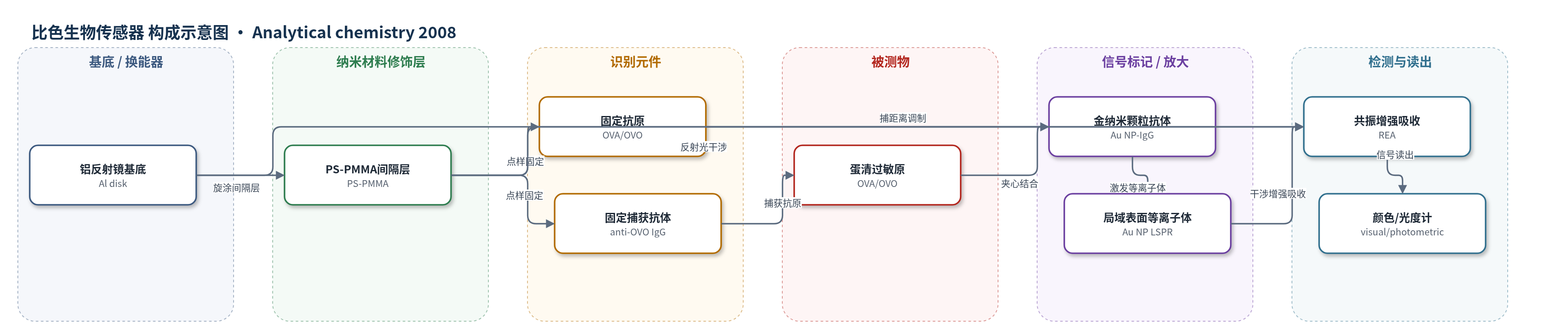
点击图片查看大图 · 依据论文自动绘制
传感器类型
比色生物传感器
检测对象
卵白蛋白(ovalbumin, OVA)、卵类黏蛋白(ovomucoid, OVO);样品基质:含蛋食品、全蛋粉及水解蛋粉的PBS提取液(复杂食品基质)
检测原理
传感器由铝反射镜、PS-PMMA光学间隔层和固定识别分子构成。直接法将OVA/OVO点样固定于PS-PMMA表面,夹心法先固定anti-OVO抗体。样品中目标蛋白与固定识别元件结合后,加入Au NP-IgG检测偶联物,形成抗原-抗体-金纳米颗粒复合物。Au NPs位于镜面附近约400 nm内,白光照激发其局域表面等离子体;镜面反射光与入射光发生纳米干涉,产生共振增强吸收(REA)。结合Au NPs数量随被测物浓度增加,吸收增强、蓝色斑点颜色加深;共振峰位置主要由间隔层厚度决定,强度用于半定量。该体系无需酶催化放大,依靠纳米干涉增强吸收实现低浓度检测。
检测灵敏度
LOD: 1 ng/mL;动态范围: 1 ng/mL–1 mg/mL
效应效果
该免疫芯片在PBS空白、未修饰金纳米颗粒及非目标蛋白对照中呈空白,非特异结合低。交叉反应显示anti-OVO对OVA和巴氏杀菌α-livetin交叉反应较高,对溶菌酶和β-乳球蛋白较低。实际含蛋食品PBS提取液1:1000稀释后,全蛋粉、婴儿食品意面奶酪番茄样中OVA和OVO均阳性,甜点样检出痕量,意面样无信号,水解蛋粉响应明显降低。结果与微孔板ELISA总体一致,检出限1 ng/mL,动态范围1 ng/mL–1 mg/mL,过敏原包被仅需5 min。信号可长期稳定保存,作者认为其适合复杂食品基质过敏原快速筛查,但半定量校准仍需完善。
传感器的构成
- 基底/反射镜:抛光硬铝盘(aluminum foil disks, 0.5 mm×13 mm),提供机械支撑与高反射镜面
- 光学间隔层:聚苯乙烯-甲基丙烯酸甲酯共聚物(PS-PMMA, 70:30)旋涂层,作为透明距离层与固相载体
- 识别元件(直接法):固定于PS-PMMA表面的卵白蛋白(OVA)或卵类黏蛋白(OVO),用于捕获检测抗体-金纳米颗粒偶联物
- 识别元件(夹心法):固定于PS-PMMA表面的兔抗OVO多克隆抗体(anti-OVO IgG),用于捕获目标抗原
- 信号标记物:16 nm柠檬酸还原金纳米颗粒(Au NPs)偶联兔抗OVA/OVO IgG抗体,作为检测抗体与等离子体信号换能器
- 封闭/稳定剂:Triton X-100(0.5% v/v)稳定Au NP-抗体胶束;PBS-T含0.05%鱼明胶(fish gelatine)洗涤封闭,降低非特异结合
- 读出层:肉眼颜色或光度计/微光谱仪读取反射最小值与共振吸收峰
中文摘要
开发了一种基于共振增强吸收(REA)的光学免疫芯片生物传感器,用于复杂食品基质中过敏原的快速检测,并评估其对蛋清过敏原卵白蛋白(OVA)和卵类黏蛋白(OVO)的检测应用。该传感器利用金纳米颗粒(Au NPs)作为信号换能器,在平面芯片上构建高灵敏度干涉式光学近场体系。通过直接法和夹心法实现简单、快速的比色固相免疫分析,检测过程无需仪器即可肉眼读取半定量免疫化学响应。芯片上固定过敏原后捕获抗体功能化金纳米颗粒,产生浓度依赖的颜色变化,检出限为1 ng/mL。直接法中,过敏原在温和非变性条件下仅需5 min包被即可获得准确重现性和灵敏度。结果表明,该REA免疫芯片易于制备、重现性和选择性良好、技术要求低,可用于技术医学领域中亲和结合相互作用的高通量筛选。
英文摘要
An optical immunochip biosensor has been developed as a rapid method for allergen detection in complex food matrixes, and its application evaluated for the detection of the egg white allergens, ovalbumin and ovomucoid. The optical near-field phenomenon underlying the basic principle of the sensor design is called resonance-enhanced absorption (REA), which utilizes gold nanoparticles (Au NPs) as signal transducers in a highly sensitive interferometric setup. Using this approach, a novel, simple, and rapid colorimetric solid-phase immunoassay on a planar chip substrate was realized in direct and sandwich assay formats, with a detection system that does not require any instrumentation for readout. Semiquantitative immunochemical responses are directly visible to the naked eye of the analyst. The biosensor shows concentration-dependent color development by capturing antibody-functionalized Au NPs on allergen-coated chips and has a detection limit of 1 ng/mL. To establish a rapid method, we took advantage of the physicochemical microenvironment of the Au NP-antibody bioconjugate to be bound directly over an interacting poly(styrene-methyl methacrylate) interlayer by an immobilized antigen. In the direct assay format, a coating time with allergen of only 5 min under "soft" nondenaturing conditions was sufficient for accurate reproducibility and sensitivity. In conclusion, the REA-based immunochip sensor is easy to fabricate, is reproducible and selective in its performance, has minimal technical requirements, and will enable high-throughput screening of affinity binding interactions in technological and medical applications.