组成图示
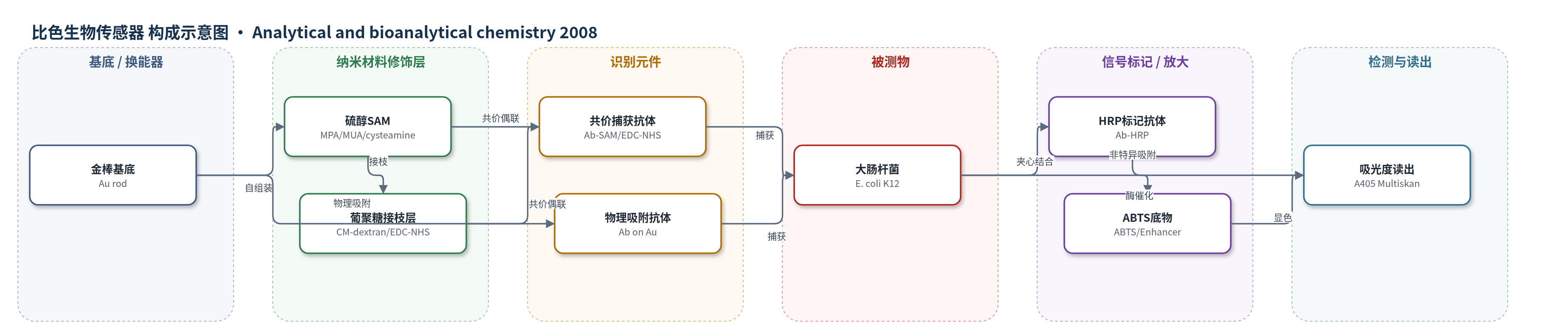
点击图片查看大图 · 依据论文自动绘制
传感器类型
比色生物传感器
检测对象
HRP 标记抗大肠杆菌抗体(Ab-HRP,PBS 溶液)、大肠杆菌(E. coli K12,PBS 重悬/培养物稀释液)
检测原理
该检测采用金表面免疫功能化与酶联比色读出。金棒经 MPA、MUA 或 cysteamine SAM 修饰,再通过 EDC/NHS 将捕获抗体共价固定,或直接将抗体物理吸附于裸金。目标蛋白 Ab-HRP 或 E. coli 与表面捕获抗体结合后,加入 HRP 标记检测抗体形成夹心复合物。HRP 催化 ABTS/ABTS-Enhancer 产生 405 nm 有色产物,吸光度随结合量增加而升高。对蛋白目标,SAM 表面可接近抗体结合位点,信号特异;对细菌,其尺寸远大于抗体且细胞壁复杂,导致表位可及性差、阴影效应和非特异吸附,SAM 表面夹心失败,而物理吸附抗体可检测 E. coli。
检测灵敏度
LOD: 5×10^5 cells mL−1(原文:allowed E. coli detection down to 5×10⁵ cells mL−1)
效应效果
对蛋白目标,MPA、MUA 和 dextranized cysteamine SAM 表面均能特异捕获 Ab-HRP,正对照信号显著高于阴性对照;检测表面抗体显示固定量相近,说明信号来自特异性识别。COOH 偶联略优于 NH 偶联,非特异更低、特异信号略高。对 E. coli,SAM 表面在 10^1–10^9 cells/mL 无特异夹心信号,细菌非特异吸附随浓度增加产生负信号;BSA 封闭对 NH 表面无效,对 COOH/乙二胺表面降低非特异但仍无特异。物理吸附抗体加 BSA 可检测 E. coli 至 5×10^5 cells/mL,仅 BSA 表面在 10^8 cells/mL 以下非特异几乎不可测。作者认为物理吸附更简单、快速、低成本,适合细菌检测。
传感器的构成
- 基底/换能器:金棒(Au rod,0.5 mm 直径、4 mm 长),提供功能化表面并作为比色检测载体
- 自组装单分子层:mercaptopropanoic acid(MPA)、mercaptoundecanoic acid(MUA)或 cysteamine hydrochloride SAM,提供羧基/氨基或接枝位点
- 交链接枝层:CM-dextran 经 EDC/NHS 偶联到 cysteamine SAM,形成可共价结合抗体的 dextranized 表面
- 识别元件:未标记抗大肠杆菌抗体(anti-E. coli Ab)或抗兔抗体(anti-rabbit Ab),通过 EDC/NHS 与 -NH2/-COOH 共价结合或直接物理吸附,用于捕获目标
- 封闭剂:ethanolamine 化学封闭未反应基团;BSA 2% 物理封闭降低非特异吸附
- 信号标记物:HRP 标记抗大肠杆菌抗体(Ab-HRP)或 HRP 标记抗兔抗体,与捕获目标形成夹心复合物
- 底物/显色剂:ABTS liquid substrate 与 ABTS-Enhancer 按 11:1 混合,HRP 催化产生 405 nm 颜色
- 读出层:Multiskan 酶标仪在 405 nm 读取吸光度
中文摘要
生物传感器开发高度依赖表面功能化策略的优化。对于金表面,基于自组装单分子层(SAM)的免疫功能化是常用方法,已有研究表明 SAM 固定抗体在蛋白和小分子目标检测中优于抗体物理吸附,但细菌检测报道较少。本文评估了多种用于蛋白检测的 SAM 基金表面免疫功能化策略在细菌检测中的表现,包括将抗体化学偶联到 mercaptopropanoic acid(MPA)和 mercaptoundecanoic acid(MUA)SAM,以及接枝葡聚糖的 cysteamine SAM。结果显示,所有修饰表面均能直接检测酶标记蛋白,但均未能在夹心酶联格式中检测细菌目标。相反,抗体物理吸附修饰的金表面在夹心酶联检测中可检测大肠杆菌(E. coli)。文章讨论了细菌尺寸和细胞壁复杂性对检测的影响,指出适用于蛋白检测的免疫功能化策略不一定能迁移到细菌等复杂目标,抗体物理吸附可作为细菌检测的合适替代。
英文摘要
Biosensor development strongly depends on the optimisation of surface functionalisation strategies. When gold surfaces are considered, immunofunctionalisation by modification of self-assembled monolayers (SAMs) is one of the preferred approaches. In this respect, SAM-based antibody (Ab) incorporation has shown better performance than Ab physisorption for the detection of proteins and small targets. Reports on bacteria detection are less frequent. In this work, we assess the performance of various SAM-based gold immunofunctionalisation strategies, currently applied to protein detection, in the field of bacteria determination. We present the results for Ab chemical conjugation on mercaptopropanoic acid and mercaptoundecanoic acid SAMs, as well as on a dextranized cysteamine SAM. All the modified surfaces studied were shown to be appropriate for the direct detection of an enzyme-labelled protein, but none succeeded in detecting a bacterial target in a sandwich assay format. Conversely, gold functionalised by Ab physisorption allowed E. coli detection when a sandwich enzyme-linked assay was carried out. The implications of bacteria size and wall complexity are discussed. These results indicate that immunofunctionalisation strategies appropriate for protein detection are not necessarily transferable to work with more complex targets such as bacteria. In this respect, Ab physisorption appears to be a suitable alternative to SAM-based gold functionalisation for bacteria detection.