组成图示
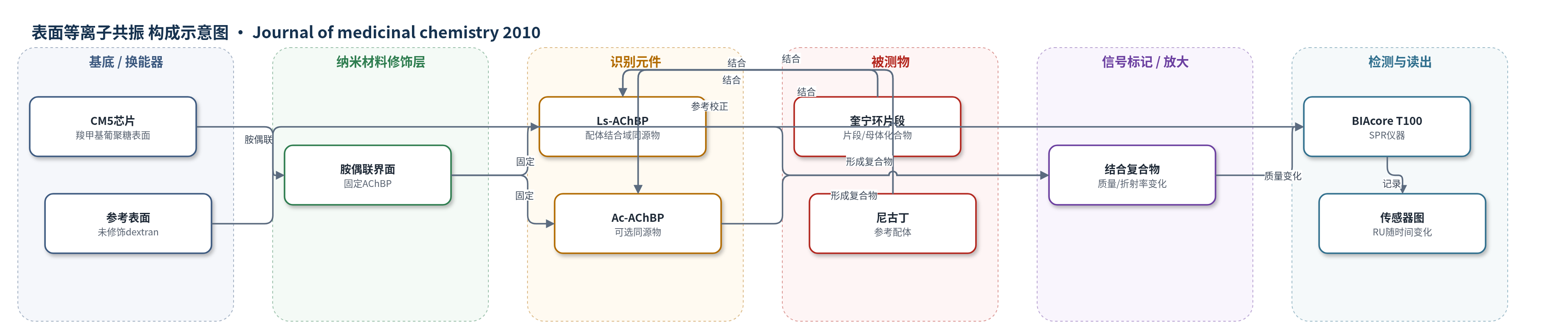
点击图片查看大图 · 依据论文自动绘制
传感器类型
表面等离子共振(SPR)生物传感器
检测对象
奎宁环片段(quinuclidine fragments)、母体化合物(parent compounds)、尼古丁(nicotine)、PNU-282987;样品基质:含5% DMSO和0.005% v/v surfactant P20的磷酸盐缓冲液(10 mM phosphate,pH 7.0,137 mM NaCl,3 mM KCl)
检测原理
将His6-Ls-AChBP或His6-AChBP经胺偶联固定于CM5传感器芯片表面,形成SPR换能界面。片段或母体化合物随含DMSO和surfactant P20的磷酸盐缓冲液流过芯片,若其碱性氮、吡啶等基团与AChBP结合口袋发生阳离子-π、氢键等相互作用,则形成AChBP-配体复合物。结合导致界面质量/折射率增加,使SPR信号(响应单位RU)变化,仪器记录传感器图。稳态RU随配体浓度升高而增大,按Langmuir方程拟合得到KD。该法为无标记直接结合检测,不依赖酶或荧光放大,通过未修饰dextran参考表面、溶剂校正和空白校正降低非特异信号。
检测灵敏度
R^2 = 0.97
效应效果
SPR直接结合法与放射性配体置换法亲和力高度相关(R^2=0.97),验证其用于片段筛选。所有化合物均可获得高质量传感器图并确定KD,但速率过快无法测定。Ls-AChBP与α7 nAChR相关性优于Ac-AChBP;group II脲/氨基甲酸酯在α7中更好,group III 2-吡啶取代奎宁环在AChBP中更好。LE显示含碱性氮的group IV片段最高,缺乏碱性氮的group V最低;多数group IV片段LE约为group I化合物两倍。α7对多数化合物亲和力约高10倍,group II三个化合物高约100倍,脲17的LE达39。作者认为SPR可检测低分子量、低亲和力片段,LE热点有助于片段筛选与生长。
传感器的构成
- 基底/换能器:CM5传感器芯片(羧甲基葡聚糖表面),提供SPR换能界面与固定化载体
- 固定化/识别元件:His6-Ls-AChBP或His6-Ac-AChBP,经胺偶联固定于CM5表面,作为nAChR配体结合域同源物识别片段
- 参考表面:未修饰dextran表面,用于扣除非特异结合与背景
- 样品缓冲液:10 mM磷酸盐缓冲液(pH 7.0,137 mM NaCl,3 mM KCl)含5% DMSO和0.005% v/v surfactant P20,输送片段并维持结合条件
- 信号标记物:无标记直接结合检测,不添加荧光、酶或放射性标记
- 读出系统:BIAcore T100 SPR仪器,25°C、90 μL/min流速下记录RU传感器图,稳态Langmuir拟合KD
中文摘要
可溶性乙酰胆碱结合蛋白(AChBP)是烟碱型乙酰胆碱受体(nAChR)配体结合结构域的同源物。为引导未来采用表面等离子共振(SPR)生物传感器技术进行无标记、直接结合的生物物理片段筛选,作者基于对一组具有纳摩尔亲和力的α7 nAChR选择性含奎宁环配体的解构,构建了聚焦片段库。利用SPR生物传感器检测片段及其母体化合物与AChBP的相互作用特性。该直接结合法所得数据与放射性配体置换参考法高度相关。将片段库中不同结构片段的配体效率(LE)与结合口袋不同区域结合相关联,从而识别出LE热点。这些热点可用于在大规模片段库筛选中识别最有前景的命中片段,并指导片段生长。
英文摘要
The soluble acetylcholine binding protein (AChBP) is a homologue of the ligand-binding domain of the nicotinic acetylcholine receptors (nAChR). To guide future fragment-screening using surface plasmon resonance (SPR) biosensor technology as a label-free, direct binding, biophysical screening assay, a focused fragment library was generated based on deconstruction of a set of α7 nAChR selective quinuclidine containing ligands with nanomolar affinities. The interaction characteristics of the fragments and the parent compounds with AChBP were evaluated using an SPR biosensor assay. The data obtained from this direct binding assay correlated well with data from the reference radioligand displacement assay. Ligand efficiencies for different (structural) groups of fragments in the library were correlated to binding with distinct regions of the binding pocket, thereby identifying ligand efficiency hot spots (LE hot spots). These hot spots can be used to identity the most promising hit fragments in a large scale fragment library screen.