组成图示
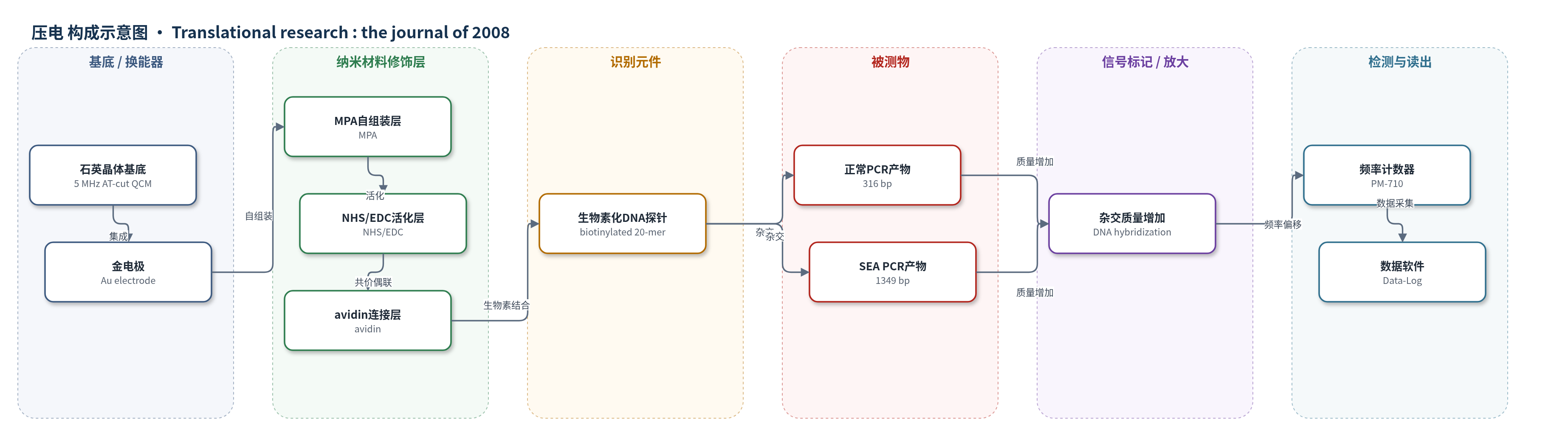
点击图片查看大图 · 依据论文自动绘制
传感器类型
压电(QCM)生物传感器
检测对象
东南亚型α-地中海贫血(SEA α-thalassemia)基因型/单倍型、正常α-珠蛋白(normal α-globin)、SEA杂合(SEA heterozygote)、SEA纯合(SEA homozygote);样品基质:人EDTA全血基因组DNA(PCR产物)
检测原理
该传感器以固定于金电极表面的生物素化20-mer寡核苷酸探针为识别元件,与PCR扩增产物杂交。正常α-珠蛋白基因产生316 bp片段,SEA α-地中海贫血缺失产生1349 bp片段;杂合样品同时含两种片段。杂交后,不同长度DNA片段在石英晶体表面形成不同质量负载。AT-cut石英晶体按Sauerbrey方程将表面质量变化转换为振荡频率变化,质量越大频率下降越多。PCR扩增先放大目标DNA,使质量信号可测;频率计数器记录频率偏移,从而区分正常、杂合与纯合SEA α-地中海贫血。
检测灵敏度
未报告
效应效果
18份盲样(7正常、8 SEA杂合、3 SEA纯合)频率变化为200±9、256±5、308±2 Hz,三组3SD范围174–227、241–271、302–314 Hz无重叠,P<0.01,选择性良好。系统稳定在±1.6 Hz内;1.0 μmol/L探针时频率变化198±15 Hz,CV 7.6%。石英晶体经1 mmol/L HCl洗脱后可重复使用3次,CV<8%。结果与常规PCR-凝胶电泳一致,避免溴化乙锭暴露,适合SEA α-地中海贫血筛查,但不能检测其他α-地中海贫血突变。
传感器的构成
- 基底/换能器:5 MHz AT-cut石英晶体(QCM)与金电极(Au),提供压电振荡和质量传感界面
- 表面自组装层:5 mmol/L mercaptopropionic acid(MPA)在金表面自组装,提供羧基用于后续活化
- 活化层:50 mmol/L N-hydroxysuccinimide(NHS)和200 mmol/L 1-ethyl-3-(3-dimethylaminopropyl) carbodiimide(EDC)活化羧基,用于共价偶联avidin
- 连接层:avidin(0.1 mg/mL)共价结合于MPA表面,通过生物素-亲和素作用固定探针
- 识别元件:5'-biotinylated 20-mer oligonucleotide probe(1.0 μmol/L),与SEA-F引物部分互补,捕获PCR产物
- 封闭剂:1 M ethanolamine hydrochloride(pH 8.6)封闭残余反应位点,降低非特异结合
- 读出模块:频率计数器(PM-710)与Data-Log Software,记录QCM频率变化
中文摘要
α-地中海贫血的DNA诊断通常依赖聚合酶链反应(PCR)和凝胶电泳。本研究建立了一种用于检测并区分东南亚型(SEA)α-地中海贫血单倍型的新方法,将三引物PCR系统与固定单一寡核苷酸探针的DNA压电生物传感器相结合。从基因组DNA扩增的PCR产物直接通过固定单一寡核苷酸探针的石英晶体微天平(QCM)进行区分。正常α-珠蛋白、SEA α-地中海贫血杂合子和纯合子代表性样品PCR产物杂交后的频率变化分别为206±11、256±5和307±3 Hz。该生物传感器经18份盲样检测评价,可准确区分正常与SEA α-地中海贫血样品。结果表明,该体系具有特异性高、有害暴露少等优点,是SEA α-地中海贫血检测的有前景替代技术。
英文摘要
DNA-based diagnosis of alpha-thalassemias routinely relies on polymerase chain reaction (PCR) and gel electrophoresis. Here, we developed a new procedure for the detection and haplotype differentiation of Southeast Asian (SEA) alpha-thalassemia using a 3-primer system for PCR coupling with a DNA-based piezoelectric biosensor. PCR products amplified from genomic DNA were differentiated directly by using a quartz crystal microbalance immobilized with a single oligonucleotide probe. The frequency changes after hybridization of the PCR products amplified from a representative sample of normal alpha-globin, SEA alpha-thalassemia heterozygote, and homozygote were 206+/-11, 256+/-5, and 307+/-3 Hz, respectively. The fabricated biosensor was evaluated through an examination of 18 blind specimens. It could accurately discriminate between normal and SEA alpha-thalassemic samples, which suggests that this biosensor system is a promising alternative technique to detect SEA alpha-thalassemia because of its specificity and less hazardous exposure as compared with conventional methods.