组成图示
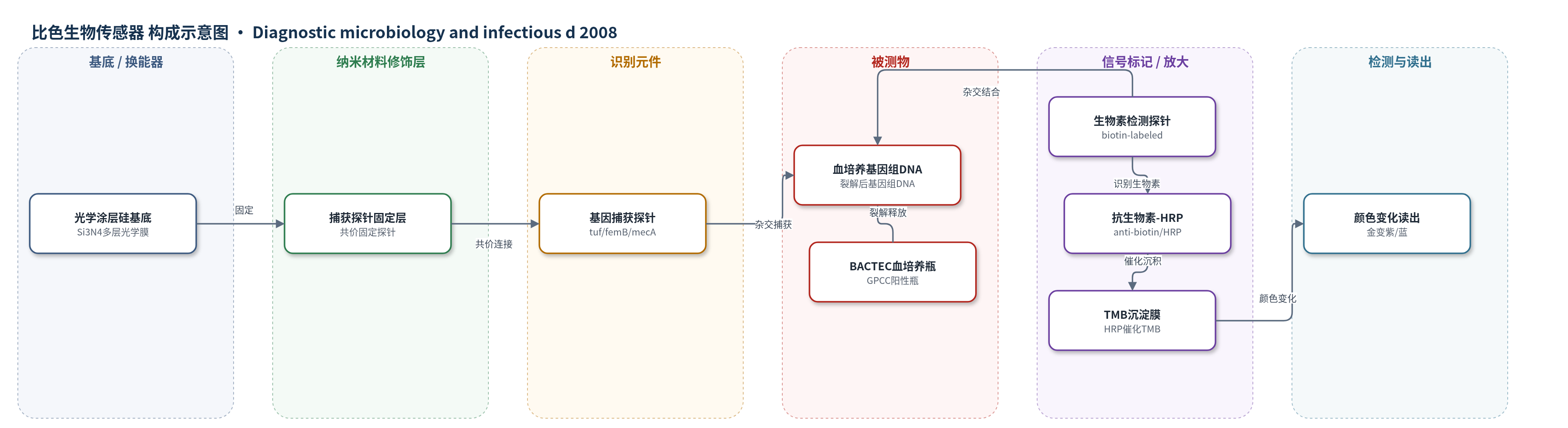
点击图片查看大图 · 依据论文自动绘制
传感器类型
比色生物传感器
检测对象
甲氧西林耐药金黄色葡萄球菌(MRSA, Staphylococcus aureus mecA/femB/tuf)、甲氧西林耐药凝固酶阴性葡萄球菌(MRCoNS, coagulase-negative Staphylococcus mecA/tuf)、金黄色葡萄球菌(S. aureus, femB/tuf)、葡萄球菌属(Staphylococcus, tuf);样品基质:BACTEC阳性血培养瓶/血培养裂解液(革兰阳性球菌成簇)
检测原理
从阳性血培养瓶取0.5 mL,经NaOH裂解、洗涤和Staph-Lyser酶提取基因组DNA。DNA与生物素标记检测探针在53°C杂交,形成夹心复合物,并被芯片表面共价固定的tuf、femB、mecA捕获探针捕获。抗生物素抗体/HRP偶联物结合生物素检测探针,HRP催化TMB沉淀底物在表面沉积分子薄膜。沉积质量使多层Si3N4光学薄膜光程增加,发生破坏性干涉,特定波长被衰减,表面由金色变为紫色/蓝色。信号强度随目标DNA量增加而增强,可肉眼判读;无需核酸扩增,利用酶催化沉淀实现信号放大。
检测灵敏度
LOD: 5 × 10^7 CFU/mL;模型系统LOD: <100000 copies or 10 fmol/L
效应效果
107份连续阳性血培养样品中,薄膜生物传感器与标准微生物学方法一致性为100%,可区分MRSA、MSSA、MRCoNS和MSSA CoNS。30株葡萄球菌均tuf阳性,11株S. aureus和5株耐药株分别femB、mecA阳性;非葡萄球菌未与femB/mecA交叉,仅tuf与A. calcoaceticus、B. subtilis、P. vulgaris交叉,但不影响判定。检测限5×10^7 CFU/mL,90 min内直接读取,无需仪器和核酸扩增,较传统24–72 h提前24–48 h。未报告RSD/回收率;局限是无法区分MRSA与MSSA+MRCoNS混合培养。
传感器的构成
- 基底/换能器:多层光学涂层硅表面(multilayered optically coated silicon surface),控制沉积Si3N4形成金色光学薄膜,通过光干涉产生颜色变化
- 固定层:生物分子固定层(attachment layer),用于共价固定寡核苷酸捕获探针
- 识别元件:寡核苷酸捕获探针(capture probes),分别识别tuf、femB、mecA及化学对照序列
- 检测探针:生物素标记寡核苷酸检测探针(biotin-labeled detector probes,20 nmol/L each),与目标DNA形成夹心杂交
- 信号标记物:抗生物素抗体/辣根过氧化物酶偶联物(antibiotin antibody/HRP conjugate),识别生物素
- 信号底物:四甲基联苯胺(TMB,tetramethyl benzidine)沉淀底物,HRP催化形成分子薄膜
- 杂交缓冲/封闭:5× SSC、0.1% SDS、0.5% BlockAid,用于杂交并减少非特异结合
中文摘要
本文报道了一种用于直接从显示葡萄球菌属革兰阳性球菌成簇生长的BACTEC血培养瓶中检测tuf、femB和mecA基因的快速检测方法。tuf基因用于鉴定葡萄球菌属,femB基因用于鉴定金黄色葡萄球菌种,mecA基因用于鉴定甲氧西林耐药性。该检测基于薄膜生物传感器平台,无需核酸扩增即可检测血培养样品中的基因组DNA。在初步验证研究中,对107份连续阳性血培养样品进行薄膜生物传感器检测,并与标准微生物学方法比较,用于鉴定甲氧西林敏感和耐药的S. aureus以及甲氧西林敏感和耐药的凝固酶阴性葡萄球菌,结果一致性为100%。检测可在90 min内直接从信号阳性培养瓶获得结果,且无需专用仪器。
英文摘要
We describe here a rapid assay for the detection of the tuf gene for the identification of Staphylococcus genus, the femB gene for the identification of Staphylococcus aureus species, and the mecA gene for the identification of methicillin resistance directly from BACTEC blood culture bottles showing Gram-positive cocci in clusters. The test, configured on a thin-film biosensor platform, allows for detection of genomic DNA from blood culture samples without the need for nucleic acid amplification. In an initial study to validate the technology, 107 consecutive positive blood cultures were tested on the thin-film biosensor, and the assay exhibited 100% concordance in comparison with standard microbiological methods for identifying methicillin-susceptible and methicillin-resistant S. aureus and for identifying methicillin-susceptible and methicillin-resistant coagulase-negative Staphylococcus. Results were obtained within 90 min directly from signal positive bottles with no instrumentation required.