组成图示
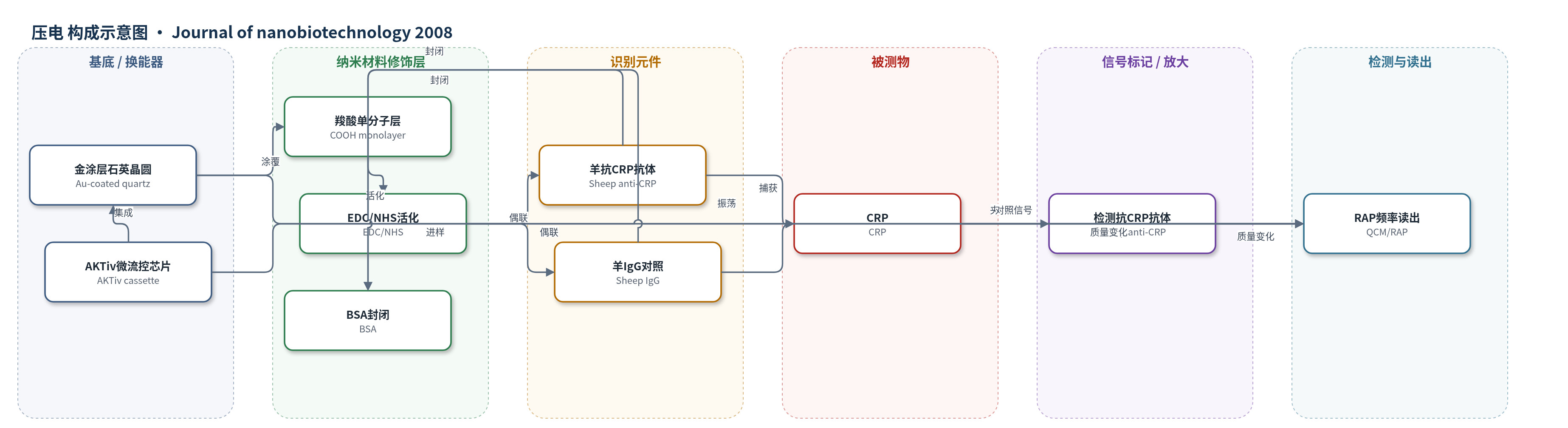
点击图片查看大图 · 依据论文自动绘制
传感器类型
压电(QCM)生物传感器
检测对象
C-反应蛋白(C-Reactive Protein, CRP);样品基质:稀释马血清、加标马全血/血清
检测原理
RAP基于石英晶体微天平(QCM)原理:高频电压驱动压电石英晶体振荡,表面捕获质量增加会使共振频率下降。传感器测试通道通过EDC/NHS共价固定羊抗CRP抗体,对照通道固定羊IgG。样品中CRP与固定抗体结合后,界面质量增加,频率下降;直接捕获模式下,5 min进样后的初始频率变化率与CRP浓度成正比。直接夹心模式在捕获CRP后注入羊抗CRP检测抗体,形成抗原-抗体夹心复合物,二次质量增加使初始结合速率对低浓度更敏感。均相夹心模式则先在样品中加入检测抗体形成复合物再被捕获。双通道实时读出频率变化,并以测试/对照通道比值进行半定量判断,实现无标记、快速免疫检测。
检测灵敏度
LOD: direct assay/homogenous sandwich 20 ng/mL;direct sandwich 3 ng/mL(摘要);direct capture 13 ng/mL;homogenous sandwich 20 ng/mL;direct sandwich 3 ng/mL(正文);标准范围: 0–231 ng/mL;0–232 ng/mL;R^2 = 0.998
效应效果
RAP直接夹心法与商业hsCRP ELISA在6个加标马血清样品中一致性良好,相关系数R^2=0.998;Bland-Altman平均差为2.17 µg/mL,2SD为6.78 µg/mL,差异在mean±2SD内。直接夹心法CV在0.1–116 µg/mL范围内为3.1%–12.6%,低于10 ng/mL时CV高于10%,高于该浓度后由11.3%降至4.7%。标准范围扩展至约231 ng/mL未观察到钩状效应。快速半定量双通道比值法中,平均风险全血样品比值为0.51±0.06(预期0.5),高风险样品为1.45±0.2(预期1.3)。方法周转时间约12 min,适合床旁或自动化高敏CRP检测。
传感器的构成
- 基底/换能器:金涂层石英晶圆(gold-coated quartz wafers)与石英晶体谐振器,提供压电振荡和质量传感
- 功能化层:羧酸终止单分子层(carboxylic acid-terminated monolayer),位于AKTiv A acrylic sensor cassette,提供蛋白固定位点
- 活化偶联层:EDC/NHS(1-ethyl-3-[3-dimethylaminopropyl]carbodiimide/N-hydroxysuccinimide)活化羧基并共价偶联抗体
- 识别元件:羊抗CRP抗体(Sheep anti-CRP)固定于测试通道,捕获CRP;羊IgG(Sheep IgG)固定于对照通道,用于背景与干扰对照
- 封闭剂:BSA(Bovine Serum Albumin,100 µg/mL)封闭未反应表面和微流控通道
- 信号标记/检测抗体:羊抗CRP抗体(Sheep anti-CRP,0.225 µg/mL)用于夹心步骤,结合捕获的CRP并增加质量信号
- 微流控/再生:AKTiv sensor cassette集成双通道微流控进样;100 mM Glycine-HCl(pH 2.5)脉冲再生表面
中文摘要
C-反应蛋白(CRP)是急性期反应物,常用于评估感染、炎症或自身免疫疾病,也可作为心血管疾病风险预测标志物。本研究开发了一种基于共振声学分析(RAP)的无标记免疫分析方法检测CRP,其灵敏度与高敏CRP酶联免疫吸附试验(hsCRP ELISA)相当,但结果周转时间仅约12分钟。方法将CRP标准液(0–231 ng/mL)或稀释加标马血清注入RAP双通道传感器:一通道固定羊抗CRP抗体,另一通道固定纯化羊IgG作为对照。5分钟进样后,共振频率初始变化率与CRP浓度成正比;随后加入抗CRP抗体进行夹心步骤,其初始结合速率也与样品CRP浓度相关,定量更敏感。直接法与均相夹心法检出限均为20 ng/mL,直接夹心法为3 ng/mL。进一步将稀释加标马血与心血管风险边界参考标准分别通过双通道,获得半定量比值以指示CRP状态。结果表明,RAP可在时间高效、无标记条件下检测正常及病理血清CRP水平,并与商业高敏ELISA结果一致。
英文摘要
C-Reactive Protein (CRP) is an acute phase reactant routinely used as a biomarker to assess either infection or inflammatory processes such as autoimmune diseases. CRP also has demonstrated utility as a predictive marker of future risk of cardiovascular disease. A new method of immunoassay for the detection of C-Reactive Protein has been developed using Resonant Acoustic Profilingtrade mark (RAPtrade mark) with comparable sensitivity to a high sensitivity CRP ELISA (hsCRP) but with considerable time efficiency (12 minutes turnaround time to result). In one method, standard solutions of CRP (0 to 231 ng/mL) or diluted spiked horse serum sample are injected through two sensor channels of a RAPtrade mark biosensor. One contains a surface with sheep antibody to CRP, the other a control surface containing purified Sheep IgG. At the end of a 5-minute injection the initial rate of change in resonant frequency was proportional to CRP concentration. The initial rates of a second sandwich step of anti-CRP binding were also proportional to the sample CRP concentration and provided a more sensitive method for quantification of CRP. The lower limit of detection for the direct assay and the homogenous sandwich assay were both 20 ng/mL whereas for the direct sandwich assay the lower limit was 3 ng/mL. In a step towards a rapid clinical assay, diluted horse blood spiked with human CRP was passed over one sensor channel whilst a reference standard solution at the borderline cardiovascular risk level was passed over the other. A semi-quantities ratio was thus obtained indicative of sample CRP status. Overall, the present study revealed that CRP concentrations in serum that might be expected in both normal and pathological conditions can be detected in a time-efficient, label-free immunoassay with RAPtrade mark detection technology with determined CRP concentrations in close agreement with those determined using a commercially available high sensitivity ELISA.