组成图示
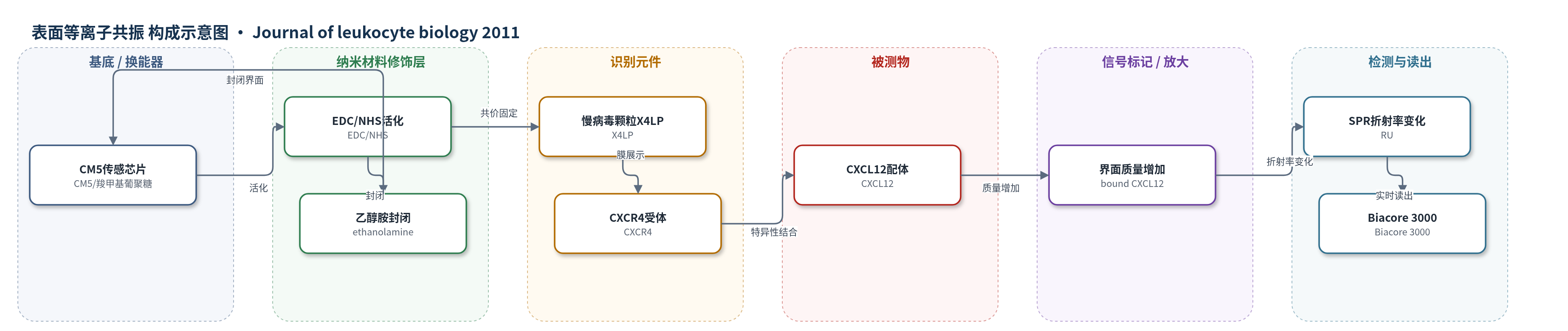
点击图片查看大图 · 依据论文自动绘制
传感器类型
表面等离子共振(SPR)生物传感器
检测对象
CXCL12(基质细胞衍生因子-1α,CXCL12/SDF-1α),PBS-P缓冲液;文中亦提出可用于生物流体
检测原理
该传感器将表达CXCR4的慢病毒颗粒X4LP经EDC/NHS胺偶联共价固定于CM5芯片的羧甲基葡聚糖表面,并用乙醇胺封闭剩余活性位点。CXCR4保留在病毒包膜脂质环境中,构象接近天然膜受体。当PBS-P中的CXCL12流过时,CXCL12与CXCR4特异性结合,使界面质量与折射率增加,SPR共振角发生偏移,Biacore 3000以共振单位(RU)实时记录结合与解离曲线。平衡响应随CXCL12浓度升高而增大,按1:1 Langmuir模型拟合得到kon、koff和KD。肝素等GAG可与CXCL12结合,低浓度主要调节局部可用性,高浓度占据CXCL12 N端受体结合域并阻断结合,从而降低RU响应。
检测灵敏度
原文未报告LOD、线性范围、灵敏度斜率或R^2;实验浓度范围:25–400 nM CXCL12;平衡响应:约7–20 RU;kon 4.20 ± 0.56 × 10^5 M s−1;koff 8.24 ± 0.11 × 10⁻³ s−1;KD 3.47 ± 0.05 × 10⁻⁸ M。
效应效果
该方法选择性良好:抗CXCR4抗体可结合X4LP,同型对照几乎无结合;CXCL12可结合,而CCL2、CCL3不结合;siRNA敲低CXCR4的siX4LP无CXCL12结合;50 μM AMD3100可明显抑制CXCL12结合。重复性与稳定性高:20次CXCL12注入/再生循环响应变化<10%,芯片再生>100次后最大信号损失约30 RU;不同批次、不同芯片及两个实验室结果可重复。动力学参数与Scatchard分析一致,且亲和力高于去垢剂溶解两步法(156–180 nM)。作者认为可用于生物流体中CXCL12定量及拮抗剂高通量筛选。
传感器的构成
- 基底/换能器:CM5 SPR传感芯片(carboxymethylated dextran,羧甲基葡聚糖),提供SPR换能界面与羧基固定位点
- 活化层:EDC/NHS(1-ethyl-3-(3-dimethylaminopropyl) carbodiimide hydrochloride / N-hydroxysuccinimide),活化羧甲基葡聚糖形成活性酯
- 识别元件载体:X4LP慢病毒颗粒(CXCR4-expressing lentiviral particles),携带CXCR4于病毒包膜脂质膜中并经胺偶联共价固定
- 识别元件:CXCR4(趋化因子受体),位于X4LP表面,特异性识别CXCL12
- 封闭/去活化剂:ethanolamine(乙醇胺,1 M,pH 8.5),封闭剩余活性羧基并降低非特异结合
- 运行/再生介质:Hepes-buffered saline-P / PBS-P(含P20)及5 mM HCl,用于结合、解离与芯片再生
- 信号读出:无标记SPR折射率变化(resonance units, RU),由Biacore 3000实时监测
中文摘要
基于表面等离子共振(SPR)的生物传感器是测量分子相互作用的成熟方法,但用于G蛋白偶联受体(GPCR)研究时通常受限于需将受体经去垢剂溶解后再重建到脂质环境中。本文以趋化因子受体CXCR4及其配体CXCL12为模型,提出一种高重复性的SPR生物传感器方法:利用慢病毒颗粒在出芽过程中携带细胞膜片段,将CXCR4以天然脂质膜环境展示于病毒颗粒表面,再共价固定于SPR传感芯片,无需抗体定向即可保持受体正确构象。作者单步实时测定了CXCR4/CXCL12结合动力学,并评估糖胺聚糖(GAG)对趋化因子呈递的影响。结果表明低浓度可溶性肝素可调节CXCR4/CXCL12相互作用,而高浓度则阻断结合,提示GAG除调节局部趋化因子可用性外,也影响受体-配体相互作用,但对亲和力参数影响有限。该方法可用于生物流体中相关生物标志物的定量及拮抗剂高通量筛选。
英文摘要
Use of SPR-based biosensors is an established method for measuring molecular interactions. Their application to the study of GPCRs is nonetheless limited to detergent-solubilized receptors that can then be reconstituted into a lipid environment. Using the chemokine receptor CXCR4 and its specific ligand CXCL12, we outline here a highly reproducible biosensor method based on receptor presentation on the surface of lentiviral particles; the approach is simple and does not require the use of antibodies to achieve correct receptor orientation on the sensorchip surface. We measured the kinetic parameters of CXCR4/CXCL12 binding in a single step and in real time and evaluated the effect of GAG presentation of chemokines on this interaction. The data indicate that at low concentrations, soluble heparin modulates CXCR4/CXCL12 interaction and at high concentrations, abrogates binding. These observations suggest that in addition to their known role in modulating local chemokine availability, GAG affect the receptor/ligand interaction, although their influence on affinity parameters is very limited. The method will also be useful for quantifying these biomarkers in biological fluids and for the development of high-throughput screening for their antagonists.